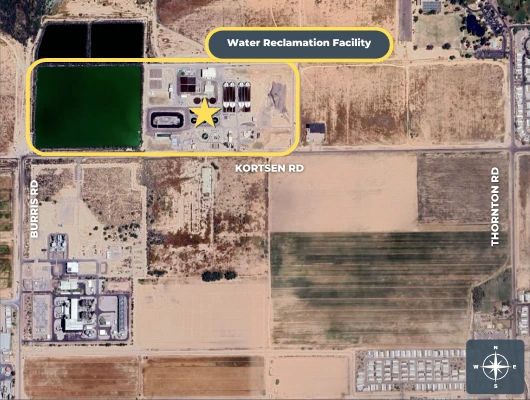
CASA GRANDE, AZ — Casa Grande’s City Council reviewed a draft effluent allocation strategy during a study session on March 16. The draft policy outlines how the city plans to distribute treated wastewater — known as effluent — among industrial users, residential developers, and a strategic reserve. It is a draft only. No final decisions have been made.
The March 16 session is the latest in a series of study sessions the Pinal Post has followed since late 2025. At a February 17 session, the Council backed aquifer recharge as its top priority, endorsed a roughly equal split between industrial and residential uses, and directed staff to set aside a reserve. City Manager Larry Rains presented the completed draft at the March 16 meeting and emphasized its role as a foundation for future decision-making, not a rigid set of mandates.
The 20/40/40 Model: How Effluent Would Be Divided
The draft proposes dividing available effluent into three categories:
- 20% goes to a strategic reserve, primarily used for groundwater recharge and generating long-term storage credits.
- 40% is allocated to industrial and commercial users.
- 40% is allocated to residential development.
This model reflects the direction the Council gave at the February 17 study session, where members endorsed a roughly 50/50 baseline split between industrial and residential uses and supported setting aside a reserve, with staff modeling a range of 15 to 25 percent.
Rains noted that Casa Grande has historically operated on a first-come, first-served basis — and that the split has already been happening organically. “We have really been on a first-come, first-serve basis with the use of our effluent,” he said. “And ironically enough, if you look at the percentages, it almost aligns with that 50/50 today anyhow in our allocation to residential development… we really have somewhat organically met that 40/40/20%.”
These percentages are not locked in. The Council retains full authority to adjust them. If demand in one sector is low, the Council can temporarily redirect unused allocation to another sector.
How Effluent Is Used Today
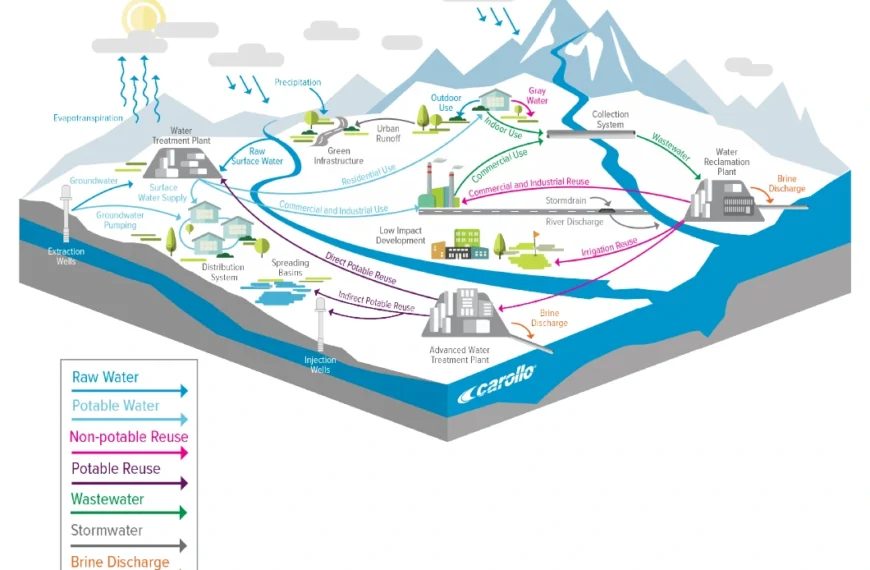
Currently, Casa Grande uses its treated effluent in several ways:
- SRP’s Desert Basin Generating Station — industrial process water
- Dave White Golf Course — landscape irrigation
- Groundwater recharge — generating long-term storage credits, including 1,370 acre-feet allocated to support the Copper Mountain Ranch development
The city is also in active negotiations with Arizona Sonoran Copper Company for an effluent purchase agreement covering the Cactus Mine — the former Sacaton Mine — for up to 1,300 acre-feet per year. The Pinal Post covered the Council’s January 5 authorization of those negotiations. That agreement has not yet been finalized and must return to the Council for approval.
Rains indicated the city also expects new requests related to the ADAWS program. “With the changes in the landscape of water, there’s no doubt that we’re going to begin to receive requests for effluent to be allocated to the assured water supply program as well,” he said.
ADAWS Drives New Effluent Requests
Rains said demand for effluent is expected to increase. In March, Arizona Water Company became the first utility in over 20 years to earn a 100-year assured water supply designation in Pinal County — clearing the way for more than 80,000 new homes in the region. That designation operates under the ADAWS program. Arizona Water Company is only the second utility to receive an ADAWS designation; EPCOR earned the first in October 2025, covering more than 140,000 residents in the Greater Phoenix West Valley.
“We’re very likely going to get more requests for the use of effluent than we ever have because of the importance of effluent to the ADAWS program,” Rains said.
Rains said the city has already received and navigated several recent requests for effluent agreements.
Council Authority and Policy Flexibility
Councilmember Anthony Edwards favored keeping the policy adaptable. “I think we need to be flexible with that, instead of saying, ‘Okay, we’re going to put this amount to this, this amount to that,'” he said. “Be flexible, because the need may change.”
Mayor Lisa Navarro Fitzgibbons said the strategy functions more as guidelines at this point. She also noted the importance of remaining consistent when making decisions on similar requests.
The draft strategy states that all major effluent allocation agreements will require public City Council approval. It also calls for annual review, or sooner if significant changes in regulation, water supply, or economic conditions occur.
Industrial Allocation: Flexible Thresholds, Case-by-Case Decisions
The draft sets out guiding principles for industrial allocations, though specific mandatory thresholds are not yet locked in. The Council discussed whether to require fixed minimums for job creation, wages, and capital investment — or leave those as flexible guidelines.
The draft document includes specific suggested triggers for industrial allocation from the 40% pool — a minimum capital investment of $100 million, at least 200 full-time jobs, wages at or above 110% of the county median, and a minimum five-year operational agreement. However, the Council expressed a preference for treating these as guiding criteria rather than hard mandates, at least in the near term.
On the question of contract terms, Rains said a company’s level of capital investment will likely shape the length and provisions of its agreement. “What likely will transpire is that it will, very likely, depending on the capital investment, drive the terms of agreements and those types of provisions that are included in an agreement, to ensure that we’re not tying up effluent that could be more valuable to us in the future,” he said.
Rains noted that the city typically receives some level of detail on capital investment, job creation, and wages from prospective businesses as part of its economic development efforts. Councilmember Matt Herman also raised the importance of industrial users participating in infrastructure capital costs.
Residential Allocation: More Questions Remain
Rains described the residential side as the area most likely to require further discussion. “I think this is probably going to be the area that we grapple with a little bit,” he said.
Rains raised the question of agreement structure. Should the city enter individual effluent purchase agreements with each developer? Or should it pursue a single agreement with Arizona Water Company that transfers effluent on a broader basis?
Residential developers will likely request 100-year assurances, a standard tied to the ADAWS program’s water supply requirements. “I know they’re going to ask for a 100-year assurance,” Rains said. “That doesn’t necessarily mean that we have to grant that.”
Another unresolved issue is how much effluent actually returns to the city’s wastewater treatment system from a given residential development. The Arizona Department of Water Resources has accepted a working assumption of 33% return flow, but Rains acknowledged that number could be higher or lower. “We don’t know if it’s going to be 50% or 12%,” he said. Rains said he envisions discussing with Arizona Water and city staff the possibility of requiring metering devices on new residential developments to measure actual return flow and avoid over-allocating effluent.
According to the draft, the residential 40% pool, at current volumes, can support approximately 12,000 dwelling units. By 2033, at a projected 1.6% annual growth rate, that capacity would grow to support roughly 14,000 units.
Reporting and Transparency
The draft strategy calls for staff to report to the Council each year on:
- Total effluent production
- Allocated volumes
- Remaining capacity
- Revenue generated
- Long-term commitments
“We take this very seriously and look to account for that and report it on an annual basis,” Rains said.
Recharge Infrastructure: Who Builds It and Who Pays
The city currently has one recharge facility, located along the North Branch of the Santa Cruz Wash near the wastewater treatment plant and Dave White Park. Rains acknowledged limitations at that location due to hydrological conditions. He said a longer-range vision should include recharge facilities distributed across multiple parts of the community.
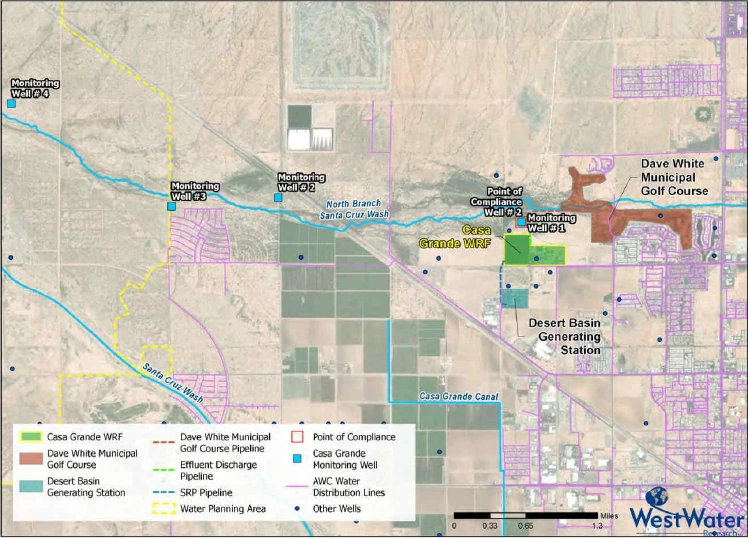
On the question of who operates future recharge facilities, Rains identified several possible models. The City of Casa Grande could operate them directly. Arizona Water Company could operate them in certain circumstances. Rains also said the development community could be made responsible for building the infrastructure needed to deliver effluent to recharge locations serving their projects.
Councilmember Sean Dugan asked who would pay for new recharge infrastructure. Rains noted that the city has been communicating to developers that they would be responsible for the infrastructure costs — a message he acknowledged is met with some surprise. He added that the city has not built recharge infrastructure costs into its utility rates. “There needs to be some level of parameter that separates the current residents from having to cover the cost of that for a specific type of a utility that’s going to benefit a certain area of town,” he said.
A 10-Year Outlook
The draft includes a 10-year projection model. At a conservative 1.6% annual growth rate, total effluent production is expected to grow from roughly 6,301 acre-feet in 2024 to approximately 7,268 acre-feet by 2033. Each sector — industrial and residential — would gain approximately 387 additional acre-feet of allocation capacity over that period.
Rains noted that population growth directly produces more effluent. “That’s the unique thing about effluent — the more you generate, the more often you have to allocate,” he said.
Allocation Priorities by Tier
The draft establishes a tiered system for deciding how to allocate effluent when multiple requests compete. The draft addresses residential development separately under the 20/40/40 framework described above, rather than through the tier system.
- Tier 1 — Municipal and regulatory needs, including aquifer recharge, ADAWS compliance, and long-term water portfolio protection.
- Tier 2 — High-value economic development: strategic industrial users, projects that reduce potable water demand, job creation, capital investment, and community benefit agreements.
- Tier 3 — Commercial, agricultural, and landscape uses, including golf courses and non-potable irrigation systems.
Council Adoption and Development Standards on the Horizon
The Council has not yet voted to adopt the strategy. Staff will incorporate feedback from the March 16 session before bringing it back for formal consideration. Rains said he would recommend that the city work closely with Arizona Water Company to develop a companion recharge strategy after the Council adopts the allocation strategy.
Within roughly the next three months, the Council is also expected to begin receiving presentations on development standards — including how lot sizes and housing densities might align with the effluent program. Rains indicated that requests for residential effluent allocations are likely in the very near term.
“It’s something that gives us the flexibility today, but we’re going to begin to build the foundation of the parameters for tomorrow,” he said.