The SunZia Transmission Project began commercial operations in June 2026. As a result, the line can now carry about 3,000 megawatts of New Mexico wind power into Pinal County. The power arrives at a converter station roughly five to six miles from Casa Grande, Coolidge and Eloy. Utilities then buy it on the open market to serve customers across Arizona and the broader Southwest.
On Sept. 9, an attorney representing Pattern Energy updated the Pinal County Board of Supervisors on the project. So far, Salt River Project (SRP) has agreed to buy 600 megawatts of that power. Meanwhile, he said the company is negotiating with other Arizona utilities for the remaining 2,400 megawatts. He also said he may return in six months to report where the rest has gone.
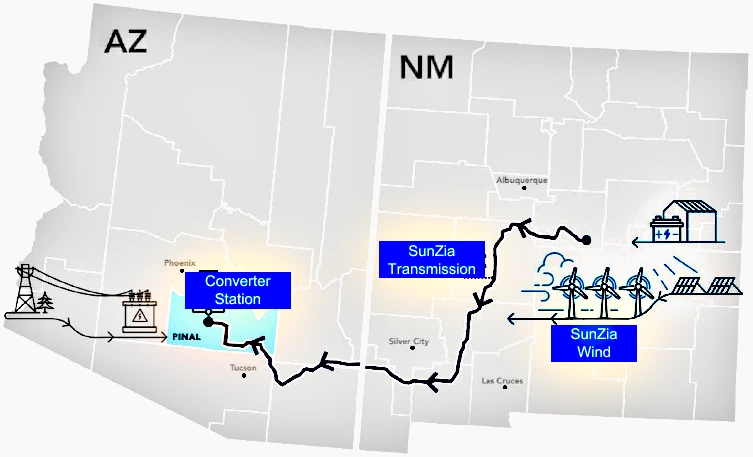
From New Mexico turbines to a converter station near State Route 87
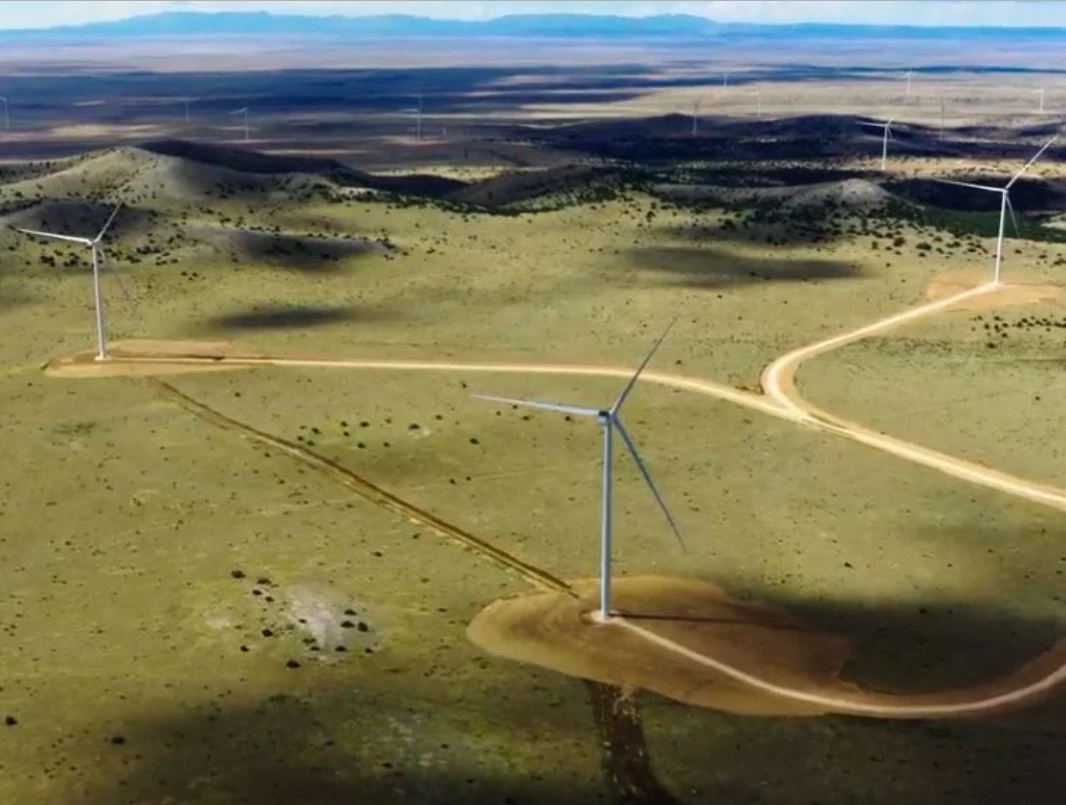
The electricity starts at the SunZia Wind Project in central New Mexico. It is the largest wind farm in the United States, according to the U.S. Energy Information Administration (EIA). The farm has 916 turbines and a capacity of 3,650 megawatts.
Peter Furlow, an attorney with Quarles & Brady who represents Pattern Energy, presented the update. “What is built in New Mexico is that wind farm that’s producing about 3,600 megawatts, or 3.6 gigawatts, of energy,” he said. “What is being taken to Pinal County is about three gigawatts of energy that is then sold on the open market to energy companies.”
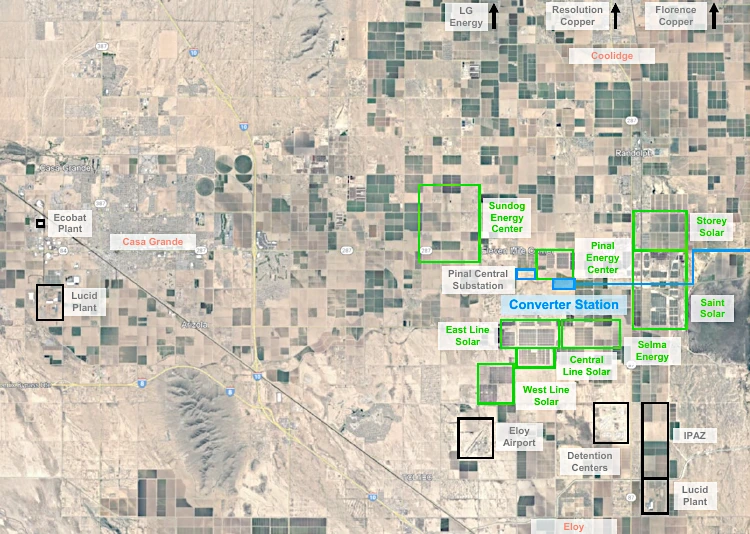
From there, the power travels west on a 550-mile high-voltage direct-current line, which SRP says moves large amounts of electricity efficiently over long distances. About 80 miles of the line run through Pinal County. It ends at the SunZia West Converter Station, which sits east of the Pinal County Fairgrounds and just west of State Route 87, at 2142 E Earley Rd, Casa Grande, AZ 85194. Equipment at the New Mexico end first converts the power to direct current for the long trip west. The Pinal County station then converts it back into the alternating current that homes and businesses use, according to Hitachi Energy, which supplied the converter technology for the stations at both ends of the line. Pattern Energy’s presentation says the station sits in a robust portion of the grid, which enables up to 3,021 megawatts of SunZia power to be delivered to Arizona and the broader desert Southwest.
The station sits in the Eleven Mile Corner area, near natural gas pipelines, transmission lines, fiber optic lines, solar farms and battery storage, Furlow said. “It’s located far away from residential,” he added. Additionally, the station sits at the north end of a designated employment corridor that runs along that highway from the Lucid plant. The presentation calls the station a foundation for building out industrial and employment uses along the corridor.
Pattern Energy calls SRP the largest buyer on the SunZia Transmission Project so far
SRP and Pattern Energy announced on July 8 that they had signed a power purchase agreement for 600 megawatts of SunZia wind energy. The utility is the largest electricity provider in the greater Phoenix area and serves about 1.2 million customers. It also serves more than 90,000 customers in Pinal County, SRP told supervisors in 2025. Under the agreement, SRP will receive 400 megawatts beginning this fall and the full 600 megawatts by summer 2027. At the time of the announcement, SRP had 288 megawatts of wind energy serving its customers. “This project will triple the amount of wind energy on SRP’s grid, helping us make progress toward our carbon reduction goals,” Bobby Olsen, SRP’s associate general manager and chief power system executive, said in the announcement. SRP also said the energy supports its plan to more than double its power system’s capacity by 2035.
Furlow said he thought SRP had become the largest buyer within the past month, purchasing 600 megawatts of the roughly three gigawatts reaching Pinal County. Chairman Jeff McClure then asked who else had purchased power.
“They’re in negotiations with other Arizona utilities right now to buy up the remaining 2.4 [gigawatts],” Furlow answered. “I know some portion then of that 3.6 [gigawatts], I think 600 stayed in New Mexico. I think a portion will continue on through CAISO, maybe over to California, maybe 500 megawatts, and the rest would be Arizona.” CAISO is the California Independent System Operator, a grid operator in that state.
Earlier planning documents listed a larger California share. In May 2024, CAISO’s board approved SunZia Transmission as a participating transmission member, Utility Dive reported. A staff memo for that decision said the line was designed to carry up to 3,021 megawatts of New Mexico wind, with 2,131 megawatts set for delivery to California through the Palo Verde Substation. The EIA repeated that 2,131-megawatt figure in a June 12 report.
Furlow also addressed how many homes the line’s roughly 3 gigawatts could serve. “That’s enough for, I think, a million homes, if residences ended up being on the receiving end of any of the energy, if it was allocated,” he said.
Supervisors ask about turbine wear, state mandates and remaining power
Vice Chairman Jeff Serdy first asked whether Furlow was involved with the project in New Mexico. Furlow said he was not. Instead, he was filling in for Matt Kowalsky, a business manager with Pattern Energy Group, though he said he would try to answer questions.
Serdy then asked about turbine durability and wildlife. “There’s a lot of talk about how the windmills are falling apart, and they break down,” he said. “They hurt wildlife, and what’s going to happen to all the blades? I was wondering, how long has this project been up and running, and are you seeing the degradation of the infrastructure over there yet?”
“There’s been no degradation,” Furlow replied. “All of the wind generation’s over there on the New Mexico side. There’s nothing located in Arizona.”
Supervisor Stephen Miller said he had no question but wanted to confirm why SRP wants the power. State requirements push utilities toward renewable sources, he said, and he put the share at about 15%. Therefore, utilities pursue solar and wind, he said.
Furlow said he could validate that. He said the purchase would triple SRP’s wind energy profile, and that Arizona buyers wanted this power to strengthen the renewable side of their portfolios. Arizona’s renewable standard comes from Arizona Corporation Commission rules, which set the requirement at 15% of annual retail electricity sales after 2024. However, those rules do not cover SRP, a political subdivision of the state that is outside the commission’s jurisdiction for rates, rules and regulations. SRP’s announcement cited growing demand and its carbon reduction goals.
McClure also asked what happens to the extra power during the day. Furlow said it gets used and will be bought, because in his understanding APS and SRP both say they need to roughly double their output. Still, McClure said he remained curious about where the rest ends up. At a 2025 county study session, APS projected demand would rise 40% within six years, and SRP forecast 6% annual growth across its system.
Four permanent jobs and up to $2.1 million a year in property taxes
Pattern Energy’s presentation says hundreds of construction workers were on site daily at the converter station from 2023 through early 2026, and that the completed station now supports four full-time onsite jobs.
In addition, Pattern Energy expects SunZia’s facilities in Pinal County to generate $1.5 million to $2.1 million a year in property taxes. The first payment is due in October 2026. Over time, the presentation projects more than $9 million in property taxes through 2030 and more than $26 million through 2040. Pattern Energy also reports more than $900,000 in community benefits to Pinal County. The company sponsored the 2023 Pinal County Fair, and Furlow said it works with Central Arizona College and other organizations in the county.
Neighbors have raised concerns too. Last month, nearby laydown yards said the site’s lights glared onto their property, and Furlow said Pattern Energy fixed it within the week. The presentation says about 70% of the site’s lights now stay off at night. The company is also working with a nearby contractor on safety and road improvements, including a turn Furlow called a possible blind spot.
Voltage swings at SunZia’s connection with SRP shrank by roughly 90% in March, as the project’s converters were integrated into the grid, according to Pattern Energy’s presentation. Furlow said that added stability means less chance of blackouts, though he noted the subject is not his specialty.
Pattern Energy’s update drew no vote
Supervisors took no vote on the Sept. 9 SunZia Transmission Project presentation, which was an update rather than a request for action.
Pattern Energy is a privately owned renewable energy and transmission developer with more than 40 facilities across North America. Furlow called SunZia its largest project, and SRP’s announcement described it as an $11 billion investment across the Southwest.
Furlow expects SRP power test in October; McClure asks for a six-month update
“SRP hasn’t even done their power test on it yet, and so I think that happens next month, and then it will enter into the SRP load,” Furlow said. He then set expectations for the next SunZia Transmission Project update. “I think this update is we’re constructed now, we’re operational, but maybe in six months I come back and tell you where the rest of the energy has been purchased and utilized,” he said. “Come back in six months,” McClure replied. If that timeline holds, the follow-up would come around March 2027.