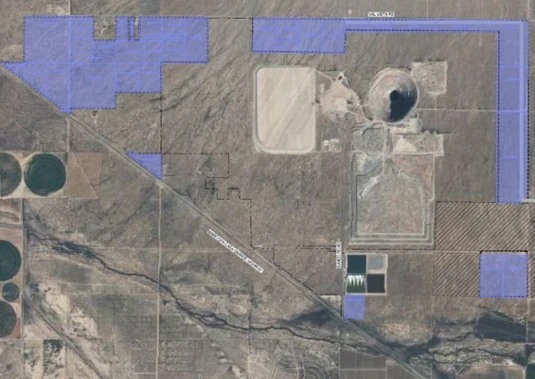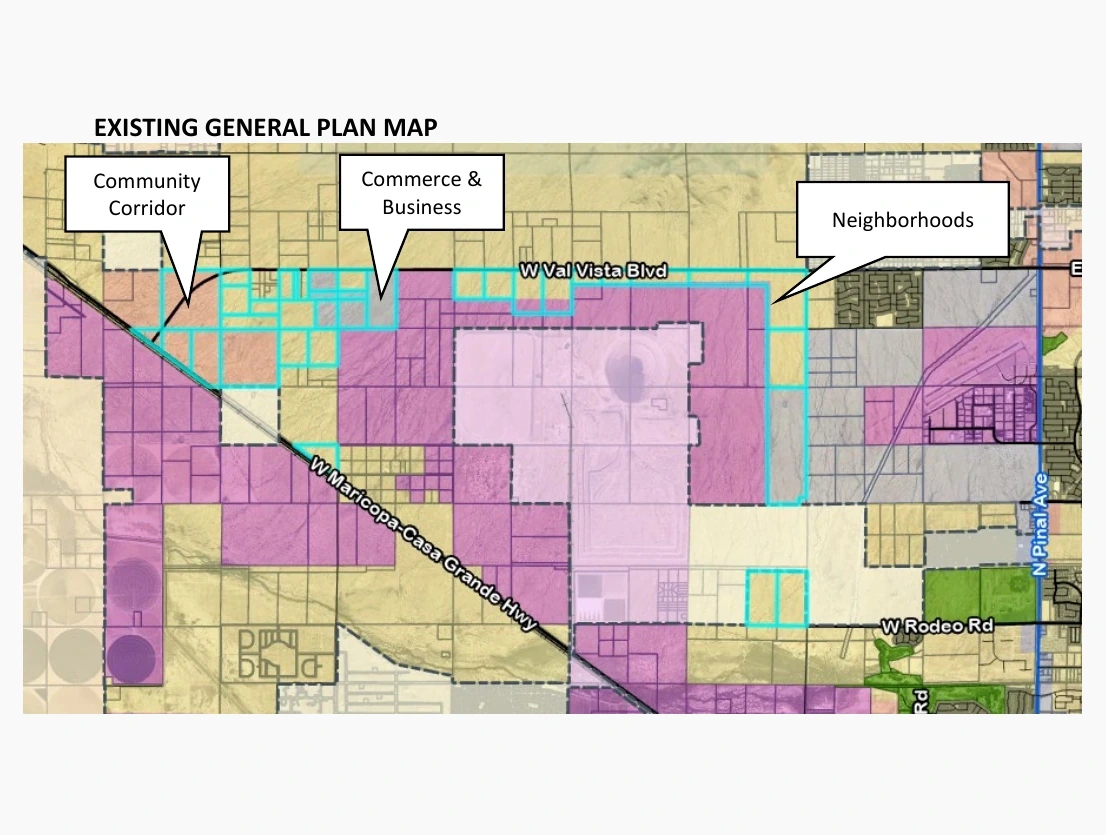
CASA GRANDE, AZ — The Casa Grande City Council on Monday voted 5-0 to approve the Cactus Mine general plan amendment, reclassifying about 1,833 acres of city land around the historic Sacaton Mine site for industrial use. The change updates the city’s long-range plan and is a required step before Arizona Sonoran Copper Company can move forward with plans to reopen and modernize the mine. The acreage wraps around the existing mine pit, with Val Vista Boulevard to the north and the Maricopa-Casa Grande Highway to the southwest.
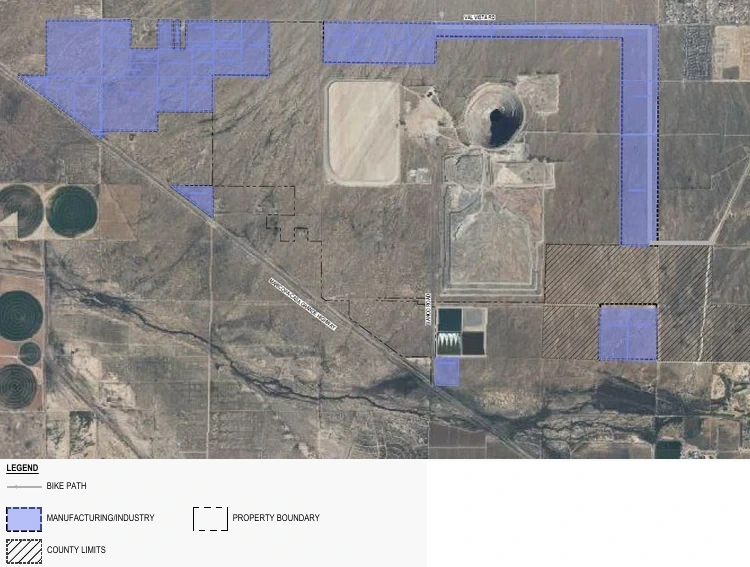
Monday’s vote does not rezone the property or authorize mining. City Attorney Brett Wallace told the Council the amendment is only a prerequisite to a future rezoning, which will require additional public hearings. In effect, the decision updates what the city considers an appropriate use for the land, but the company still needs further approvals before the land can be rezoned for the proposed mining-related uses.
Mining replaces what was once planned as homes and shops
The amendment shifts the land’s designation from Neighborhoods, Community Corridor, and Commerce and Business to Manufacturing and Industry in the city’s 2030 General Plan. The change would expand Casa Grande’s total Manufacturing and Industry land by about 9.33 percent. It applies to property owned by Cactus 110 LLC, an Arizona Sonoran Copper Company entity. The company plans to reopen and modernize the Sacaton Mine, with the 1,833 acres supporting that effort. According to the application, the project is expected to generate high-paying skilled jobs. Those positions could include mining engineers, geologists, equipment operators, and project managers. The applicant expects the majority of those workers to come from Casa Grande.
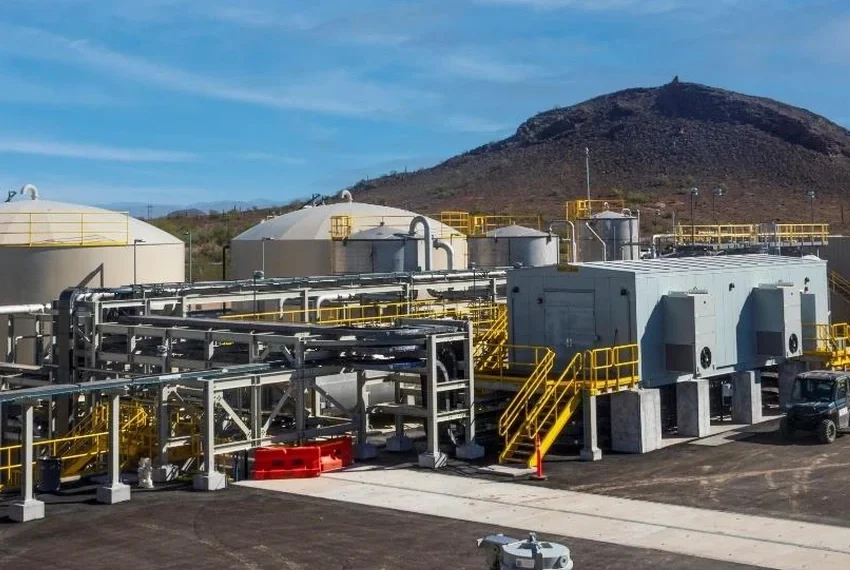
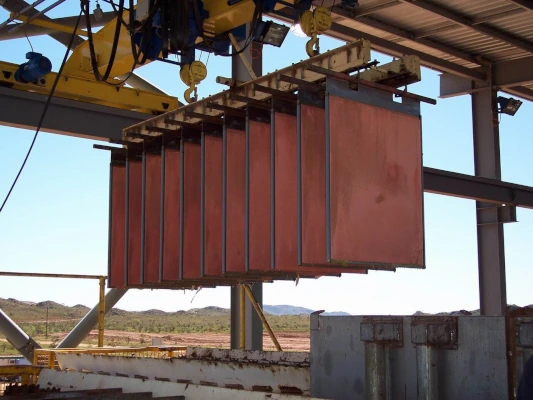
Modernization, as described in the application, would mean operating the site under standards that regulate modern mines. The applicant has committed to meeting Arizona’s Aquifer Protection Permit requirements and Best Available Demonstrated Control Technology standards. The company has also committed to a reclamation plan for the site after mining ends. Plans contemplate open-pit or underground mining along with supporting facilities such as a heap leach pad, where crushed ore is sprayed with acid that dissolves the copper for collection and processing. The application notes the final site configuration has not yet been determined.
Staff described Manufacturing and Industry areas as designed to take advantage of regional transportation networks, including Interstates 8 and 10 and the Union Pacific Railroad. The Cactus Project site itself is accessed from the Maricopa-Casa Grande Highway and lies about 10 miles west of I-10. Mining activity would occupy one portion of the property. Meanwhile, processing operations would be located near the Val Vista curve and the Maricopa-Casa Grande Highway. Viewshed berms could reach 200 to 300 feet in some areas and would be contoured and vegetated to resemble natural hills. The applicant told the Planning and Zoning Commission the berm would be kept lower near the eastern boundary to stay below airport flight-path height requirements. A 500-foot buffer from the property boundary is also planned.
Two neighbors push back on dust and buffer distance
Two adjacent property owners addressed the Council during the public hearing. Hubert Charles Dillon Jr. told the Council his family has lived near the site for nearly 30 years. He said he believes he is the closest full-time resident to the project. He raised concerns about the proposed heap leach pad, where acid is used to extract copper from ore. He told the Council he believes it will sit less than 1,000 feet from his door, possibly as close as 600 to 800 feet.
Dillon questioned whether a dirt berm would protect his family from chemical dust. “No matter how high they build their dirt berm, it will not stop chemical dust and it will not stop the wind,” he told the Council. He also said he never received a mailed notice about the project and raised concerns about a potential drop in property values.
Richard Vazquez also spoke during the hearing. He told the Council he lives within 1,000 feet of the site and bought his property because there was nothing there at the time. “I wanted to be separated from development,” Vazquez said. “Now, development’s coming to my backyard.” He asked who decides the size of the buffer between mining operations and existing homes.
In response, Mayor Lisa Navarro Fitzgibbons said she hoped Arizona Sonoran Copper Company would continue meeting with nearby neighbors. She also directed Senior Planner Jaclyn Sarnowski to follow up with Dillon after the meeting about his notification concerns.
Why the Cactus Mine general plan amendment fits the city’s plan
Staff and the Planning and Zoning Commission found the request meets the city’s general plan review criteria. The 2030 General Plan was adopted in 2021 and identified Manufacturing and Industry as a category that may need additional acreage. One of the plan’s aggregate resources goals calls for diversifying industrial land uses to include aggregate and mining activities.
Sarnowski told the Council the project directly supports those policies. Staff found the request compatible with surrounding land uses tied to the existing mine. Cactus 110 acquired the historic Sacaton Mine site in 2020 and assumed responsibility for future cleanup obligations associated with the property. The company added approximately 2,123 acres of additional private land in 2025. Earlier Pinal Post reporting on the Planning and Zoning Commission’s recommendation detailed the project’s history under ASARCO, the property’s path from custodial trust to private acquisition, and the environmental commitments tied to reopening the mine.
A bigger hurdle than most land use decisions
Major General Plan amendments are considered only twice a year. Wallace explained that approval requires two-thirds of the entire Council, which normally means five of seven members. With only five members present Monday night, the vote effectively required unanimous approval. “If anyone does vote no, we will announce that it fails,” Wallace said before the vote.
Arizona state law required two public hearings at separate locations before the Planning and Zoning Commission. The first hearing was held April 23 at the Casa Grande Community Recreation Center. The second took place May 7 at the City Council Chambers. The Commission unanimously recommended approval at that second hearing on a 7-0 vote.
Staff reported that notices were mailed to property owners within 1,000 feet of the site, signs were posted on the property, and public hearing notices were published in the local paper.
More hearings, and a possible new owner
The next step is a separate rezoning request (known as a Planned Area Development amendment, or PAD) that will determine the specific buffer distances, allowed uses, and site design. The PAD must clear public hearings before both the Planning and Zoning Commission and the City Council. After that, the final site plan goes to staff for administrative review without another public hearing. No date has been set for the PAD’s next public hearing.
Arizona Sonoran Copper Company is also in the process of being acquired by Hudbay Minerals Inc., a Canadian copper producer. The companies announced a definitive agreement on March 2, and the transaction is expected to close in the second quarter of 2026, pending remaining approvals. As a result, the project may be operating under Hudbay ownership by the time the PAD returns to the Planning and Zoning Commission.