Key Points
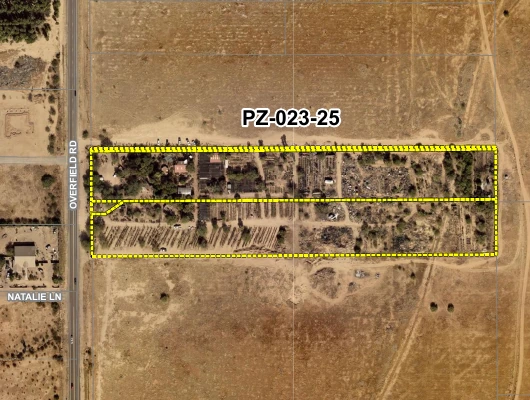
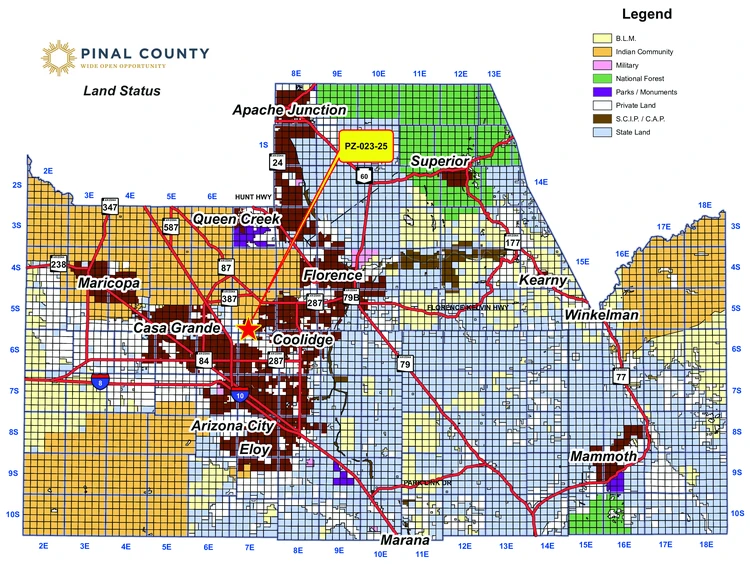
- Pinal County Board of Supervisors approved a commercial rezoning at 6855 N. Overfield Road, Casa Grande, on March 18, 2026
- Vote was 3–1, overruling an 8–1 recommendation of denial from the Planning and Zoning Commission
- Site is the former Avocado Nursery, which closed after the new owners could no longer sustain operations, located approximately one mile from Central Arizona College
- First phase of development is expected to include a drive-through restaurant and possibly a coffee shop
- Larger plans for retail, grocery, and self-storage remain conceptual and subject to further county approvals
- Residents submitted 33 letters of support but predominantly in-person opposition at public hearings
The Pinal County Board of Supervisors approved a commercial rezoning at 6855 N. Overfield Road on March 18, 2026. The vote was 3–1, overruling a recommendation of denial from the Planning and Zoning Commission. Supervisor Rich Vitiello cast the lone dissenting vote.
What the Property Is and Why It Is Changing
The 9.93-acre site operated for more than four decades as the Avocado Nursery under a Special Use Permit (SUP-114-82) issued in 1982. That permit was tied to the original owner, Phil Bond, a certified master gardener, according to a letter submitted in support of the rezoning. The property was subsequently sold in 2024 to Azumar LLC, managed by Maria Silva.
Azumar LLC attempted to continue nursery operations after purchasing the property. However, according to applicant agent Samir Slatewala of Architecture All & Associates, the business could not sustain itself financially. “Expenses would increase, sales would decrease,” he said, and the new ownership eventually could not cover ongoing losses. “At the end of last year, my clients could no longer keep the losses going,” Slatewala told the board.
During the period the nursery was still open, Slatewala said he asked the owners to informally ask customers two questions: what they thought about the property potentially turning commercial, and what services were missing in the area. Over several months, the owners noted the responses. Based on the informal feedback from customers, the responses pointed to food options, a coffee shop, a grocery outlet, and self-storage. When the owners explored adding a restaurant to the property, a pre-application meeting with the county confirmed that a drive-through restaurant was not permitted under the existing GR zoning and that a rezoning to C-1 Neighborhood Commercial would be required. A formal rezoning application followed.
Catering to a Growing Community and College Students
Planning Supervisor Sangeeta Deokar described the proposal to the board as “catering to the growing needs of the surrounding community and college students.” The property sits approximately one mile from the Central Arizona College Signal Peak Campus and 0.7 miles from the incorporated City of Coolidge.
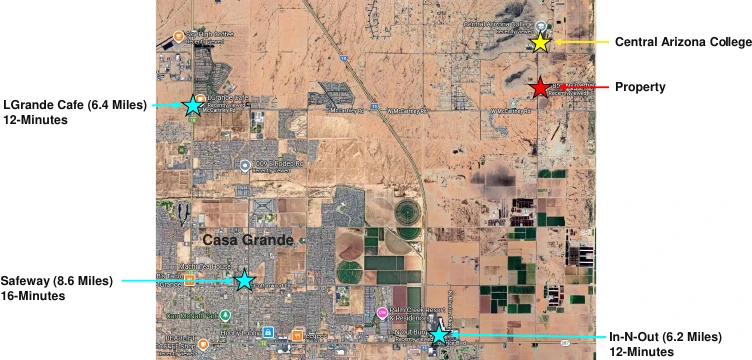
Slatewala told the board that feedback from nearby residents and college students made the need for nearby services clear. “We kind of understood why the same few things kept on being mentioned,” he said. “If somebody wanted to grab a carton of milk, it’s going to be a 35-minute round trip, not even taking into consideration your time to go into the grocery store.”
What Is Planned — and What Remains Conceptual
The immediate development focus is converting an existing 1,500-square-foot structure on the property into a drive-through restaurant, with Filiberto’s described by the applicant as a serious option. A small coffee shop or retail space has also been discussed as part of the first phase.
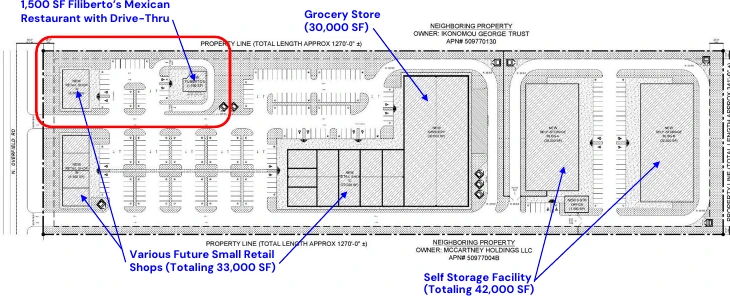
A conceptual site plan presented during the hearing illustrated a larger vision for the full 9.93-acre site. That concept includes approximately 33,000 square feet of future retail buildings, a 30,000-square-foot grocery store, and a self-storage facility totaling approximately 42,000 square feet. However, those elements remain conceptual.
Deokar told the board that the second and third phases are “kind of conceptual at this point and would be developed based on what the market demands are.” Slatewala added that the hearing was fundamentally about zoning, not site design, and that future development would require additional site plan review and county engineering approvals, including a traffic impact analysis and drainage reports.
Supervisor Jeff Serdy asked directly whether Filiberto’s was confirmed. Slatewala replied that the owners have a tie to the Filiberto’s brand and that it is “a very, very, very serious option,” but said another restaurant concept could be used instead.
Supervisor Miller on the Property’s History and Current Condition
Supervisor Stephen Miller, who represents the district where the property is located, noted the nursery’s past popularity. “There was a time when you, on a Saturday, if you were to go from Casa Grande to Coolidge, that nursery was packed with cars all the way around it, all the time,” Miller said.
Miller then addressed the site’s present condition. “I’m gonna be real honest with you, it’s getting run down,” he said. “It’s about a nanosecond away from code enforcement coming by and saying, ‘You need to start cleaning this place up a little bit.’ I think the development is a great idea. There’d be something there.”
Supervisor Miller on Property Rights, Traffic, and Sewer Infrastructure
Miller offered additional remarks before the vote, addressing several arguments raised during public comment.
On property rights, Miller said he holds a “philosophical belief that if it’s not obtrusive — and I don’t think this is — you should be able to enjoy your property to the best of your ability to move forward with a dream or an idea.” He added that he has “a hard time when people are trying to tell other people what they should do with their property.”
On traffic, opponents raised concerns that Overfield Road already carries heavy volume. Miller responded: “It ain’t getting less. There will be a time, maybe, in everybody in this room’s life, that that’ll be a five-lane road.” He said filling up the surrounding lots with houses would demand road widening on its own.
On property values, Miller said: “I’ve never seen where something that was built ever, ever devalued somebody else’s property. I’ve researched it. I’ve talked to realtors. We’ve studied it, and it doesn’t happen. If your property devalues, it ain’t because something else was built. There’s other circumstances that came along with it.”
On sewer infrastructure, opponents raised the absence of sewer lines in the area. Miller noted that residential homes throughout the area operate on septic systems and that the restaurant would be required to do the same. “They’ll have to put a sewer system in. They’ll have to put a septic tank in to handle that,” he said. “There’s no getting around it. But they’re entitled to do that. They’re allowed to do that.” He noted the college is the only property in the area with its own sewer plant. “That’s not a reason to stop somebody from building out there,” he said.
Miller concluded: “There’s just so many things that are myths about somebody wanting to develop their piece of property. I see more reasons to approve than I do deny.”
How the Board Framed the Rezoning Question
Miller also addressed the fitness of the proposed use for the location. “When a zoning case has come before us, ‘Is this an appropriate use in this location?'” he said. “This is not a bad use. Well, first of all, it’s not much different than what has been there for decades. It’s not a gas station. It’s not a body shop. It’s not something that’s out of the ordinary. … there’ll be a need for all the items that you’ve talked about if just half of those lots fill up. So I think it’s a fit.”
Before the vote, Serdy said: “This is one of those cases where it’s such a big county that I kinda think we should defer to the supervisor in that area. Steve knows that area better than I do.”
Support, Opposition, and the Planning Commission’s Denial
Applicant representatives submitted 33 letters of support from area residents, college students, and community members. One letter, from Kim Penunuri of On Point Small Business Solutions, described a vision that includes a coffee and food venue with shaded patio seating, yoga programming, and a small playground designed with consideration for children on the autism spectrum and those with special needs. Penunuri wrote that “Casa Grande and Pinal County have limited spaces designed with inclusive recreation in mind.” One formal letter of opposition was submitted to staff, raising concerns about insufficient infrastructure, erosion of the area’s rural character, and increased traffic, noise, and pollution.
At the November 20, 2025 Planning and Zoning Commission hearing, the commission voted 8–1 to recommend denial. Opposition came primarily from residents who appeared in person at that hearing and at the September 26, 2025 neighborhood meeting. Commissioner Pranzo, who made the motion to deny, said: “It doesn’t feel like the area is ready for commercial land, considering the amount of opposition by people who live adjacent to it.” Pranzo also noted that a neighborhood commercial approval could allow uses beyond those presented.
A neighborhood meeting held at the property on September 26, 2025 had approximately 15 residents sign in. The majority in attendance expressed opposition. Common concerns included traffic, loss of rural character, and skepticism about the owners’ intentions regarding the nursery and the rezoning.
Public Comment at the March 18 Board Hearing
Five members of the public spoke at the March 18 Board of Supervisors hearing.
Jon Morton, who described himself as living across the street from the project, opposed the rezoning. He said neighboring residents had not been meaningfully surveyed, despite the applicant’s claims. “People that did show up were all in opposition of this particular project,” Morton said, “and that’s why P&Z declined it.” He said residents moved to the area specifically to be rural, having left the city to get away from it.
Laura Ellis, who said she has full view of the property from her home on McCartney Road, also opposed it. She raised concerns about traffic speed on McCartney Road, nighttime lighting from a potential 24-hour restaurant, and the absence of sewer lines. Ellis also questioned the letters of support, saying that few of the 33 included addresses and that she believed many came from college students who do not own property in the area.
David Ellis, who also lives on McCartney Road, raised procedural concerns. He alleged that construction activity was already visible on the property when the neighborhood meeting was held, and that a county inspector incorrectly reported finding nothing requiring a permit.
JW Salazar, a retired firefighter who lives nearby and also opposed the project, raised concerns about fire protection infrastructure and the cost of buildout.
Keith Seaman, a former state legislator who said he has lived on North Overfield Road since 2008 and resides about a mile and a half south of the site, spoke in support. He noted the rapid pace of residential construction in the area. “There must be 50, 75 new homes being built on McCartney all the way down to Cox and up to Coolidge,” Seaman said. “This is going to be much more convenient for the people in that area who have no shopping, who have no grocery stores.”
Tom Bean, a former resident who said he built a home on North Overfield Road about 30 years ago, also spoke in support. Now living in Casa Grande, he said he would still be in favor of seeing something nice developed there.
Staff Recommendation and Comprehensive Plan Consistency
The Pinal County Comprehensive Plan designates the site as residential but allows for complementary commercial uses when they improve community access to services or reduce travel distances. Deokar told the board that the proposed neighborhood commercial zoning is consistent with that allowance. Staff also noted that nearby parcels approximately a half-mile north and south are already zoned for commercial use.
The Vote and Required Next Steps
The board voted 3–1 to approve the rezoning of the property. Before any construction begins, Azumar LLC must complete site plan review, submit a traffic impact analysis, and receive approval of drainage reports from the county engineer.