Key Points
- Vote: 5–2 recommendation of approval, 21 stipulations
- Design: 84-foot eucalyptus monopole, not yet in county code
- Location: N. Gary Road, within the San Tan Valley Special Area Plan, unincorporated Pinal County
- Carrier: Verizon, initial tenant; co-locatable for future carriers
- Opposition: Eight letters; two residents spoke at the hearing
- Commissioners: Raised concerns about wireless companies siting towers in established neighborhoods rather than ahead of residential development
- Next: Board of Supervisors makes the final decision
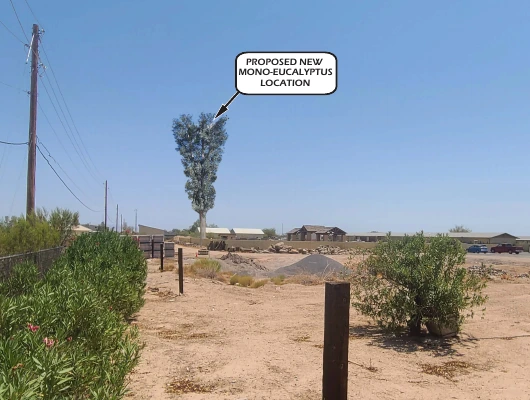
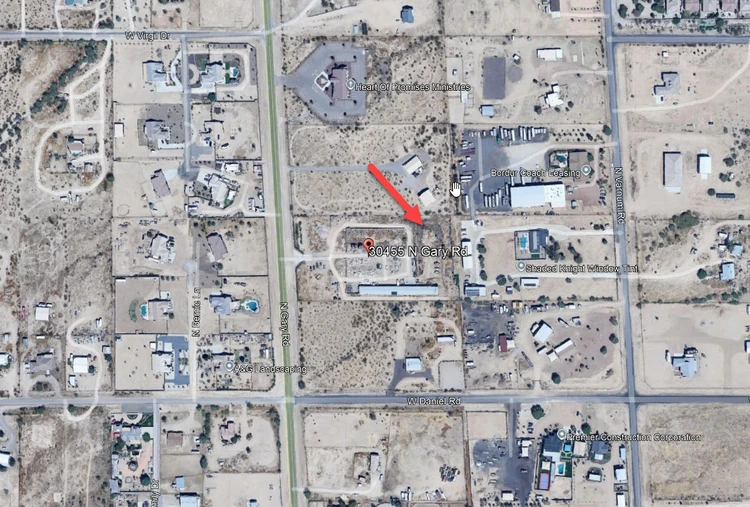
SAN TAN VALLEY, AZ — A wireless tower owned by Vertical Bridge will move forward in a San Tan Valley residential neighborhood after the Pinal County Planning and Zoning Commission voted 5–2 on March 19 to recommend approval with 21 stipulations of the project. Verizon is the initial tenant. The 84-foot facility, styled as a eucalyptus tree, would be built at 30455 N. Gary Road — 0.5 miles west of the incorporated Town of San Tan Valley, within the San Tan Valley Special Area Plan, in unincorporated Pinal County. The Board of Supervisors will make the final decision.
Eight neighbors submitted letters of opposition. Two spoke during public comment. Commissioners also raised concerns about placing cell infrastructure inside an established residential community and questioned whether the county should require more scrutiny before approving such placements.
A New Eucalyptus Design Not Yet in the County Code
The proposed tower introduces a stealth design type that Pinal County does not yet formally recognize. Planner Sam Amaya told commissioners that monopine facilities are permitted up to 90 feet under current code — but the eucalyptus variant has no specific listing.
“We don’t have eucalyptus trees in our code,” Amaya said. “They’re kind of a newer one, so the closest one we have is the monopines.” He added that the county is currently updating its code and plans to include eucalyptus and other newer wireless facility types.
Last month, commissioners debated a 125-foot monopine approved near Maricopa and questioned why the county’s 90-foot code limit is consistently exceeded — and whether stealth designs belong in the desert at all. That discussion included questions about aligning county code with federal law, which sets no maximum tower height.
Applicant Tom Johnson of TSJ Consulting Inc. explained why he chose the eucalyptus design over a pine. The original proposal called for a bare monopole at 70 feet. Following the November 2025 community meeting, Johnson said, he and his team reconsidered. “A monopine didn’t seem logical for that location,” he said. “The best suiting stealth design is a monoeucalyptus.” Johnson said the design screens the facility more effectively than a pine.
Commissioner Daren Schnepf acknowledged the reasoning but wasn’t certain the eucalyptus would fare better visually. “Pines, as we’ve all noticed, don’t even look real and kind of don’t blend into a desert,” he said. “A eucalyptus — I don’t know. Maybe the same thing.”
Commissioner Bryan Hartman was more enthusiastic. “I personally like that idea,” he said. “I think this would look better than the pine.”
Height Increased After Neighbor Notification — No Second Letter Sent
In an October 2025 outreach letter, the applicant described a 70-foot bare monopole. After the November 2025 community meeting, the design was revised to include eucalyptus stealth cladding, raising the height to 84 feet.
Scott asked directly whether an updated notice had gone out. Johnson confirmed that it had not.
“Was there an additional letter sent out to the neighbors so that they could be aware of that change?” Scott asked.
“No, there was not,” Johnson replied.
Johnson explained the height increase: adding a stealth design to a bare monopole requires additional steel infrastructure and foliage. That structural addition raised the height from 70 to 84 feet. He also clarified how the 84-foot figure breaks down: “Technically the steel of the tower with the antenna goes up to 80 feet. You’ve got a four-foot lightning rod, where that 84 feet comes into play. The branches are within that envelope as well.”
Vice Chair Karen Mooney noted that on past monopine cases, branches have extended significantly above the stated structure height. Johnson confirmed that in this design, the branches remain within the 84-foot envelope.
Commissioners Question Residential Placement as a Pattern
Commissioner Gary Pranzo said the case stood out from others he had reviewed. “Most of the poles that I’ve experienced, but I’m only here maybe a year and a half, have been quite remote,” he said. “This one doesn’t seem to be that. It seems to be right in the middle of residential. I’m concerned that this is going to be a pattern now that the wireless companies are late to the game.”
Pranzo acknowledged the tension between community impact and utility. “When somebody puts something up that wasn’t there and it’s ugly no matter what you do, it’s just an irritant. On the other side of the coin, of course, is that even though this is a for-profit endeavor, cell phones — every one of us has one. I view it as a utility. So this is a tough one, knowing which way to go with this.” He said he wanted to ask the applicant whether alternative sites had been considered, but the comment period had closed before he could pose the question.
Vice Chair Mooney said a wireless carrier had tried to place infrastructure in her HOA community but it did not work out due to the community’s own governing documents being more restrictive than county code. That carrier, she said, eventually found a suitable location after shopping multiple sites. “I do know from experience that they have shopped around trying to find the best location,” she said. She noted that a tower in her own community — present before she moved in — has not resolved service problems. “We still have terrible service,” she said.
Commissioner Scott focused on the broader question of community character. “How do we justify placement of a tower like this in this magnitude in an already established neighborhood?” he asked. “I would assume that these people specifically chose that location for one reason or another, and now it’s being altered by something that doesn’t fit in.”
Commissioner Schnepf said he understood why networks expand into residential areas as population grows. The need for new infrastructure, he said, follows demand — and this area was likely underserved when the surrounding homes were first built.
Pranzo closed by directing his concern at staff. “Hopefully staff will hear it, and as these applications come in, there’ll be a little more scrutiny,” he said.
What the Tower Would Do — and Who Would Use It
Johnson said the tower is designed to close a coverage gap along Gary Road and serve the surrounding residential area, including denser development toward San Tan Valley to the east. The facility is co-locatable, meaning additional wireless carriers could be added in the future. At this time, Verizon is the only tenant.
Johnson described how Verizon identified the site. Carriers continuously analyze their networks for call drops and capacity limits. When a problem is flagged, he said, it points to a specific location. “That X marks the spot usually identifies about a quarter-mile radius,” he said. “That’s what transpired here.”
The site sits on a 4.2-acre parcel zoned SR (Suburban Ranch) and operates as a landscaping business. It has no prior permitting history for this type of use. The surrounding area consists primarily of single-family residential properties.
Commissioners noted that landowners are typically compensated for hosting a tower. Commissioner Scott said he had been approached about one of his own properties. “It was pretty lucrative,” he said. “Around $1,000 a month — something you don’t want to pass by.” Commissioner Schnepf said the landscape company “had that opportunity” and suggested the landowner may be benefiting from the arrangement.
The compound will be unmanned, enclosed by an 8-foot masonry wall with a secured gate, and will house equipment cabinets and a backup diesel generator. Routine maintenance visits are expected approximately once per month during normal weekday hours, with occasional tower maintenance once a year or every two years.
Lighting: Residents’ Concerns Addressed by Code and Applicant
One neighbor asked specifically about nighttime lighting — whether it would shine onto her property, face upward, or disrupt the rural character of the neighborhood.
Johnson said no lights run continuously at the facility. Ground-level lighting exists only for technician use and is on timers. Nothing is mounted above ground level.
Amaya confirmed the facility must comply with Lighting Zone 1 standards — the county’s most restrictive designation. “No upward-facing lights,” he said. “Pretty much no light penetrating outside of the property.”
Eight Letters of Opposition — Neighbors Raise Health, Property Value, and Animal Concerns
Eight letters of opposition were submitted by the day of the hearing, up from three noted in the staff report at publication. Johnson said he had not yet had a chance to reach the residents who submitted the additional letters. He said the concerns raised at the November community meeting centered on design, aesthetics, and health impacts. He addressed the health topic directly at the hearing: as long as the facility complies with FCC guidelines, he said, federal law limits what a municipality may consider in its approval or denial.
Among the eight letters of opposition, two residents also addressed the commission in person.
Diana Breen, who said she lives immediately to the south of the proposed site, said she is not opposed to infrastructure but is opposed to placing it in a residential setting. She described the tower’s proximity to her home, noting that the staff presentation photo depicted her fence line at the edge of the frame. She raised concerns about property values, stating that studies she had reviewed suggest homes within visible range of a cell tower can lose between 2% and 20% of their value. She also cited radiofrequency radiation concerns for her horses and other livestock, referencing studies suggesting behavioral changes and increased stress in animals from prolonged electromagnetic field exposure. “My home is one of the biggest investments I will ever make in my life,” she said.
Valerie Ciarleglio, who said she lives across the street from the proposed site and within the 600-foot notification radius, cited potential health risks including certain cancers, neurological effects such as headaches and dizziness, and reproductive health impacts in children. She acknowledged the FCC sets safety standards but raised a question no one at the hearing answered: “When they do check — where do the results go? Who sees what radiation is being exposed? Does it go to the town or the county? Can it go to the residents?”
Among those who submitted written letters:
Amy Wiles, a resident who attended the November 2025 neighborhood meeting less than a week after knee surgery, wrote that she has lived in the neighborhood for six years and uses Verizon without service issues. She raised health concerns about 5G facilities and noted that during the community meeting, the consultant and landowner were unable to answer most residents’ questions. She also pointed out that her neighbors received the meeting notice only three to five days before the event. Wiles noted that the tower height grew from 70 feet to 84 feet after that meeting and that she was not notified of the change.
Jacqueline Mendoza, a resident on Bernie Lane, wrote that she never received notice of the November meeting and only learned of it from a neighbor. She said she has Verizon service and does not experience dropped calls or connectivity issues. She cited unresolved questions about long-term health research and expressed concern as a parent with children who live and play at home daily.
The Vote: 5–2 in Favor
Commissioner Bryan Hartman moved to forward a recommendation of conditional approval to the Board of Supervisors. Commissioner Albert Lizarraga seconded.
The roll call vote:
- Aye: Hartman, Lizarraga, Keller, Schnepf, Mooney
- Nay: Scott, Pranzo
The motion passed 5–2. The approval carries 21 stipulations. Among them, the applicant must submit RF engineer certification within 30 days of Board of Supervisors approval confirming FAA and FCC compliance.
Board of Supervisors Has Final Say
The commission’s vote is a recommendation only. The Pinal County Board of Supervisors, representing District 4 under Supervisor Jeffrey McClure, will make the final decision on case SUP-011-25. Residents who wish to participate may contact the Pinal County Planning Division at [email protected] or 520-509-3555.