Key Points
- Florence Town Council voted 7-0 on March 17, 2026 to raise the local sales tax from 2.0% to 3.5%, effective July 1, 2026.
- Groceries and gasoline are not subject to the increase.
- 1.0% of the increase is dedicated exclusively to a restricted Transportation Sales Tax Fund for road projects.
- 0.5% goes to the General Fund to offset losses in state-shared revenues.
- The transient lodging (bed) tax increases separately from 2.0% to 5.0%, applying to hotels, motels, and short-term rentals.
- Hotel and short-term rental stays will see their combined lodging tax rate rise from 4.0% to 8.5% — a 3.5% sales tax plus a separate 5.0% bed tax.
- Florence faces an estimated $43.5 million gap in its 10-year, $150 million transportation plan even with the new revenue.
- The town lost an estimated $3 million over four years following the 2020 state prison closure and expects to lose $1.5–$1.7 million annually due to the incorporation of San Tan Valley.
- In-person open house attendees were more supportive (59%) than opposed (23%); online respondents were more opposed (32%) than in support (13%).
FLORENCE, AZ — The Florence Town Council unanimously approved a Florence sales tax increase on March 17, 2026, raising the local Transaction Privilege Tax (TPT) rate from 2.0% to 3.5% and the transient lodging (bed) tax from 2.0% to 5.0%. The new rates take effect July 1, 2026. Groceries and gasoline are not affected. The 7-0 vote passed Ordinance No. 780-26, which dedicates 1.0% of the increase to a restricted Transportation Sales Tax Fund and 0.5% to the General Fund.
What Residents Will Pay — and What Stays the Same
Finance Director Carl Dudding confirmed during the public hearing that the sales tax adjustment “does not apply to food for home consumption, i.e. groceries, nor does this increase any tax on gasoline.”
Town materials illustrated the practical impact:
- A dozen eggs: no change — still $5.00
- Gas at the pump: no change — still $2.99 per gallon
- A fast-food meal at $12.00: increases to $12.18
- A retail purchase like a grill at $500: increases to $507.50
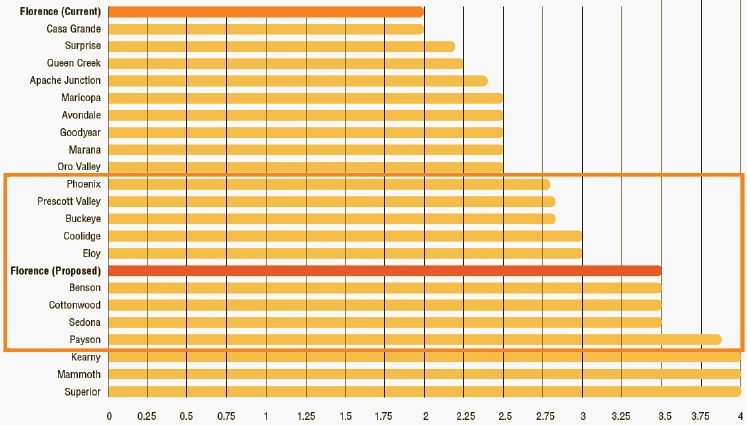
The median local sales tax rate in Arizona is 2.95%. Florence previously charged 2.0%. Communities such as Benson, Cottonwood, Sedona, and Payson operate at or near 3.5%.
Where Does the Money Go?
Of the 1.5% increase, 1.0% flows into a dedicated Transportation Sales Tax Fund, restricted exclusively to street projects and maintenance. The remaining 0.5% goes to the General Fund to offset losses in state-shared revenues and support day-to-day services.
Vice Mayor Cathy Adam addressed public concern about accountability, noting that specific road projects had already been identified and listed in the council packet. “We have something like a $43 million gap in trying to pay for them, even with our most optimistic rose-colored glasses on. This is not a pie in the sky.” She added that the 1% would be placed into a dedicated fund, isolated from other revenues, to ensure it is used exclusively for transportation.
Town Attorney Robert Wingo confirmed the ordinance includes specific dedication language: “There is dedication language in the ordinance that dedicates the one percent to that certain transportation fund, and then the 0.5% to the general fund.”
The Transportation Special Revenue Fund revenues and expenditures will appear in Finance Director Dudding’s monthly financial report, allowing the public and Council to track how the funds are used.
Over 10 years, the full 1.5% increase is projected to generate:
- $27.5 million for street capital projects
- $13.7 million for the General Fund
- $3.6 million per year in total new revenue
The General Fund supports police and fire services, parks and recreation, the Senior Center, library services, 911 dispatch, community services, and administration.
Understanding the Hotel Tax: Two Separate Charges
Florence currently charges hotels and motels a 2.0% regular sales tax and a separate 2.0% bed (transient lodging) tax — totaling 4.0%. Under the ordinance, the regular sales tax rate for hotels rises from 2.0% to 3.5% along with all other taxable categories, and the bed tax increases from 2.0% to 5.0%. The ordinance also extends the bed tax to short-term rentals such as Airbnb. That means a hotel stay in Florence will carry both charges — the 3.5% sales tax rate plus the 5.0% bed tax — for a combined lodging tax rate of 8.5%.
Councilmember Tony Bencina sought to clarify this during the meeting. Finance Director Dudding confirmed: “The additional bed tax is like an add-on,” separate from the sales tax. Bencina confirmed the council would be “establishing that add-on line.”
Mayor Keith Eaton addressed the bed tax in his opening remarks: “We are looking at going from a 2% bed tax to a 5% bed tax. When you combine small increases on sales tax and bed tax, it also makes it so our visitors — which we’re getting more and more of — help pay for the services that they’re using while they’re in our town, the roads that they’re driving on. The bed tax is very small right now. We’ve got minimal rooms to rent. That is expanding over the next few months, so we hear. This is not an income tax that taxes additional tax on us that live here. This brings in the visitors to come in and to help us through this.”
The Roads: A $150 Million Funding Gap
Florence’s 10-year Capital Improvement Plan for transportation totals approximately $150 million. Current funding sources cover only a portion of that.
| Funding Source | Amount |
|---|---|
| 10 Years of Current Funding | $37.4M |
| Development Impact Fees (new homes) | $31.6M |
| New Sales Tax Revenue (10 years) | $27.5M |
| Grants & Private Partnerships | $10.0M |
| Total Funded | $106.5M |
| Unfunded (of $150M total) | $43.5M |
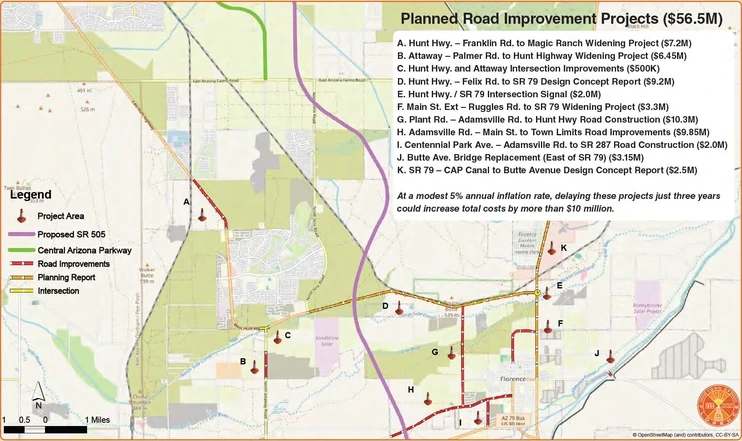
Eleven road projects are currently identified for funding, totaling $56.5 million. At a 5% annual inflation rate, delaying these projects just three years could increase total costs by more than $10 million.
Mayor Eaton acknowledged construction cost pressure the town had already encountered: “This was coming, and we saw it early on when we bid out the Attaway and Hunt Highway, where it was originally budgeted for $8 million, it came in at $15 million. Again, these are things that are out of our control.”
Hunt Highway currently serves more than 17,000 vehicles per day. Attaway Road and other corridors are over capacity.
Why Revenues Have Fallen
State prison closure: “When the state prison closed in 2020, the town census decreased by 3,000, roughly 10%, and that resulted in a $3 million loss over four years,” Dudding told the council. Town materials identify the affected funds as the General Fund, Vehicle License Tax, and Highway User Revenue Fund (HURF).
San Tan Valley incorporation: Dudding told the council that San Tan Valley incorporated with an estimated population of 99,000 — one of the largest incorporations in Arizona history. At the San Tan Valley Town Council meeting on March 4, 2026, Town Manager Brent Billingsley announced that San Tan Valley’s certified 2020 census population is 91,130. Residents from the new city now draw from the same state-shared revenue pool as Florence. However, Dudding told the council the revenue reduction started early — in October 2025. For fiscal year 2026, the town anticipates a loss of $800,000 to the General Fund and HURF transportation funding. Long-term, the annual loss is projected at $1.5 to $1.7 million annually. State Shared Revenues currently account for approximately 47% of Florence’s General Fund.
Stagnant gas tax: Dudding told the council that the Pinal County gas tax — which funds the town’s HURF allocation — has been fixed at 18 cents per gallon since 1990. Over that same period, construction material costs have surged:
- Asphalt up 317%
- Aggregate up 311%
- Concrete up 249%
- Steel up 143%
The purchasing power of state transportation funding has declined by nearly 60% since 1990.
Vice Mayor Adam also addressed state-level policy impacts on town revenue: “One of the reasons we’re coming to you is because they are taking money. They are taking away our ability to earn money from the developers, from some of the businesses that you all are suggesting that we go knock on their door and try and get some money. These things are beyond our control, except that we have a vote.” She also noted that ongoing tariff costs have “exponentially increased the cost of everything we do.”
Council Members: What They Said
Vice Mayor Cathy Adam said the town is actively lobbying state legislators for a greater return on revenues Florence already generates. “We’re banging at their doors very aggressively trying to get, wherever we can, our share of the money back. And we’ve seen some success.” She noted that economic development work is underway — the town is working to hire an economic development director — but acknowledged it takes time. She also encouraged residents to pay attention to the midterm elections: “Those people have way more control over our revenue stream than we do.” Florence has taken formal positions on dozens of 2026 state bills affecting local funding and control. For a full breakdown, see the Pinal Post’s coverage: Florence Opposes State Bills That Would Cut Local Funding and Control.
Councilmember Tony Bencina said he had studied every city and town in Arizona by sales tax rate and noted that the majority charge more than Florence currently does. He noted that, unlike most towns, Florence is directing the majority of the increase to road infrastructure rather than the general fund.
Councilmember Nicole Buccellato said she attended all but one of the open houses to prepare. She acknowledged the difficulty for residents: “There’s a lot of people on fixed income, Social Security — that’s the one thing that’s not really increasing much,” she said, noting that a dozen eggs that once cost 97 cents now costs nearly $6. “It’s really hard to try to go and impose another tax on somebody. But what I’ve learned throughout this is things that used to cost 66 million in 2021 is now costing 156 million now — 135% increase on materials, asphalt, aggregate, all that — and we’re still buying eggs because we need to eat.” She added: “Who’s to say that this is forever? Maybe one day if we get more commercial and more retail in here, we can go ahead and lower this back down.”
Councilmember Jose Maldonado cited a principle from his time as a military civil engineer: “Those who fail to plan, plan to fail.” He said infrastructure cannot be treated as an afterthought and expressed support for the initiative as a way to generate tourism, build on Florence’s historic value, and position the town as “the premier town here in Pinal County.”
Councilmember Arthur Neal acknowledged the tax is unwelcome but unavoidable. He thanked residents who sought out accurate information and expressed frustration with social media misinformation about the increase. “Facebook and some of the social media stuff that came out was just… it’ll make you not even want to talk to nobody,” he said. “But the information that people got out and actually took advantage of, it was awesome.”
Councilmember Sherrie Bedford said she wished the tax increase weren’t necessary but that something has to be done to preserve Florence’s roads.
What Residents and the Public Said
The town held three open houses in March — at Florence Gardens, Anthem at Merrill Ranch, and the community center. A total of 82 community members attended. Of 39 written responses collected at those events, the majority were in support of the increase — 21 in full support and 2 in partial support — while 9 were opposed and 7 left informational comments only. Of 31 additional online responses, 4 were in support, 10 were opposed, and 17 were informational.
Those who supported the increase cited rising infrastructure costs, growth outpacing funding, and the need for road improvements. Several noted the increase should have come years earlier.
Those who opposed raised concerns about affordability for residents on fixed incomes, a preference for attracting businesses before raising taxes, the possibility that higher rates would push shoppers to neighboring cities, and questions about whether the rate needed to exceed the state median of 2.95%. Several Florence Gardens residents cited strains on retirement-level budgets.
Key Dates for Florence Residents
| Date | Event |
|---|---|
| January 6, 2026 | Council authorized posting of notice of intent |
| February 21, 2026 | Newspaper advertisement published |
| March 17, 2026 | Public hearing and unanimous council vote to approve |
| March 18, 2026 | Arizona Department of Revenue notified of rate change |
| July 1, 2026 | New TPT rates take effect |
Proposed TPT Rate Changes by Business Category
The following table shows all business categories affected by Ordinance No. 780-26, including current rates, proposed rates, and which categories remain unchanged.
| Category | Current Tax Rate | Proposed Tax Rate | Justification | Customers Impacted |
|---|---|---|---|---|
| Advertising | 2.00% | 3.50% | Transportation, Infrastructure, General Operations | Businesses operating under this business class |
| Amusements | 2.00% | 3.50% | Transportation, Infrastructure, General Operations | Businesses operating under this business class |
| Contracting – Prime | 4.00% | No Change | ||
| Contracting – Speculative Builders | 4.00% | No Change | ||
| Contracting – Owner Builder | 4.00% | No Change | ||
| Job Printing | 2.00% | 3.50% | Transportation, Infrastructure, General Operations | Businesses operating under this business class |
| Manufactured Buildings | 2.00% | 3.50% | Transportation, Infrastructure, General Operations | Businesses operating under this business class |
| Timbering and Other Extraction | 2.00% | 3.50% | Transportation, Infrastructure, General Operations | Businesses operating under this business class |
| Severance – Metal Mining | 0.10% | No Change | ||
| Publication | 2.00% | 3.50% | Transportation, Infrastructure, General Operations | Businesses operating under this business class |
| Hotels | 2.00% | 3.50% | Transportation, Infrastructure, General Operations | Businesses operating under this business class |
| Hotel/Motel (Additional Tax) | 2.00% | 5.00% | Transportation, Infrastructure, General Operations | Businesses operating under this business class |
| Commercial Rental, Leasing, & Licensing for Use | 2.00% | 3.50% | Transportation, Infrastructure, General Operations | Businesses operating under this business class |
| Rental, Leasing, & Licensing for Use of TPP | 2.00% | 3.50% | Transportation, Infrastructure, General Operations | Businesses operating under this business class |
| Restaurant and Bars | 2.00% | 3.50% | Transportation, Infrastructure, General Operations | Businesses operating under this business class |
| Retail Sales | 2.00% | 3.50% | Transportation, Infrastructure, General Operations | Businesses operating under this business class |
| Retail Sales Food for Home Consumption | 2.00% | No Change | ||
| MRRA Amount | 2.00% | 3.50% | Transportation, Infrastructure, General Operations | Businesses operating under this business class |
| Communications | 2.00% | 3.50% | Transportation, Infrastructure, General Operations | Businesses operating under this business class |
| Transporting | 2.00% | 3.50% | Transportation, Infrastructure, General Operations | Businesses operating under this business class |
| Utilities | 2.00% | 3.50% | Transportation, Infrastructure, General Operations | Businesses operating under this business class |
| Use Tax Purchases | 2.00% | 3.50% | Transportation, Infrastructure, General Operations | Businesses operating under this business class |
| Use Tax From Inventory | 2.00% | 3.50% | Transportation, Infrastructure, General Operations | Businesses operating under this business class |