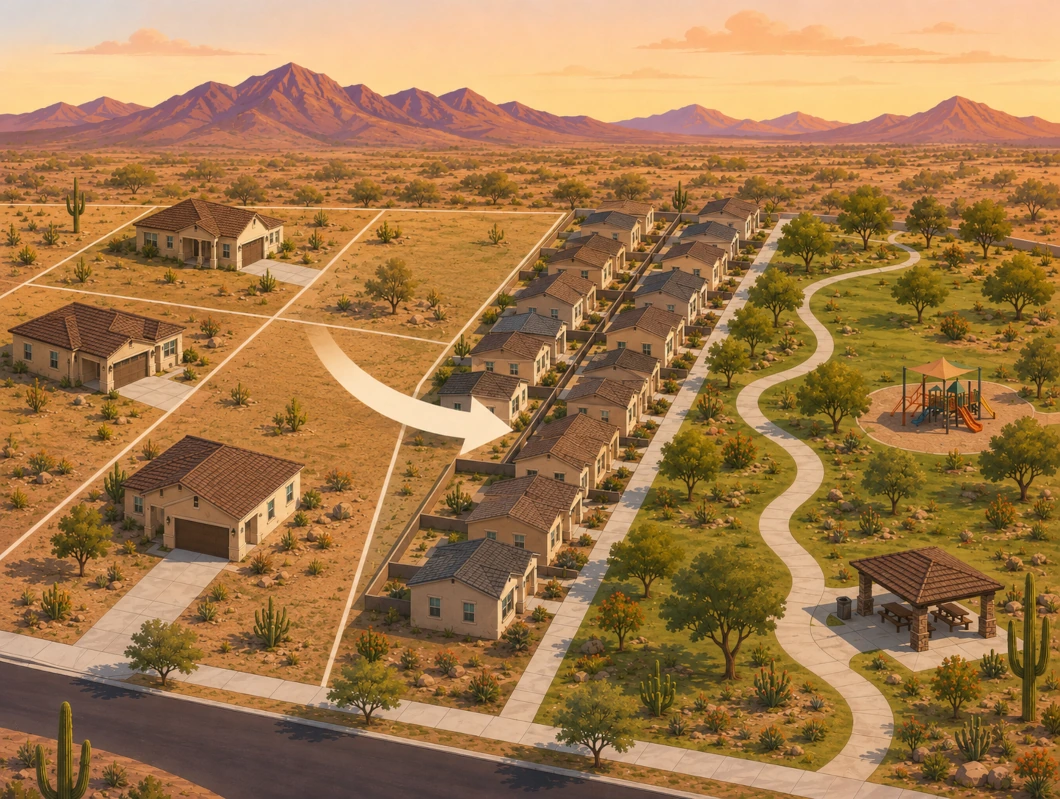
CASA GRANDE, AZ — Smaller home lots already appear in some new Casa Grande neighborhoods. But they’re only built when developers request exceptions to the current rules. On Monday, the City Council reviewed a proposal that would make Casa Grande smaller home lots the new default, replacing the current minimums with new standards. In exchange, developments would have to include more recreational space within their required open areas. They would also have to add pedestrian connections through it.
The June 15 study session ended without a vote. Instead, council members offered feedback to Planning and Development Director Dan Coxworth. He is seeking direction before drafting formal code language.
What the Casa Grande smaller home lots proposal would change
Under the current rules for Planned Area Developments, lots are required to be at least 5,500 square feet and at least 50 feet wide. However, developers can request exceptions, and many have. Staff says updating the baseline would reduce the reliance on those exceptions. The proposal would shift the lot-size requirement to a 4,500-square-foot average and the width requirement to a 45-foot average. The current 50-foot minimum on every lot would be replaced by a 35-foot floor.
Side yard rules would also loosen. Today, builders must leave 10 feet on one side of a house and 5 feet on the other — 15 feet combined. For detached homes, the proposal would require 10 feet of total side yard space, with building separation rules limiting how that’s split between the two sides.
A rule requiring a mix of larger lots would stay in place, but the bar for what counts as “larger” would drop. Today, 25% of lots in each section of a development must be at least 6,500 square feet. Under the proposal, that share stays at 25%, but the threshold would drop to 6,000 square feet.
Open space rules would also change. Today, 50% of a development’s required open space must include recreational features. Under the new rules, that share would rise to 65%.
Why the city is rethinking lot sizes
Coxworth told the council that developers keep asking for exceptions to the current rules. “We’re repeatedly seeing requests, or just even comments by builders of how a project can pencil out, and the need for smaller lot sizes,” he said. “So this is really a reaction to the development community.”
Coxworth also pointed to surrounding communities for context. A staff review of nearby Pinal County jurisdictions found their smaller lot sizes range between 4,000 and 6,000 square feet. Casa Grande currently requires at least 5,500 square feet; the proposal would shift to a 4,500-square-foot average.
Coxworth also pointed to a slowdown in apartment financing. “When it comes to apartments, the funding has gone away. You’re likely not to see any proposals for new apartments in the community,” he said. “The market took care of that issue, and with that market going away, the home builders are just needing a little bit more density.”
Mayor Lisa Navarro Fitzgibbons linked the change to entry-level housing. “I definitely do believe that we need to bring more affordable housing,” she said. However, she also asked staff to show “how this pencils out to the home buyer.” She wants to see the price difference between homes on smaller and larger lots — and whether builders would actually pass on the savings or keep them as profit.
Where the rules apply
The proposal would not raise overall density. Even with smaller lots, developers can’t fit more homes per acre than the General Plan allows — the cap counts homes per acre, not lot size. That cap is 4.5 homes per acre across most of Casa Grande’s residential land.
“They can’t go above that per the general plan, unless they amend the general plan. So you always have that absolute limit there,” Coxworth told the council.
Parking and on-street congestion
Councilmember Sean Dugan said congestion and on-street parking are his biggest worries. “You go into a neighborhood and you just see cars just everywhere, and people don’t use their garages,” he said. He noted that many homeowners use garages for storage instead. “That’s my biggest fear, is getting too congested, too small. And then if the streets aren’t wide enough too, you’re zigzagging in the neighborhood trying to avoid hitting cars.”
In response, Coxworth said staff shares the concern. The proposal would require developments with narrow lots to distribute extra guest parking throughout the neighborhood. That parking would also have to sit within walking distance of the homes it serves. Coxworth also pointed to existing tools the city uses, including street bump-outs and rules that keep front yards from being paved entirely in concrete. He said staff would propose additional recommendations as part of the amendment.
Dugan signaled he would prefer not to change the current rules. “Just, it’s my opinion that we should keep the baseline,” he said.
What ‘average’ could mean for individual lots
Councilmember Bob Huddleston told staff he was uncomfortable with the move from minimums to averages. “One of the things that I did not like is in the proposed PAD, that term of average,” he said. “I mean, we’ve always had minimums, but when you put average, that leaves a lot of room for … fairly good ratios in some parts, but terrible ratios in others.”
Mayor Pro Tem Brent BeDillon raised a similar concern about distribution. He worried developers could pack one corner of a project with very small lots and offset the math with open space elsewhere. “I don’t want it to get to the point where all of a sudden then you’ve got one, half of it is just jam packed at nine, and the other is at one,” he said.
In response, Coxworth raised — as an idea worth exploring — a cap on how many small lots a development could include. “It might be worth considering percentages,” he said, suggesting a limit such as no more than 25% of lots at the 4,500-square-foot size. That cap is not part of the current proposal.
Buffers and design rules for nearby neighborhoods
The proposal would keep existing architectural standards in place. Rules covering floor plans, elevations, color schemes, front entries, roof variation, garage limitations, and patio covers would all carry over.
Additionally, staff has recommended new transition requirements where smaller lots would back up to established single-family neighborhoods. Those could include enhanced landscape buffers, perimeter setbacks, single-story edge lots, open-space buffers, or height limits. Cohesive themes — streetscape design, perimeter walls, landscaping, and open-space maintenance — would also stay in place.
When residents can expect updates
Staff will likely test scenarios with the Planning and Zoning Commission and developers before bringing the question back to council. If members then direct staff to proceed, a draft amendment would go out for public review, followed by a Planning and Zoning Commission recommendation and formal council consideration.