Key Points
- Two Casa Grande residents spoke against the city’s Flock camera program at the January 20 and April 6, 2026 council meetings.
- Both speakers expressed support for law enforcement while raising concerns about surveillance, data security, and accountability.
- Casa Grande unanimously approved a 10-year, $10 million Flock Safe City Initiative in September 2025, adding drones, gunshot detection, and over 220 cameras.
- Apache Junction operates 39 Flock cameras, an Axon-powered drone-as-first-responder program, a real-time crime center built on Axon’s Fusus platform, and DeDrone by Axon counter-drone detection technology.
- Resident Jacob Petrosky said deleting Flock images does not erase what the system has already learned from them.
- Petrosky called for a third-party audit of Flock searches, or for searches to require a warrant.
- Resident Michael Hanrion questioned the system’s security and said Flock holds a perpetual, irrevocable license to all captured data.
- The Institute for Justice (IJ) lost a federal district court ruling in January 2026 over Norfolk, Virginia’s ALPR system. Plaintiffs have appealed to the Fourth Circuit.
- IJ filed a new federal class action lawsuit against San Jose’s 474-camera Flock network today, April 15, 2026.
Concerned residents have stepped forward at two Casa Grande City Council meetings to challenge the city’s expanding Flock Safety camera network, raising questions about warrantless surveillance, data security, and accountability. The comments came during the call to the public at the January 20 and April 6, 2026 council meetings.
Residents Voice Concerns as Flock Cameras Expand Across Pinal County
Flock Safety license plate reader cameras have spread across Pinal County in recent years. Casa Grande’s city council approved the acquisition of 14 cameras in September 2022. At the March 5, 2025 State of the City address, Councilmember Bob Huddleston reported that the city’s 22-camera network had helped identify 67 stolen vehicles and 18 stolen license plates, resulting in 33 arrests. (Pinal Post)
On September 15, 2025, the Casa Grande City Council voted unanimously to approve a 10-year, $10 million contract with Flock Safety for what the city calls its Safe City Initiative. The proposal had been first presented to council at an August 18 study session, where no vote was taken. The program adds more than 220 devices, including 100 additional license plate readers, 100 PTZ video cameras, drones, gunshot detection, and integration with third-party cameras. Police Chief Mark McCrory described it as “probably one of the top two decisions that council had to do” in recent years. Oversight policies for the expanded system are still being developed.
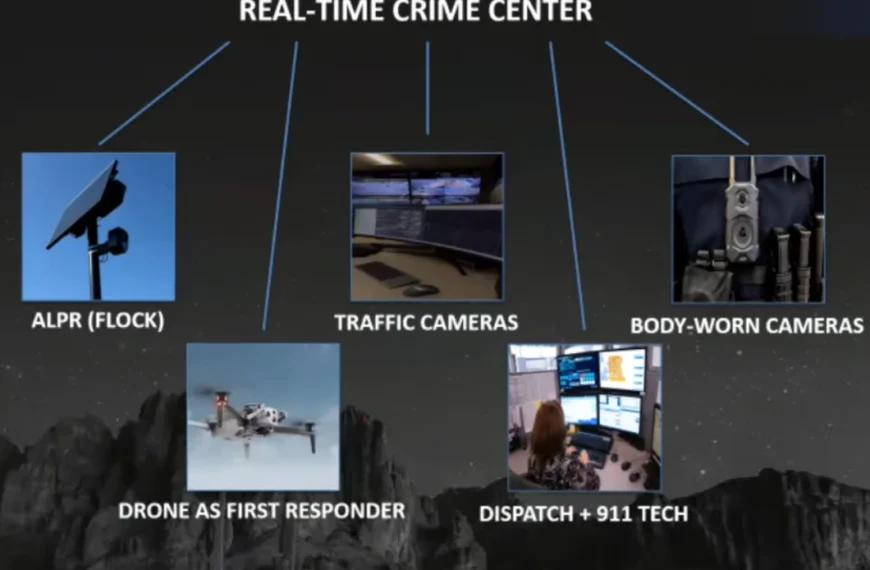
Apache Junction has similarly expanded its program. As of April 2026, that department operates 39 Flock cameras in and around Apache Junction and Gold Canyon, alongside an Axon-powered drone-as-first-responder program, a real-time crime center built on Axon’s Fusus platform, and DeDrone by Axon counter-drone detection technology. In a September 2025 report to the city council, the department said that since the start of 2025, the system had generated over 6,000 alerts and helped identify 224 stolen license plates, 199 stolen vehicles, and 18 missing persons.
Law enforcement agencies in both cities have described Flock as a “force multiplier.” Apache Junction Police Chief Michael Pooley has credited the technology with solving hit-and-run cases, locating a domestic violence suspect armed with a loaded handgun, and recovering stolen vehicles. In February 2026, Casa Grande police used Flock to track a suspect vehicle following a shooting outside the Wonder Bar on West 2nd Street, leading to a Gila River Police Department arrest in the Laveen area.
“I’m Not Anti-Police”: Jacob Petrosky Addresses the Council in January
At the January 20 meeting, resident Jacob Petrosky spoke during the call to the public. He opened by emphasizing his support for law enforcement and public safety.
“I wanna begin by being very clear,” he said. “I’m not anti-technology, I’m not anti-police, I’m not anti-government, or anti-public safety. What I am here to speak about is mass warrantless surveillance and long-term consequences of deploying it without fully understanding how modern machine learning systems actually work.”
Petrosky organized his concerns around several points:
Documented misuse in other jurisdictions
Petrosky said that systems like Flock have already been used in ways residents were not promised. He cited non-violent people being tracked without warrants, insiders using the system to monitor former partners, immigration enforcement beyond original intent, false accusations of crime, and wrongful stops and arrests. He described these as documented outcomes, not hypothetical risks.
Why the 30-day deletion policy may not protect residents
Petrosky said Flock’s 30-day deletion policy does not adequately protect residents. He explained that once an image is captured, machine learning models extract metadata automatically. He said the system infers not just license plates, but also race, age, sex, body type, weight, clothing, passengers, movement patterns, and associations. He stated that deleting the image does not undo what the model has already learned.
Re-identification without names or plates
Petrosky said anonymization does not ensure privacy in 2026. He said AI systems can re-identify people with high accuracy using only behavioral patterns, such as timing and movement, even without names, faces, or license plates.
The effect on everyday residents
“The ability to retroactively search where people have been, who they were near, and how often they travel certain routes without probable cause or warrant fundamentally changes the relationship between residents and their government,” he said.
He added that there is now no practical way for him to leave his home on any paved road in Casa Grande without his movements being recorded, analyzed, and categorized.
A comparison to personal surveillance
Petrosky noted that if he personally followed the mayor around town and took photographs, he would likely face consequences. He said the intent may differ, but the effect on residents does not.
Mayor Lisa Navarro Fitzgibbons thanked Petrosky for his comments. She then offered him the opportunity to speak directly with one of the city’s police officers after the meeting.
Petrosky Returns in April with Specific Accountability Requests
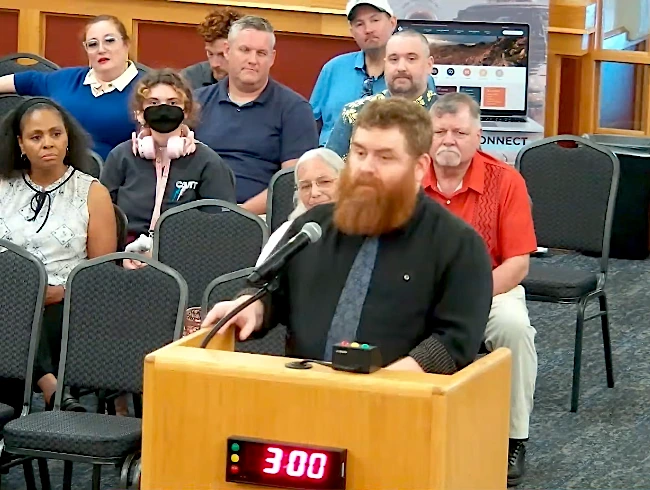
Petrosky returned to the April 6 council meeting and told the council he did not expect them to abandon the Flock program.
“I don’t think that you guys are gonna change your mind about the Flock Safety Program, and I’m okay with that,” he said. “I’m just asking that you guys do something about auditing it. Hire a third party, maybe put it behind a warrant like other public records requests, like phone data. Do something.”
He said his own research found that 70% of searches currently conducted through the system have no documented reason on record. “They’re just blank,” he said.
He asked the council to consider either placing Flock searches behind a warrant requirement or commissioning an independent audit. “Let’s do something to third party audit this data, to make sure that what the police say that they’re doing is actually happening,” he said. “Accountability is a good thing.”
Second Resident Raises Security and Data Storage and Licensing Questions
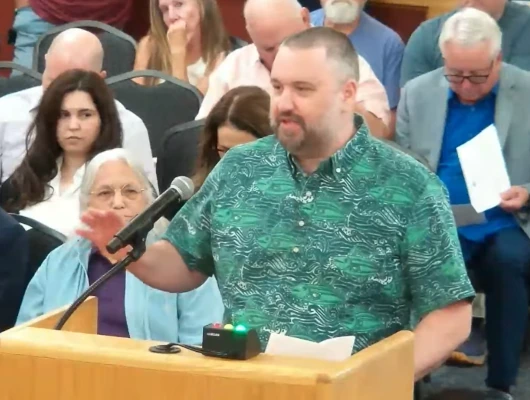
At the April 6 meeting, Michael Hanrion also addressed the council. He opened by expressing appreciation for law enforcement. He said local police had shared that Flock helped apprehend a murder suspect in Tucson by tracking vehicle license plates, and that this, in his view, led to the system’s implementation in Casa Grande.
However, Hanrion said he has “some concerns about the Flock platform and the organization behind it.” He began outlining three issues:
The system as a workaround to warrant requirements
Hanrion said the system “effectively works as a workaround to putting a GPS tracker on your vehicle without the need of a warrant.”
Security vulnerabilities
Hanrion said that while Flock claims only authorized personnel can access its cameras, he had personally observed behavior that raised concerns about potential vulnerabilities. He said he personally knows of a number of devices he can directly interact with using his phone. He referenced Flock’s position that the system has never been hacked, then said: “It doesn’t need to get hacked if it’s wide open already.” He said the system is “clearly not as secure as is claimed.”
Data storage and Flock’s perpetual license
Hanrion raised concerns about where data is stored. He noted Flock’s terms and conditions specify that data goes to Amazon Cloud infrastructure. He said that as of 2019, major organizations had been breached through that platform. He then pointed to a clause in Flock’s terms and conditions, updated as recently as February 16, 2026, stating that Flock holds a “perpetual, irrevocable, worldwide license” to data gathered by its cameras. He said perpetual means forever, and irrevocable means the rights cannot be withdrawn. He said the license to that data may end for the customer in 30 days, but for Flock, the data is retained forever. He said Flock can claim it does not sell customer data.
Hanrion said he ran out of time before finishing his remarks and indicated he would return to address the council again.
Constitutional Questions Extend Beyond Pinal County
The Institute for Justice (IJ) has been challenging the constitutionality of Flock camera networks in federal court. In October 2024, IJ filed a Fourth Amendment lawsuit against Norfolk, Virginia’s 172-camera Flock network. Attorney Robert Frommer described the system as collecting data on the entire driving population without warrants or suspicion. Attorney Michael Soyfer noted the nationwide Flock database handles approximately one billion plate reads per month.
On January 27, 2026, the U.S. District Court for the Eastern District of Virginia ruled against the plaintiffs, granting summary judgment in favor of the City of Norfolk. The court found that Norfolk’s ALPR system did not capture enough data to reveal the whole of individuals’ movements, or to permit deductions from the whole of their movements, and therefore did not constitute an unconstitutional search under the Fourth Amendment. The plaintiffs appealed, and the case was docketed at the U.S. Court of Appeals for the Fourth Circuit on February 26, 2026. As of this article’s publication, the opening brief was due April 13, 2026, per the Fourth Circuit’s briefing order.
Today, April 15, 2026, IJ filed a separate federal class action lawsuit against the city of San Jose, California, over its use of 474 ALPR cameras. IJ Attorney Soyfer said the city allows thousands of government employees across California to access its data without a warrant, with searches conducted thousands of times daily and almost no oversight.
Both Casa Grande and Apache Junction have established written policies for their Flock systems. Casa Grande’s September 2025 contract maintains a 30-day data retention limit, after which data is automatically deleted unless saved as evidence. At the September 15 council meeting, Chief McCrory stated that officers cannot conduct searches without entering a reason, and that the audit trail is kept permanently. The city’s 2022 resolution additionally prohibits facial recognition. Oversight policies for the expanded system are still being developed. Apache Junction’s transparency portal prohibits use for immigration enforcement, traffic enforcement, harassment or intimidation, usage based solely on a protected class, and personal use. The portal also states that all system access requires a valid reason and is stored indefinitely.
Council Could Not Respond to Public Comments at the April 6 Meeting
As of the April 6 meeting, Casa Grande’s city council had not publicly responded to the requests raised by Petrosky or Hanrion. Council members are not permitted by law to discuss items raised during public comment that are not listed on the agenda. Hanrion stated he plans to return to continue his remarks.