Key Points
- Casa Grande City Council voted 7-0 on May 4 to approve the agreement.
- Police will get limited access to existing elementary school cameras during emergencies.
- The cameras belong to the school district, not the police.
- A Flock Safety gateway will connect the school’s cameras to the police system.
- Costs will be absorbed within the city’s Safe City Project.
- Either party can end the agreement immediately in writing.
- Residents raised concerns about Flock employee access to camera feeds, vague contract definitions of “authorized users,” data security risks, and the potential for AI to build dossiers on children that could be used to profile them later in life.
- Jacob Petrosky launched deflockcg.com to collect signatures opposing the program.
CASA GRANDE, AZ — The Casa Grande City Council voted unanimously on May 4 to approve an intergovernmental agreement (IGA) giving the Casa Grande Police Department limited access to the Casa Grande Elementary School District’s campus monitoring system. Officers will be able to view existing district-owned cameras during emergencies, active calls for service, or community incidents near school property.
The cameras are already installed and were set up by the school district. Police are not adding new cameras inside elementary campuses. The agreement formalizes when and how officers can tap into footage the district already monitors.
What the agreement does
According to the resolution authorizing it, the agreement “establishes terms for the Police Department to access the District’s Campus Monitoring Systems during emergencies, active calls for service, or community incidents near District property.”
The IGA itself states that an “‘Authorized User’ is a Police Department employee who is authorized by Police Department to access the Campus Monitoring System.” It also provides that “access by an authorized user to any Campus Monitoring System shall be utilized for public safety purposes only.”
The agreement requires the Police Department to “promptly report in writing to the District if it becomes aware of any disclosure of the data that is not permitted by this Agreement or by law.” According to staff, any costs related to secure system maintenance, data storage, or access infrastructure will be absorbed within the city’s Safe City Project.
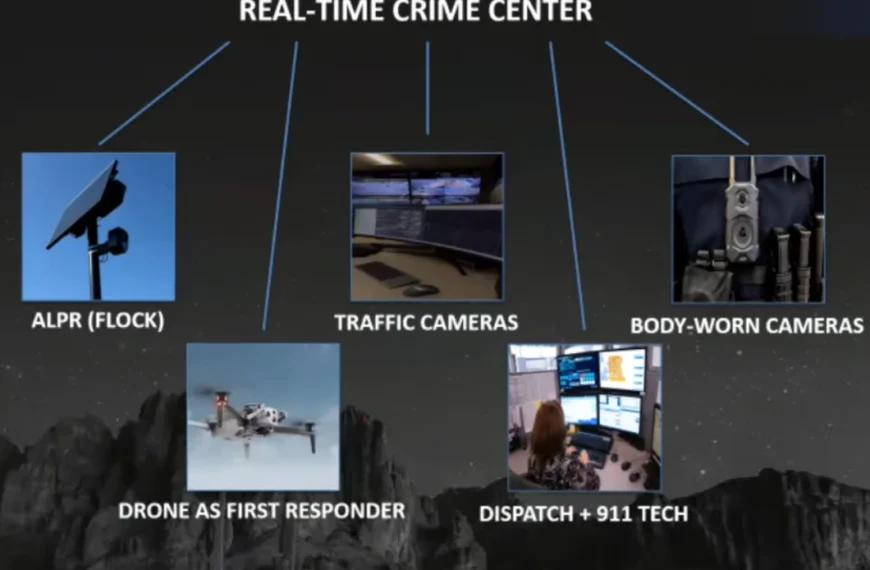
The IGA expands the city’s existing surveillance footprint. Casa Grande first approved 14 Flock license plate reader cameras in September 2022. In September 2025, the council unanimously approved a 10-year, $10 million contract with Flock Safety as part of the Safe City Initiative, adding more than 220 devices including 100 additional license plate readers, 100 pan-tilt-zoom cameras, drones, gunshot detection, and integration with third-party cameras.
Why the chief recommended approval
Police Chief Mark McCrory framed the agreement as a tool for faster response. “We’re gonna be judged on the rapid response to neutralize the threat, and we’re gonna be judged on how quick we can get medical attention to those in need,” he said. “That is gonna be the benchmark for any police department, any city, any school system.”
He said real-time camera access changes how officers move once they arrive, giving them a live view of where a threat or victim is at any moment instead of relying on outdated information from the original call. Without that view, he said, responders can be looking in the wrong place by the time they enter the building. “If a call comes in, somebody’s in the library. By the time we get there, that person’s in the cafeteria,” McCrory said. “So this allows us to make a rapid response to where the individual or the threat might be, where the injured are.”
McCrory said the elementary school IGA is “the exact same thing we currently have in place with the high schools right now.” That existing arrangement covers “over 200 and some other cameras,” he said, and to his knowledge those cameras have not yet been used by police.
Who has access and who does not
McCrory clarified that the cameras belong to the school, not the police. “We don’t have FLOCK cameras in the high school. Or in the schools,” he said, agreeing with the mayor that “it’s their cameras.” Pressed by Councilmember Matt Herman, McCrory said the cameras “were set up by the elementary school” and police did not move them. “All we did was ask for access to them when we need them,” he said.
Councilmember Rebecca Romo, a school principal, confirmed the district monitors the cameras. “As a principal, I have access. Assistant principals have an access to it,” she said.
McCrory said footage will not be pulled outside emergencies. “We are not viewing the elementary schools’ cameras unless there is a call for service that warrants us getting there,” he said.
Concerns about third-party access
Much of the chief’s presentation addressed Flock Safety, the third-party vendor that provides the gateway connecting the school’s cameras to the police department’s system. A gateway is the hardware and software that lets two otherwise incompatible camera networks communicate, pulling video feeds from one system into another.
McCrory cited a Dunwoody, Georgia, incident as the kind of arrangement Casa Grande will not adopt. In Dunwoody, public records showed Flock sales employees had accessed local cameras, including ones at a children’s gymnastics room, a playground, a school, and a Jewish community center pool, to demonstrate the technology to other police departments.
“There was an incident in Dunwoody, Georgia, where a Flock employee who was a retired police officer was viewing some video from one of the schools. Wasn’t a sworn officer,” McCrory said. “The thing that is not brought up all the time is they were granted that authority by the police department. We don’t plan on doing that.”
He explained that Flock has an “operator account” used during installation. “That operator account gives them the permission to view while they’re setting up. Some jurisdictions have the view where they can troubleshoot, so they keep that account open,” he said. He said the police department has the ability to change the password after setup. “Anytime there is an incident where we need to have Flock employees assist us in troubleshooting one of our gateways, they have to go directly to our IT department and work hand-in-hand with our IT department. They won’t have outside access.”
McCrory pushed back on social media claims he said misrepresented his position. “I read that the police chief has confirmed we will use Flock Safe City to upload children, daily school activity to Flock. I never said that,” he said. “I said we use Flock gateways, and we use Flock.”
He emphasized the audit trail. “There are audit trails to this,” he said, noting the Dunwoody case “came to light” because of one. The department’s policy requires “a case number, a reason for it, and the officer’s name, anytime we make a search.”
Council comments and reasons for support
Councilmember Bob Huddleston, a retired Casa Grande police chief, drew on his earlier career in supporting the agreement. “About 30 years ago, I was somewhat in charge of school resource officers. And we had citizens that didn’t like that idea. Some of them called it a police state, and thought we were grooming children to be part of that police state,” he said. “That contact and that availability, the information is like you said, Chief, it’s critical, it’s timely, it’s just a necessity in today’s world. I think this is a good move. As a parent, I feel more confident with every step you take in this direction.”
Councilmember Anthony Edwards tied his vote to feedback from town halls, where he said safety and health came up as a top concern from residents. He recounted telling Huddleston, “Councilman Bob, if my children are there, I want this in place.” He said residents told the council “this is part of that safety. And we need this in place. It’s gonna help us in the long run.” Edwards said the council voted yes because residents said yes.
Mayor Pro-Tem Brent BeDillon pointed to incidents elsewhere where delayed response cost lives. “If you look at some of the situations that have happened around the country, Texas, others, where the first responders were delayed, emergency medical personnel were halted outside while the police tried to clear the situation. Police couldn’t find the threat because they didn’t know where they were in the building, resulting in more deaths and injuries inside the building,” he said. “I think it’s critical to the safety of our children that the police know where the threat is and that the emergency medical personnel can respond as quickly as possible.”
Romo added a principal’s perspective. “Seconds matter. I know it doesn’t seem like a lot of time, but in situations like that, seconds matter,” she said. “Having access to that, limited access to that, dependent on need, is important.”
Herman said he weighed the concerns raised but came down on the side of approval. “I think the good outweighs the bad, from hearing from the school districts and the police, just to help the safety of the children,” he said. He also reported positive feedback from a city open house. “Last Monday we had our open house at the fire station, and I was with the Flock booth. … I don’t remember anyone that was negative against. Everyone was very happy with the Flock program that came to the event that night, and thought that was a great thing for our city to help keep them safe.”
Councilmember Sean Dugan voted in favor without making a separate statement.
Public comments raised privacy and data concerns
Residents have raised concerns about the city’s Flock program at prior council meetings, including questions about warrantless surveillance, data security, the system’s 30-day deletion policy, what artificial intelligence can learn about people from captured images, the lack of independent oversight, and Flock’s perpetual license to data gathered by its cameras.
Resident Michael Packard questioned whether Casa Grande needs the same camera footprint as a much larger city. “Casa Grande has as many Flock cameras as Tempe, or if it’s not exact, it’s pretty darn close, which is really kinda concerning when you look at the crime rates,” he said. “Tempe is about 52% higher than average. Their crime rate is about 3,364 per 100,000 people. Down here, we have 8.5% lower than average in Arizona, and our crime rate is only 410 per 100,000 people. So, I don’t understand, first off, why do we need all of this security? … Why don’t we let Tempe have it?”
Michael Hanrion said his concern is the vendor more than the police. “It’s the third-party company or companies that are in charge of that surveillance that I have a problem with,” he said. He cited a report from “just last month” that “FOIA documents in Georgia revealed that executives of Flock personnel were logging into camera feeds located inside daycares, gymnastics studios, workout facilities, specifically areas where children were present.”
Hanrion also referenced an Oshkosh, Wisconsin, dispute in which he said a police chief expressed regret over a Flock contract and was publicly criticized by the company. He distinguished the company from local officials. “I had conversations with our police chief and I think he’s trying to do the right thing by our community. And I don’t think he’s trying to be misleading at all,” he said. “I feel like Flock has been disingenuous to us.” He noted pending Arizona legislation, including House Bill 2917 and Senate Bill 1111, that would restrict or require warrants for such systems.
Jacob Petrosky, who launched deflockcg.com to collect signatures opposing the program, said he is not asking the city to remove the cameras but to tighten the contracts. He said the agreement is too vague, particularly the definition of “authorized users,” which he called overly broad. He urged the council to amend the contract to clearly define authorized users and to specify that passwords can be reset after each use so Flock cannot access the cameras without the city’s knowledge.
Petrosky’s central warning concerned children’s data. “With this kind of data, you could build a dossier on all these kids before they even turn 18. I could look at all this data and set up an AI system that would classify them on race, their gender, their income, everything. Whether they’re late to class,” he said. “I built a website, deflockcg.com, in one day. I’m one person.” He added: “These are children. Don’t screw ’em. They don’t wanna get to 18 and already have a massive dossier on all their habits, what they eat, where they go, who they hang out with.” Petrosky returned later during general public comments to reiterate his contract concerns and say he is collecting signatures across the city.
Tyler Stein, a policy analyst with Rural Arizona Engagement (RAZE), asked the council to deny the agreement. He said connecting district cameras to the Flock system “could also be used to take pictures of drivers and their passengers, which could include children” and warned that hackers or insiders could share that data.
Pablo Correa, a co-founder of RAZE who spoke as a parent of children in the schools, disputed the chief’s account that the school board had approved the IGA, saying it was a decision made by Superintendent Adam Leckie, not the board. He argued that police should be “forced to do good police work and good well-funded police work, not to just offset it or shop it out to a for-profit corporation like Flock.”
McCrory said he had been told the “MOU was signed and approved at the March school board meeting,” but acknowledged he was not at that meeting himself. A school board member in the audience confirmed he had been present for the approval.
Richard Wilkie, the Legislative Representative on the Casa Grande Union High School District governing board, spoke in favor. “What the cameras allow school districts to do is to provide on-site, timely situational awareness to our officers so they can respond appropriate and as quickly as possible,” he said. “It’s all about the safety of our kids.”
Resident Peter Encinas, who described himself as a former criminal turned preacher, also backed the program. “I completely 100% back up the Flock camera,” he said. “If I’m not doing anything wrong, what I gotta worry about?”
Mayor responds on policy access and transparency
Mayor Lisa Navarro Fitzgibbons asked the chief how residents can access the Flock policy. “Chief, is there the actual policy, the Flock policy, is that online? Can people look at that? How do people have access to that?” she asked.
“I don’t believe that it’s online,” McCrory said. “But if somebody wants to get it, all they have to do is ask for it. I don’t think we put it online specifically.”
Fitzgibbons returned to that point before the vote. “If you wanna see it, ask. Ask for it, and we can get you that policy,” she said.
She also addressed the theme of distrust. “It does seem, Chief, that the policy seems to come up a lot, and there’s distrust. And I know who’s behind the monitors, ’cause I’ve been there. I’ve seen the Real [Time] Crime Center, and I’ve seen how it works,” Fitzgibbons said. “I wish all of you can go and see what is really happening there. As far as the policy, Chief, I don’t know how we can get this out to the public so they can take a look at it, that we can make people a little bit more confident in our personnel, our policy, and the auditing process.”
She said the city has tried to invite scrutiny. “We have been open and transparent. We have invited the public to come and learn more about it. We have surveys on what do you feel is important in the community. And public safety is the number one priority in this community.”
McCrory directed residents to the city’s transparency page, which he said shows “how many times it’s been used, how many times it’s been accessed.” It includes the Transparency Portal and a Flight Dashboard showing “every place that our drone has responded to a call.” Both are linked from the Safe City Initiative page.
Vote and agreement terms
The council approved the agreement by unanimous roll call vote, with Romo, Dugan, Edwards, Huddleston, Herman, BeDillon, and Fitzgibbons all voting yes.
Per the IGA, either the district or the police department may immediately end the arrangement in writing at any time.