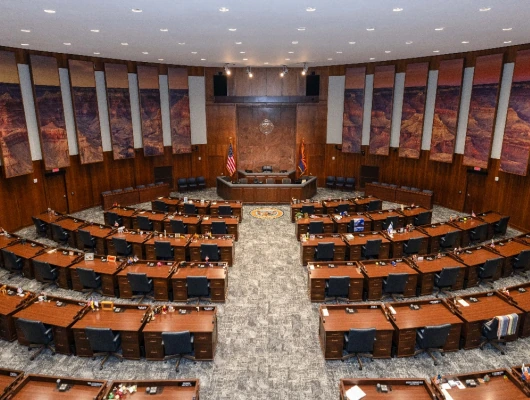
FLORENCE, AZ — The Town of Florence has taken formal positions on dozens of state bills in March 2026, opposing several measures that would reduce local revenue, limit local authority over land use and permitting, and restrict how the town manages its budget and infrastructure.
Revenue and Funding Threats to Florence Residents
Residents could see shifts in town funding under several bills Florence opposes. HB2290 would change transaction privilege tax sourcing rules in a way that could redirect locally generated sales tax revenues away from cities and towns. Florence has taken a position against the bill, citing revenue instability and harm to municipal fiscal planning.
Additionally, HB2946 would place tight limits on local authority to calculate, collect, adjust, and credit development impact fees. As a result, Florence warns that existing residents may end up shouldering more of the cost for roads, water, sewer, parks, and public safety infrastructure—expenses that growth would otherwise help fund.
Meanwhile, HB4030 / HCR2052 would bar cities and counties from raising most fees, transaction privilege taxes, or utility rates from July 1, 2026 through June 30, 2030. Florence opposes this four-year moratorium, noting it would significantly restrict the town’s ability to adjust revenues to fund services and infrastructure.
HB2115 would cap administrative spending for state agencies and all political subdivisions at 8% of public monies received. Florence opposes this cap, stating it restricts local budgeting flexibility.
Florence also opposes HB2839 and HCR2018, both of which would prohibit cities and towns from taxing SNAP/WIC-eligible food sales.
Loss of Local Control Over Land Use and Development
Several bills would limit Florence’s authority over land use, zoning, and development standards. HB2588 would preempt cities and towns from imposing most architectural and aesthetic design standards on HOAs or single-family residential subdivisions outside designated historic districts. Florence opposes this bill, saying it significantly limits local subdivision and design oversight.
Similarly, SB1431 would prohibit cities and towns from requiring certain subdivision features, design standards, or architectural elements. Florence opposes the measure, stating it restricts local land-use authority and the ability to maintain community character and long-term planning standards.
HB2795 would limit a city or town’s ability to regulate or deny approval of small modular reactor facilities, preempting local zoning authority. Florence opposes the bill, noting it weakens local land-use control and community compatibility standards.
SB1293 would narrow local authority to use Government Property Lease Excise Tax tools for economic development. Florence opposes this restriction, stating it limits the town’s flexibility to incentivize redevelopment and compete for private investment.
Permitting, Inspections, and Enforcement Concerns
Florence opposes several bills that would shift permitting and enforcement authority away from local government. SB1241 would broaden access to private third-party permitting providers in ways that could undermine municipal oversight of inspections, plan review, and code enforcement. Florence cites potential liability, coordination, and public safety concerns.
SB1566 would prohibit cities and counties from “maliciously” delaying permit decisions for single-family residential construction. It would also allow the Attorney General to investigate complaints and impose $5,000 penalties. Florence opposes the bill, noting it creates new state enforcement authority over local permitting processes and increases legal risk.
SB1787 would require cities and counties to provide a detailed individualized determination for development exactions within 60 days. It would allow applicants to appeal to the Attorney General or courts. Florence opposes this measure, citing increased administrative burdens, expanded state oversight, and greater litigation risk.
Florence also opposes SB1054, which would grant any Arizona resident or business standing to sue a city, town, or county over ordinances adopted with emergency clauses, increasing litigation exposure and limiting local agility in emergencies.
Business Regulations and Public Safety Tools
Florence opposes HB2118, which would eliminate local licensing authority for mobile food vendors, leaving only state health-based licensing in place.
Additionally, Florence opposes HB2460, which would prohibit cities and counties from penalizing businesses when their movable property—such as shopping carts—is stolen or abandoned off-site. The bill would also block local cost-recovery or compliance requirements and open the door for businesses or the Attorney General to seek court orders against local enforcement. Florence states this undermines local nuisance and public safety tools.
Bills Florence Supports
Florence supports several bills it says would strengthen local tools or deliver direct community benefits.
On transportation, Florence supports HB2304, which appropriates approximately $7.84 million for Hunt Highway improvements — $2,000,000 for design review between Felix Road and SR-79 and $5,837,300 for upgrades at the Hunt Highway and Attaway Road intersection. Florence also supports HB2106, which would redirect undistributed county transportation excise tax revenues by April 10, 2026, to ADOT for projects within Pinal County.
On short-term rentals, Florence supports HB2429 and HB2430. Together, these bills would expand municipal authority over vacation and short-term rentals to include occupancy limits, sex offender background checks for booking guests, permit requirements, insurance standards, neighbor notification, and enforcement authority to suspend permits for serious building or safety violations — while still prohibiting outright bans.
On water and property, Florence supports HB2026, which would allow ADWR to verify a subdivision’s water supply based on its designated source — even when that water travels through shared pipes alongside water from other sources. The town notes this reflects how most municipal water systems actually work. Florence also supports HB2716, which would authorize towns to require registration, inspections, insurance, maintenance standards, and cost-recovery fees for buildings vacant or abandoned for more than 150 days.
On budget flexibility, Florence supports SB1163 and HB4130, both of which would allow the town to amend its budget during the fiscal year to spend revenues that were not included when the budget was originally adopted — provided no new or increased taxes or fees are involved.
Florence also supports SB1111, which sets statewide rules for law enforcement use of automated license plate readers, including data access limits, warrant requirements after 48 hours, and criminal penalties for misuse. SB1167 would further allow towns to satisfy certain public notice requirements by posting on their official website, reducing publication costs while maintaining public access.
Florence’s Position as the 2026 Session Continues
Florence’s legislative position document was last updated in March 2026. Several bills were newly added that month, including expanded short-term rental oversight (HB2429), a streamlined annexation process (HB2793), a four-year fee and rate moratorium (HB4030/HCR2052), improvement district petition requirements (HB4064), mid-year budget amendment authority (HB4130), candidate committee closure procedures (SB1029), and new state penalties for permit delays (SB1566) and development exactions (SB1787). Residents can monitor the progress of these bills through the Arizona Legislature and expect the town to continue tracking and responding to measures that affect local services, revenue, and governance authority.