Key Points
- Florence town officials discussed annexation strategy at a March 30 work session. No vote was taken.
- Annexation can only apply to unincorporated territory. The town’s planning area includes land near San Tan Valley and Coolidge.
- Both the town and property owners can initiate annexation. A majority of property owners must consent before any annexation proceeds.
- Residents in annexed areas may gain access to town services such as police and fire, but could also see higher tax rates.
- The town is drafting an ordinance to formally adopt its annexation policy — the standards and guidelines it will use when evaluating future annexation requests. It is expected to come before council in mid to late April.
FLORENCE, AZ — Florence town officials discussed annexation strategy at a March 30 work session. Residents living near Florence — particularly those in unincorporated Pinal County and areas bordering San Tan Valley and Coolidge — could be directly affected. Council gave general direction to staff to begin identifying annexation opportunities.
No vote was taken. The item was a presentation and discussion only.
What Annexation Could Mean for Residents
Residents who are annexed into Florence may gain access to town services. These include police and fire protection.
However, annexation also brings trade-offs. Community Development Director A.J. Monroe noted that annexed areas would see an increase in tax rates in certain areas. He added that the town may also look at parks, open space, and utilities as part of annexation planning. Monroe acknowledged residents’ concerns. “They have a lifestyle that they’ve become used to,” he said, “and they want to make sure that coming into the corporate limits of the community, they don’t see any negative impacts on their lives, whether that might be ranching, or whatever it is. We know that they have some expectations because that’s what they bought into.”
Some Residents Unaware They Are Outside Town Limits
Councilmember Jose Maldonado said residents living in unincorporated areas near Florence often believe they are within the town’s incorporated limits. “They thought, ‘Oh, I’m in Florence. I’m in Florence.’ No, you’re not in Florence. You’re in Florence, but you’re not Town of Florence,” Maldonado said, referring to constituents he had spoken with.
He described a practical test he gave constituents: if a fire occurred at their property and Rural Metro Fire responded, they are not within the town’s incorporated limits.
The town itself can also initiate annexation — it does not require residents to start the process. However, a majority of property owners in the affected area must still consent before any annexation can proceed.
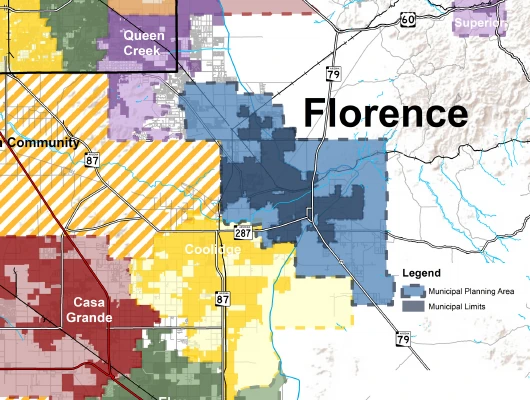
Florence Municipal Boundary and Planning Area
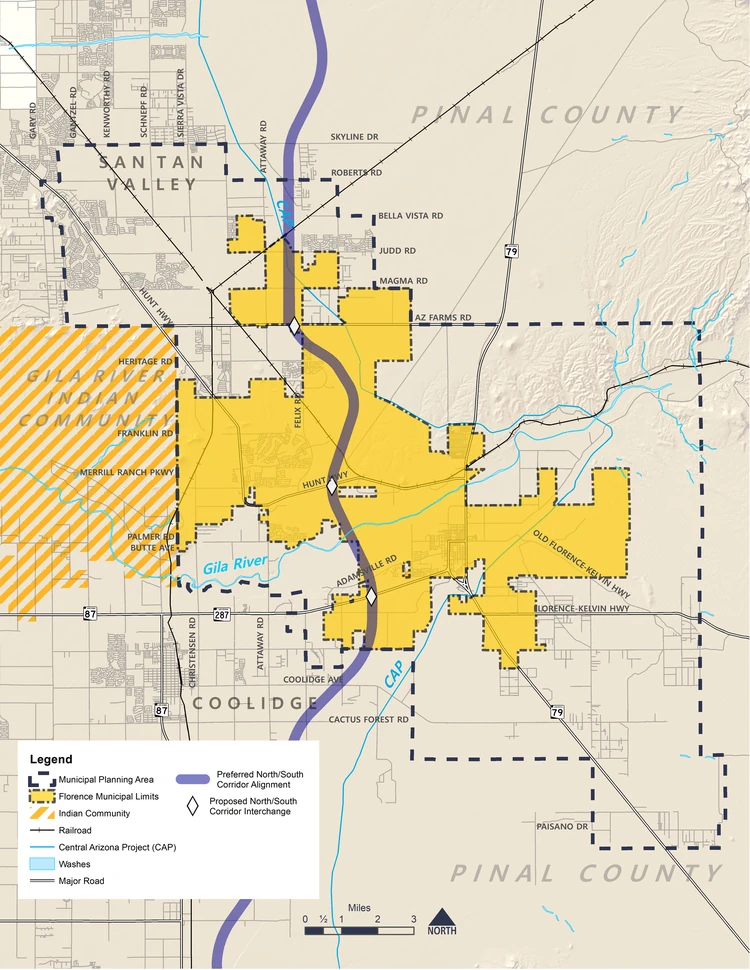
Florence’s current municipal boundary is shown in yellow. A black dashed line outlines the broader Municipal Planning Area — the zone where the town has long-range planning interest and has considered future annexation.
Monroe described the map during his presentation. “You’ll notice that even a number of years ago, the community had identified San Tan Valley as an area,” he said. “You also see that we considered how we interface with Coolidge, to our south and west.”
What Triggers an Annexation — and Who Must Approve It
Arizona state law sets clear requirements for any annexation to move forward. The land must border Florence’s existing boundary. Property owners in the affected area must then sign a petition showing majority support, and the town council must vote to approve.
Town Attorney Robert Wingo said that before the town commits resources to a town-initiated annexation, informal discussions or surveying of property owners must occur first. “An annexation takes time and money when it’s initiated by the town,” he said. “There needs to be some due diligence performed to gauge whether all of those property owners, or at least a majority of those property owners, have an appetite to come into the town.”
The annexation process generally takes between four and nine months to complete, though timelines can vary based on petition collection, public hearings, and council approval schedules.
Monroe outlined two key limitations: annexed areas cannot create isolated “county islands,” and zoning applied at annexation cannot immediately exceed county densities.
Under the draft policy, the town will evaluate any annexation proposal against criteria including infrastructure capacity, fiscal impact, water resources, and alignment with the General Plan before bringing it to council.
The Animal Grandfathering Issue That Derailed a Prior Attempt
Councilmember Nicole Buccellato raised a concern rooted in Florence’s own annexation history. A prior effort to annex Crestfield Manor and Wild Horse Estates failed in part over the issue of animals.
“When they were trying to annex Crestfield and Wild Horse Estates, the issue was the grandfathering of the animals,” Buccellato said. Residents were told they would have to give up animals they had purchased their properties specifically to keep. “It’s called Wild Horse Estates. And they were being told they only could have personal animals.”
She described how the news spread quickly through the community. “That kind of spread like wildfire, because you shouldn’t have to give up something that you purchased that acreage for. I think that’s a big reason why it didn’t possibly go through the first time.”
Mayor Keith Eaton responded directly. He said the current draft policy addresses that issue. He also indicated the town could bring annexed areas in “as is” — meaning with zoning that matches the county’s existing designation for that land. Town Attorney Robert Wingo added that for previously developed properties, zoning applied at annexation is comparable in nature to existing county zoning. For undeveloped property, pre-annexation development agreements are a common tool.
Monroe agreed that matching zoning would be a priority. “Those folks bought into something,” he said. “I don’t know why else they would want that — that’s why they moved there.”
Councilmember Tony Bencina echoed the concern. “I’ve heard that before — that Wildhorse doesn’t want to come in if it’s going to mean we’re going to tell them they got to change the way they live. That would be important to make sure we keep what they have.”
Councilmember Arthur Neal also weighed in. “There’s no reason in this world for them to be out there for that long as they have been, wanting to be annexed, and then, ‘Oh, no, you can’t have your animals,'” Neal said.
Annexation Seen as Tool for Population Growth and State Revenue
Vice Mayor Cathy Adam pointed to new apartment construction she observed towards Casa Grande and in Queen Creek. Arizona distributes state-shared revenue to municipalities based in part on population. Adam noted that Florence stands to lose ground in that funding as neighboring areas grow. “You hear Lisa talk all the time about we’re losing ground because we don’t have population when you’re talking shared revenue,” she said. “So this is one way of instantly growing our population. It’s very important to consider.”
Mayor Eaton also identified small areas south of town that residents and even the town believe are already within Florence’s limits. “There’s a couple islands south of town, and some stuff that could be brought in that people think they’re already in,” he said. “It looks like some clean-up, trying to kind of square some up.”
Annexation Policy Ordinance and Timeline for Residents
Council directed the clerk’s office to draft a formal ordinance based on the annexation policy for a future council vote. The annexation policy ordinance could be placed on a mid to late April council agenda for formal consideration.
In parallel, Mayor Eaton indicated that staff will begin gauging community interest in potential annexation areas. He suggested open houses and informational meetings as a first step. “Just to try to get some kind of appetite — is there even an appetite out there for that in those areas?” he said.