Key Points
- Casa Grande’s Planning and Zoning Commission unanimously approved a permit for the Samba Energy Center battery energy storage facility on April 2, 2026.
- The 36-acre facility will deliver up to 650 megawatts of electrical output to a proposed APS substation north of the site.
- Kirk McCarville, a local land broker, told the commission the surrounding industrial park cannot currently support projects requiring more than 10 megawatts of power, limiting its ability to attract large employers.
- Construction is estimated at $400 million to $660 million, with a projected start date of March 2028.
- The project is projected to generate $8.6 million to $14 million in tax revenue to the city over its lifetime.
- The facility will require no water, sewer, or fuel connections.
- The Casa Grande Fire Department has met with the applicant and will receive additional emergency response training from the applicant’s third-party consultant.
- The approval includes conditions requiring the applicant to submit an Emergency Response Plan and a Hazardous Materials and Spill Management Plan, binding on all future property owners.
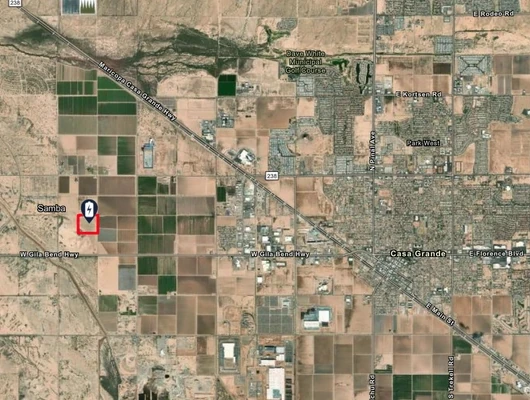
CASA GRANDE, AZ — Casa Grande’s Planning and Zoning Commission unanimously approved a Conditional Use Permit for a battery energy storage system (BESS) on April 2, 2026. The project, known as the Samba Energy Center, is being developed by Mission Clean Energy, a utility-scale renewable energy and storage developer based in San Francisco. It will occupy approximately 36 acres in the General Industrial zone northeast of the Gila Bend Highway and Bianco Road intersection.
Project Description and Capacity
Applicant representative Jon Gillespie of the Rose Law Group told the commission: “The BESS concept is to provide grid stability. It stores energy during the day and is able to deploy that at night to stabilize the grid and support APS operations.”
The project will have a total electrical output of up to 650 megawatts alternating current (AC) at the point of interconnection. It will connect to a proposed Arizona Public Service (APS) 230 kV substation immediately north of the site via proposed transmission infrastructure and utility easements. Gillespie noted that the adjacent location means “no new transmission lines to connect that power directly into it, spanning across other properties,” though the project narrative describes proposed transmission infrastructure and easements connecting the two facilities.
Routine site visits from a maintenance crew of two to four people are expected to total approximately four trips per week. According to the applicant’s project narrative, the project will not require water, sewer, or fuel connections during operation.
Location, Surroundings, and General Plan Fit
The 36-acre site sits north of Gila Bend Highway, east of North Bianco Road, and south of West Clayton Road. It is surrounded on the south, east, and west by undeveloped industrial-zoned land. Urban Ranch-zoned land owned by APS borders the site to the north, designated for the proposed Bianco substation.
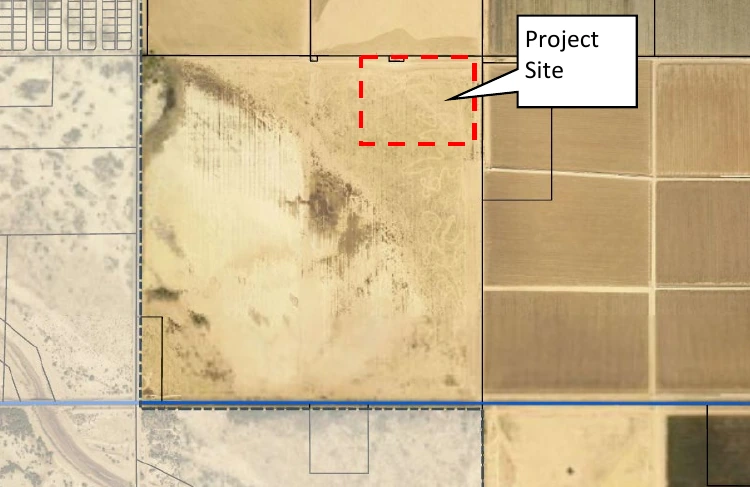
The site is zoned General Industrial (I-2). That zoning carries conditions requiring architectural design standards and restricting certain land uses on properties within 600 feet of Gila Bend Highway. Sarnowski told the commission the proposed site sits approximately 1,759 feet from the highway, placing it outside the area where those conditions apply.
The proposed site is within the Manufacturing/Industry General Plan Land Use category.
Supporting Infrastructure Planned Adjacent to the Site
Kirk McCarville, a Casa Grande-based land broker with Land Advisors Corporation, addressed the commission during public comments. He said 80 acres adjacent to the Samba site were sold to APS for a switching yard. That yard, he said, will include 500 kV, 230 kV, and 69 kV substations to build out the area’s energy infrastructure. McCarville added that it will be years before that infrastructure comes fully online.
McCarville also told the commission that the broader 1,500-acre advanced technology industrial park surrounding the project already hosts five industrial tenants — including Chang Chun, Kohler, Green Bay Packaging, and NRS. A supplier to Kohler is also about to break ground, he said. The park has sold approximately 460 acres. He said the park currently has about a thousand acres remaining, but attracting large industrial employers has become difficult because power availability above 10 megawatts is constrained. He said the park has already slowed its marketing program as a result. McCarville told the commission that energy projects in or near the area “should be embraced.”
Fire Safety: Plans for Response and Prevention
Sarnowski told the commission that some commissioners had raised safety questions before the meeting and that she had consulted the city’s Fire Marshal ahead of the hearing. She said battery fires behave differently than traditional fires. The Fire Marshal’s approach, she said, would emphasize isolation, cooling, monitoring, and coordination with facility representatives. The department would implement a risk-based, pre-planned response strategy focused on life safety, incident stabilization, and exposure protection. The Fire Marshal also said the department would contact ADEQ and other hazardous material response partners in the event of a fire.
The Fire Marshal noted that the project is designed to the 2024 International Fire Code (IFC), which has better language and provisions than the existing 2018 IFC standard. The applicant and their third-party consultant have already met with the fire department and will provide additional training.
The applicant’s project narrative commits to a final Emergency Response Plan prior to installation. That plan will include an emergency notification procedure, site evacuation process, and fire prevention protocol. The facility will also include an independent smoke and fire detection and suppression system. Key lockbox systems will be installed at locked entrances for emergency personnel access.
Conditions Added to the Approval
At the hearing, staff announced two conditions to be added to the permit resolution. The applicant was informed of both and agreed to them. Those conditions require the applicant to produce an Emergency Response Plan and a Hazardous Materials and Spill Management Plan. Both will be binding on the landowner and all future successors and assigns.
Public Support and Comment
All speakers addressed the project in support. No opposition was expressed during the public hearing.
Summer Shepherd, a student at Central Arizona College studying environmental science, said she was excited to see Pinal County becoming a leader in clean energy. She also said the project was an opportunity to employ local Arizona residents and get them “a good pay, a solid job that would help our community.”
Cepand Alizadeh, representing the Arizona Technology Council, also spoke in support. His organization, a trade association of more than 750 Arizona tech companies, submitted a formal letter of support that was distributed to commissioners the day of the hearing. He said battery energy storage systems are critical components of 21st-century energy infrastructure and that energy demands are growing, especially in Casa Grande and Pinal County. He also said his organization is hearing from renewable energy developers who want to operate in Pinal County and Casa Grande.
Michael Packard also spoke in support. He said the project’s location directly adjacent to the APS substation could reduce the need for overhead power lines. He also said that with Pinal County among the fastest-growing counties in the country, preparing for energy infrastructure now would prevent the city from playing catch-up later. Packard also noted the applicant appeared to be working with any extra requirements around fire and water concerns, and said the project uses little to no water during operation.
Two additional members of the public who did not submit speaker cards indicated support but declined to address the commission.
In addition, a petition of support with approximately 50 signatures was submitted to staff prior to the hearing. Sarnowski noted she was uncertain of the signatories’ locations but wanted the commission to be aware of it.
Construction Timeline and Economic Projections
Project construction is expected to begin in March 2028 and take 12 to 18 months to complete. Capital and construction expenditures are estimated at $400 million to $660 million. Approximately 100 full-time equivalent construction jobs are anticipated, with qualified workers to be sourced from Casa Grande and Pinal County to the extent possible.
Once operational, the facility will support two to four permanent full-time equivalent positions for a minimum of 20 years. The project is projected to generate between $8.6 million and $14 million in tax revenue over the life of the facility, without adding any burden to local governmental organizations, businesses, or residents, according to the applicant. The applicant notes those estimates are preliminary and subject to change based on final project design and future tax assessment changes.
Typical BESS facilities have a usable lifetime of 20 to 25 years. After decommissioning, battery components will be recycled, repurposed, or disposed of through traditional means.
Commission Approval and Site Plan Requirement
The commission approved the permit unanimously, 6-0, with affirmative votes from Members Ibrahim, Clegg, Smith, Aldrete, and Hubbard, and Chairman Benedict. A formal site plan application will be required before construction can begin.