Key Points
- Craig McFarland of Pinal Partnership warned the Casa Grande Planning and Zoning Commission that Arizona faces an urgent energy shortfall driven by population growth, advanced manufacturing, and large industrial users.
- APS projects a 40% increase in peak demand in six years and estimates it will need to double its capacity within six to ten years. SRP projects it may need to double or triple its power system over the next decade.
- Solar, battery storage, and natural gas are identified as the most viable near-term energy options for Pinal County.
- A natural gas pipeline from Texas — the Transwestern Pipeline — terminates in Pinal County and is expected to support several planned gas projects.
- SRP and APS are jointly evaluating sites for a new large nuclear power plant modeled after Palo Verde, which supplies 14 to 15 percent of the state’s electric power. Small modular reactors are a separate future option, though the presentation noted they are likely 10 or more years away.
- APS is building two new substations in Casa Grande. Residents can participate in public meetings to weigh in on where associated power lines are placed.
- The commission took no action. The same evening, it unanimously approved the Samba Energy Center, a 36-acre battery storage facility in Casa Grande.
CASA GRANDE, AZ — Craig McFarland, President and CEO of Pinal Partnership, presented an energy development overview to the Casa Grande Planning and Zoning Commission on Thursday, warning that Pinal County energy development must accelerate — or the region risks losing major economic opportunities to competing states.
The commission held the item without a vote, treating it as a discussion and public information session. The same evening, the commission unanimously approved a conditional use permit for the Samba Energy Center, a 36-acre battery energy storage facility in Casa Grande.
Arizona Urgently Needs New Power
“Arizona urgently needs new power resources,” he told commissioners, “to keep pace with the explosive economic growth that we’re seeing, to avoid losing future economic development to our neighbors. Texas, in particular.”
“The current state of power in Pinal County is dire, if we continue the way we are,” he said.
Demand Projections: APS and SRP Both See Dramatic Growth
McFarland presented demand forecasts from both of Arizona’s largest utilities.
The presentation reported that APS predicts a 40% increase in peak demand in just six years. McFarland added that APS estimates it will need to double its capacity within the next six to ten years to meet projected demand. SRP faces comparable pressure — McFarland said it may need to more than double, and possibly triple, its power system over the next decade.
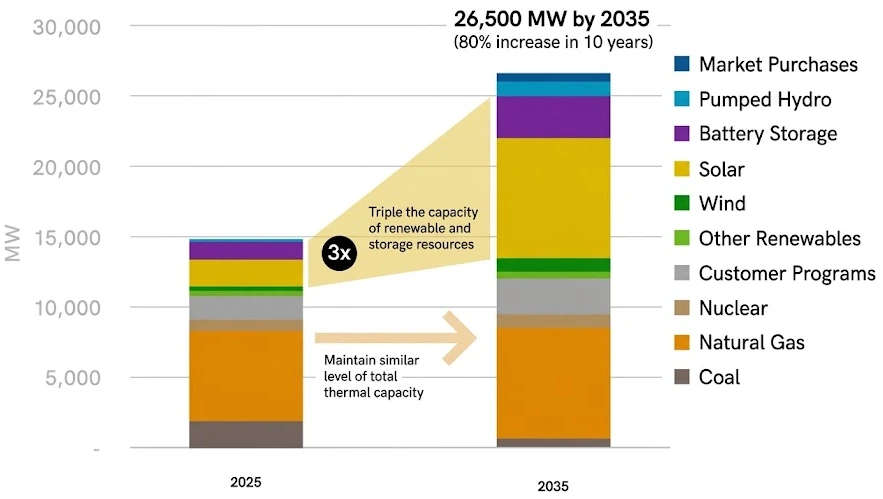
He noted that across all demand growth scenarios, Arizona must add significant new capacity of every source type to stay reliable. McFarland described the required approach as “all of the above.”
What Is Driving the Demand
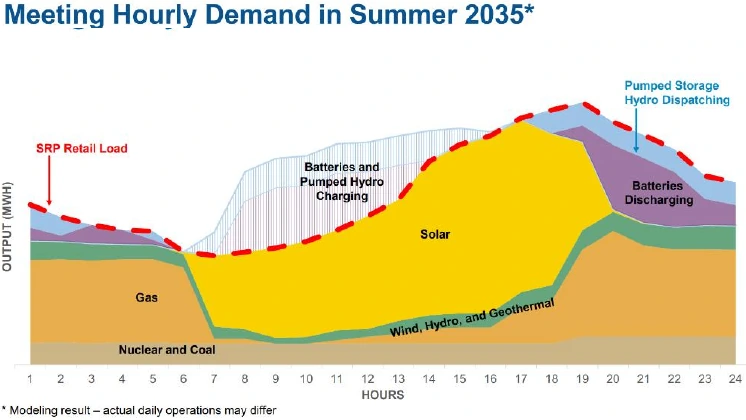
According to the agenda item description, rapid statewide load growth is being driven by population growth, advanced manufacturing, and large industrial users. McFarland noted that utility customer programs — including smart devices, virtual power plants (distributed energy resources managed collectively to support the grid), and demand response programs (incentives for customers to reduce usage during peak periods) — help reduce consumption. However, he said, those programs alone are not sufficient. Significant new infrastructure is still required to meet Pinal County’s growth.
Energy Options for Pinal County: Solar, Batteries, and Natural Gas
McFarland said three energy technologies are the most viable near-term options for Pinal County.
“The opportunities we have in Pinal County are solar, batteries, and gas,” he said, “because they are the most viable energy developments in Pinal County. It’s a combination of things. It won’t be one. It’s an all-above approach.”
He elaborated on the timeline advantages of two of those sources. “Battery storage projects can be developed quickly. Solar projects can be developed quickly. They’re sustainable.” He added that battery storage, combined with solar, provides an additional four to five hours of power after the sun goes down. Natural gas, he noted, “remains a critical reliable source.”
The presentation noted that Arizona’s climate gives Pinal County a particular advantage for solar, offering maximum efficiency compared with the rest of the country.
McFarland on Power Sharing: Arizona and the Western Grid
McFarland addressed the claim that power generated locally is exported to California rather than staying in Arizona.
“When somebody says that this solar field is being built and that power is going to California, that’s not true,” he said. “The power stays in our grid and is shared, but we also share with California, so it goes back and forth.”
He explained that Arizona is part of the Western Interconnection — a shared, multi-state grid.
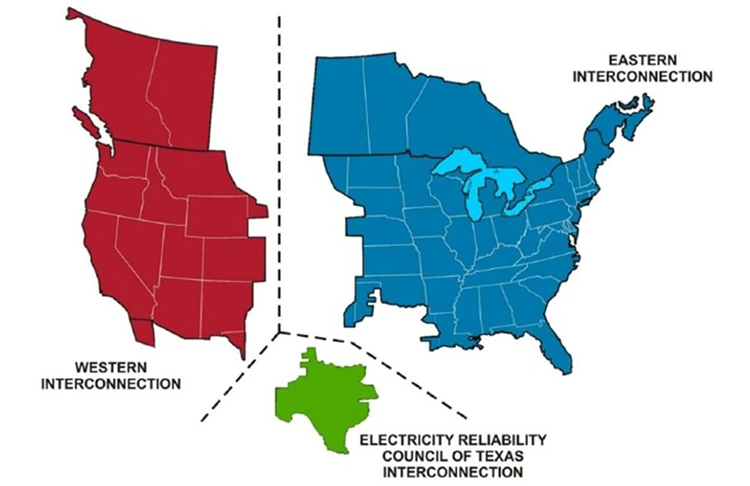
“If you recall back when Texas had their issues in the freeze, they had no power because they were not connected to anybody else,” he said. Texas operates its own isolated grid, the Electric Reliability Council of Texas, separate from both the Western and Eastern interconnections. As a result, when a severe winter storm struck in 2021, the state had no neighboring grids to draw power from.
Projects Underway and Planned for Pinal County
Several specific energy projects are either planned or in development, according to McFarland.
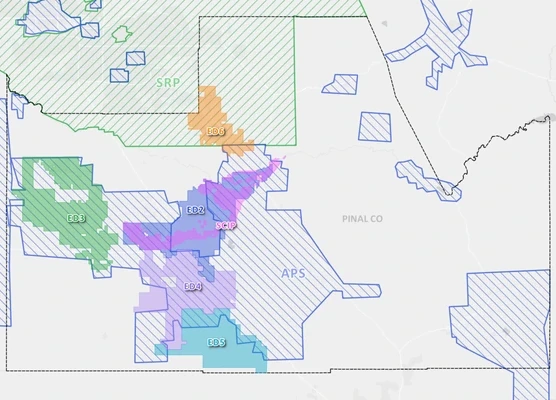
Transwestern Pipeline: A natural gas pipeline running from Texas terminates in Pinal County. McFarland said the pipeline is being sponsored jointly by Tucson Electric Power, APS, and SRP, with expanded capacity expected by end of 2029. He added that several gas projects are in the works along this corridor.
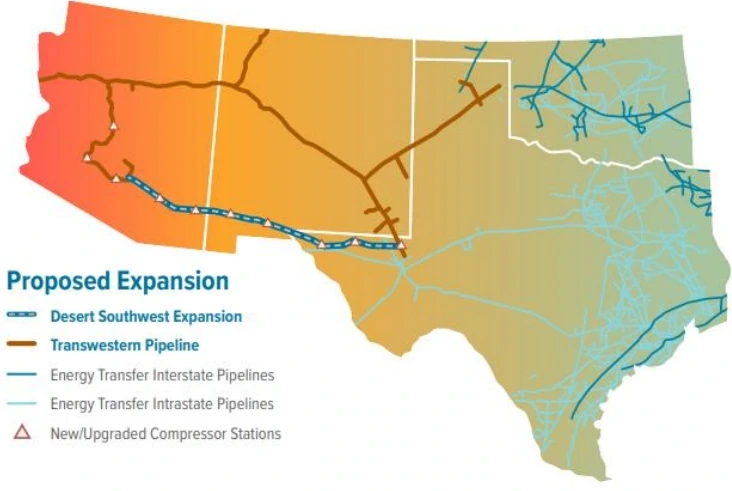
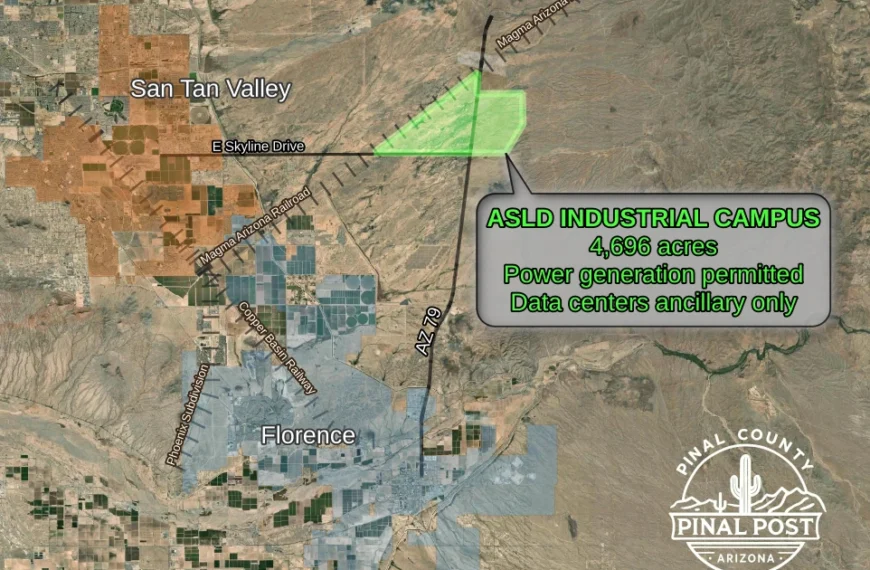
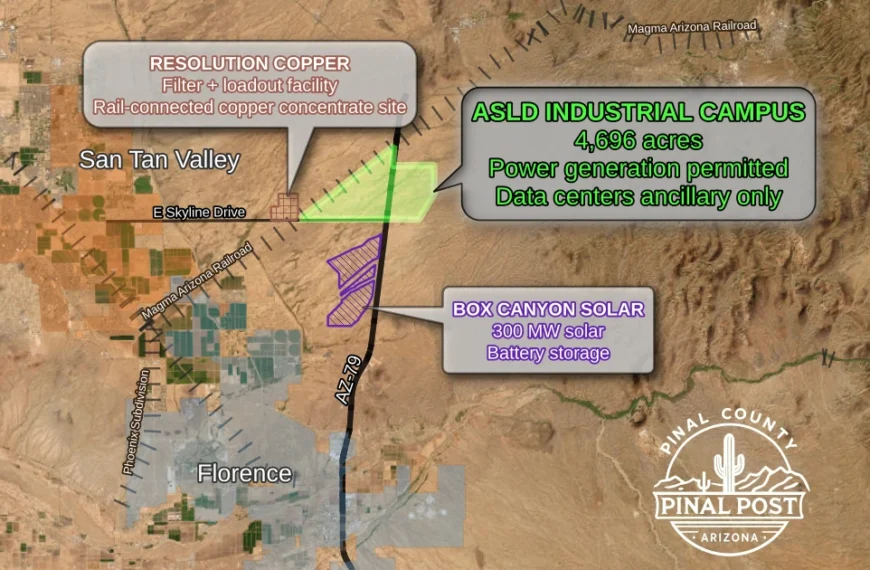
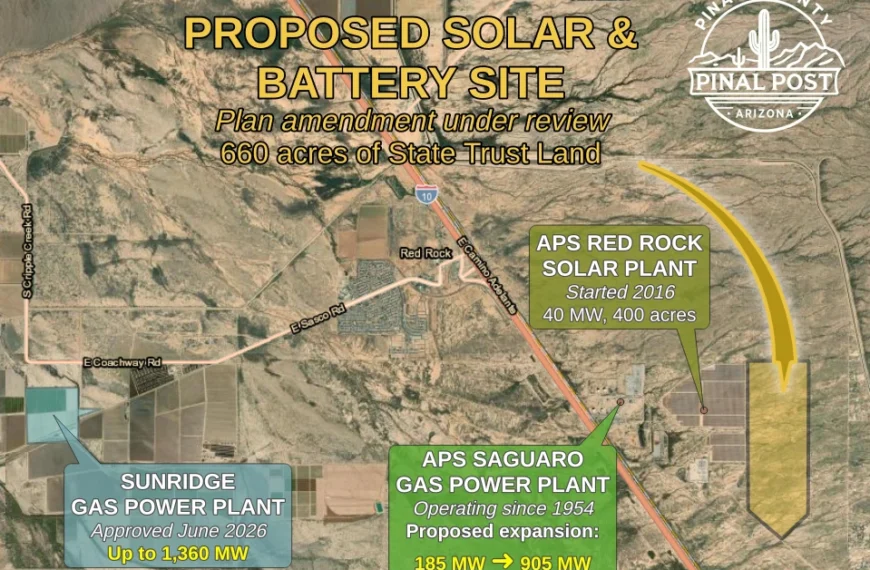
Natural Gas Plant near Picacho Peak: McFarland said a 300-megawatt natural gas plant is planned in the area around Picacho Peak, relying on the Transwestern Pipeline for fuel supply. The Pinal County Board of Supervisors approved a comprehensive plan amendment for the La Osa Gas-Fired Power and Data Center Complex in November 2025, a nearly $20 billion project that includes on-site natural gas power generation along the Transwestern Pipeline corridor near Picacho Peak.
Nuclear — New Siting Study: SRP and APS are jointly evaluating sites for a new nuclear power plant. McFarland pointed to Palo Verde Nuclear Generating Station, located on the west side of Phoenix, as the model. He said that facility produces approximately 14 to 15 percent of the state’s electric power. The presentation also noted small modular reactors as a separate future option, though it listed them as likely 10 or more years away.
Coal-to-Gas Conversions: Coal plants in the northeast corner of Arizona are being shut down and will be converted to natural gas facilities. “There’ll be some additional power coming from those gas facilities,” he said.
SRP Hydro Expansions: The presentation noted that SRP is planning expansions along the Salt River, but that hydro infrastructure options are limited for Pinal County specifically.
Wind: Wind development requires locations with strong and consistent wind conditions. Pinal County, he said, is not an ideal candidate for wind development.
The Ripple Effects for Residents and Local Government
McFarland told commissioners that energy development carries substantial long-term economic benefit. “The ripple effect is significant,” he said. He outlined five areas of impact: community funding and donations, long-term tax revenue, diversified income for landowners, direct and indirect job creation, and economic stimulus during and after construction.
As a concrete example, he noted that a single battery storage project costing $512 million to build would generate approximately $13.4 million in tax revenue to the county — including the community college and local schools — over a 20-year period.
He also described a broader economic dynamic. More energy projects mean more developers competing to supply power to utilities, which drives down energy costs. Lower energy costs, in turn, attract more large employers.
Undergrounding Power Lines: A Community Conversation
Councilmember Garrett Aldrete raised the issue of overhead power lines, noting the visual impact on existing neighborhoods and the vulnerability of wood poles during monsoon season. He asked whether the city could partner with APS or SRP to underground more infrastructure — pointing to a cost-sharing program between Paradise Valley, SRP, and property owners as a possible model.
McFarland responded that new development typically includes undergrounding by default. For existing neighborhoods, he said the utilities “would be interested if there was some appetite on the part of the city of Casa Grande” to have that conversation.
However, he noted a limit to undergrounding. “There’s a certain level of power that they can’t underground,” he said. High-voltage lines, such as those along some major corridors, cannot be placed underground.
On the process for placing new lines, McFarland said utilities hold public meetings before installing high-powered lines, giving residents an opportunity to weigh in on the route.
He specifically flagged two substations APS is building in Casa Grande — one on the east side and one on the south side — as projects residents should follow. “Those are things the public should be aware of and should participate in if you want to have some say in where those power lines go,” he said.
McFarland on Developer Accountability
“Energy development raises legitimate concerns around siting, safety, information conspiracy, and consistency that must be addressed openly,” he said.
He said the developers currently working in the area prioritize choosing appropriate locations, environmental impact mitigation, regulatory compliance, and community engagement. He described them as “responsible developers” and encouraged commissioners to reach out to him directly if they need additional information or data to address constituent questions.
Public Participation and Resources
The Casa Grande Planning and Zoning Commission did not take action on the item. Residents who want to weigh in on infrastructure decisions — including substation locations and power line routing — can participate in the public processes that APS and SRP hold before major line installations.
The full presentation is available as an attachment to the April 2, 2026 Planning and Zoning Commission agenda.