Key Points:
- Council voted 5-2 to deny the 300-unit Roers 88 North LIHTC apartments
- Project met all zoning requirements and had staff and Planning Commission support
- Traffic and infrastructure concerns drove the denial
- City pay study showed police recruits would exceed LIHTC income limits for one-person households
- Mayor Wilson suggested taking the general plan back to voters
- The 13-acre site remains undeveloped; other downtown housing projects continue
APACHE JUNCTION, AZ – The Apache Junction City Council denied the Roers 88 North apartments project on February 3, 2026. Council members voted 5-2 against Resolution No. 25-24, which would have approved a conditional use permit for the 300-unit income-restricted rental community. Traffic concerns on state-controlled roads drove the decision, despite the project meeting all zoning requirements and receiving staff support.
The 13-acre site near Idaho Road and Scenic Street will remain undeveloped for now.
What the Roers 88 North Project Proposed
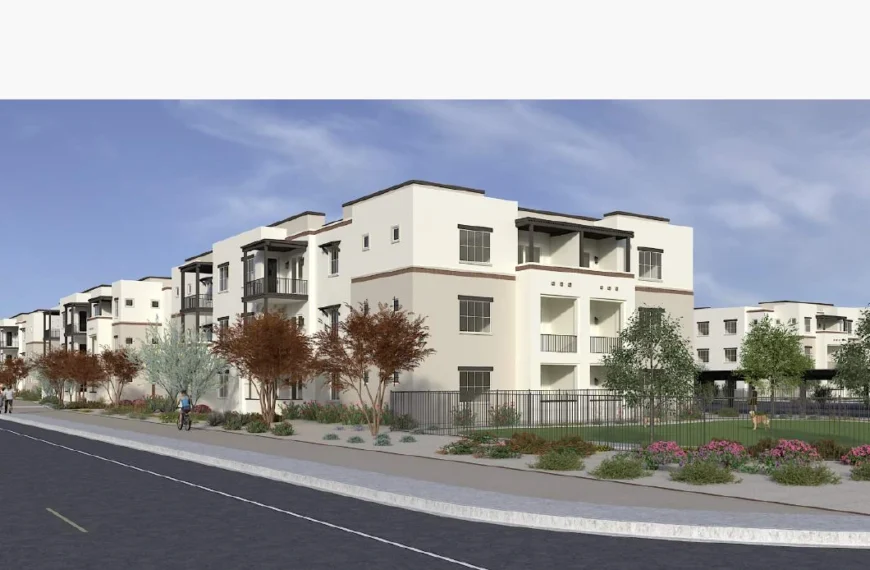
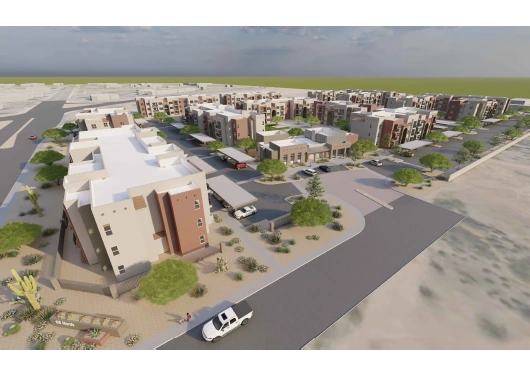
Roers Companies sought approval for a three-story, 300-unit apartment complex using the Low-Income Housing Tax Credit (LIHTC) program. The property sits within the City Center (B-3) zoning district. According to city staff, this designation permits apartments with a conditional use permit and allows buildings up to 60 feet tall and 40 units per acre.
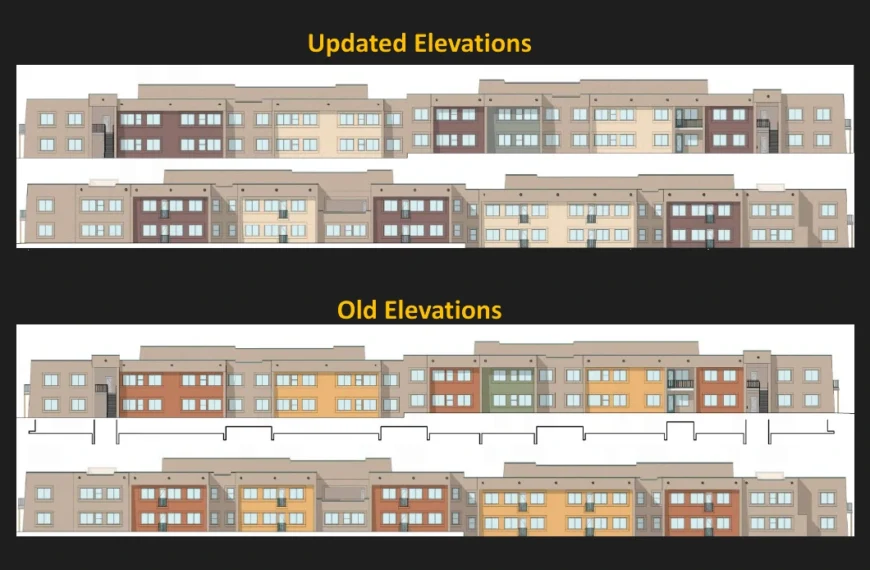
The developer proposed 38-foot buildings at approximately 23 units per acre. The project required no zoning deviations. Davis said it aligned with the voter-approved 2020 General Plan, the B-3 zoning code, and the 2024 Downtown Master Plan. That master plan specifically calls for high-density residential at this location, he noted.
“The whole goal of us being here, and for HUD also to be bringing us to the site, was to implement the town’s plan for the downtown core,” said Greg Davis, the project’s land planner from Iplan Consulting.
The Planning and Zoning Commission had voted 4-1 to recommend approval in October 2025. City staff also supported the project. However, the City Council ultimately disagreed.
For background on the project’s earlier hearings, including the December delay and January design revisions, see the previous Pinal Post coverage.
How LIHTC Differs from Section 8 Housing
The Low-Income Housing Tax Credit (LIHTC) program emerged as a central topic during the hearing. Davis characterized LIHTC as substantially different from Section 8 housing.
Davis said Section 8 funding “goes directly to the participant or the resident” as “a cash voucher that they can use to help supplement their income levels so they can qualify.” He said this “kind of hides how much income they have,” which leads developers to lower rents and “build to a lower standard.”
LIHTC works differently, Davis explained. The program provides tax credits to developers in exchange for a minimum 15-year commitment to income-restricted rents. Residents receive no vouchers. They must prove their income and pay rent themselves. Davis said the maximum income for a single person is $47,160. He estimated tenants would need roughly $30,000 in income to afford the units, based on the program’s requirement that income be at least double the rent.
“This isn’t meant to serve the very lowest income of our community,” Davis explained. “It’s meant to serve the lower middle class section of the community, the people that are moving into town for new jobs that need a place to stay.”
Councilmember Peter Heck asked clarifying questions about the income requirements. “So, if their income level goes down, they can’t remain there. Is that correct?” he asked.
Davis confirmed this. Residents who lose their jobs and can no longer afford rent would eventually need to leave. Similarly, if someone’s income exceeds the maximum, they must move to market-rate housing.
“So we’re really trying to serve the middle class here?” Heck asked.
“It’s the middle class, the entry level to the middle class,” Davis replied.
Karl Huish of Bela Flor Communities, which is developing a neighboring project, offered additional context. “The background checks for LIHTC are more extensive than the background checks that we do for market rate,” he said. “That’s just a fact.”
The Median Income Calculation Debate
Councilmember Darryl Cross raised concerns about how HUD calculates income limits. The agency uses the Phoenix metropolitan area’s median income rather than Apache Junction’s local figure.
“But that is not an accurate reflection of the median income in our community. It is not,” Cross said.
The Phoenix metro area’s median household income is approximately $84,700, according to Census data, while Apache Junction’s is about $58,600—roughly two-thirds of the regional figure. Because LIHTC limits are set at 60% of the regional median, Cross said the limits don’t reflect local conditions. “Sad. Real sad,” he said.
Cross also questioned the requalification process. Davis said residents complete a full income certification the first year, then self-certify annually while the state tracks compliance.
Resident Elisa Krcilek questioned whether teachers, firefighters, and police—workers often cited by LIHTC proponents—would actually qualify based on the income limits.
LIHTC Income Limits for Apache Junction (2025)
| Household Size | Maximum Income |
|---|---|
| 1 person | $47,160 |
| 2 person | $53,820 |
| 3 person | $60,600 |
| 4 person | $67,320 |
Source: Applicant presentation
Earlier that evening, the council reviewed a city compensation study showing Apache Junction police recruits would earn $67,191 under the proposed pay scale. A single recruit would exceed the $47,160 limit for a one-person household. Even a recruit supporting a family of four would be just $129 below the maximum.
Traffic Drove the Denial Decision
Traffic emerged as the decisive issue. Idaho Road, known officially as State Route 88, falls under Arizona Department of Transportation control. The city cannot install traffic signals or make improvements without ADOT approval.
Councilmember Bambi Johnson made the motion to deny. She cited “inadequacy of roadways, off-street parking, public facilities, and services to accommodate the proposed use at this time.”
“These roads are controlled by ADOT,” Johnson explained. “I do not feel that there is adequate control over this road at this time for an apartment building of this complexity.”
Cross seconded the motion.
Councilmember Bryan Soller acknowledged the developer’s responsiveness. “They did what I asked them to do. They lowered it, they changed the architecture, they had a live-in manager,” he said.
But Soller said he couldn’t support adding so many units to the area. “I cannot put 610 units in there because that’s not people, that’s just units. There could be two, three, four people per unit with cars,” he said. He added: “I know what’s coming, and we’re gonna have bad accidents and fatalities.”
The 610 figure refers to the combined total of three planned projects in the area: Roers 88 North (300 units), Bella Norte (210 units), and Skyline (100 units).
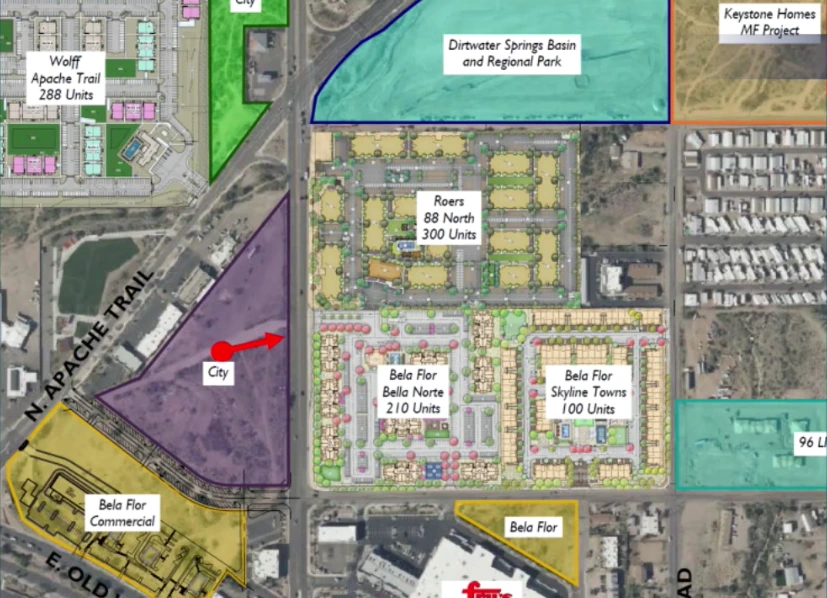
Vice Mayor Robert Schroeder also voted to deny, citing traffic and what he described as “the social climate” the project could impose.
Council Members Who Opposed the Denial
Councilmember Tess Nesser voted against denial. She addressed the property’s zoning.
“It’s my understanding the developer has agreed to not go higher than 38 feet for the apartment complexes,” Nesser said. “If we don’t give them that or agree to that, do you realize that tomorrow they could walk into Development Services and take out permits for 60-foot high commercial complexes there? We have no say over it. It’s already zoned for 60-foot high.”
Nesser also noted that commercial development would generate more traffic than residential, a conclusion supported by the applicant’s traffic analysis. Apartments create traffic bursts in the morning and evening, while commercial use brings vehicles all day long.
Councilmember Heck argued against waiting for traffic solutions. “If we say, ‘Well, wait, let’s hold off until we have it all figured out,’ well, so we’ll wait three, four, or five years before we do any more development,” he said. “And then, in the meantime, we don’t get the benefit of the retail that we would like to have downtown.”
Heck emphasized the importance of following the voter-approved general plan. “I think the whole point of this was we want to make this downtown the focal point for this city,” he said. “I think it’s incumbent upon us to do our very best to follow and comply with that document.”
Public Comments Showed Both Support and Opposition
Supporters argued the project would jumpstart downtown development. Opponents said it would damage Apache Junction’s reputation.
Huish, whose company owns the adjacent property, spoke in favor. “You’ve heard the saying, ‘Rooftops before retail,'” he said. “If you want good quality retail, you need to have more full-time residents first.”
He described the housing mix planned for downtown. Wolff will offer market-rate apartments. His Bella Norte project will also be market rate. “That’s 500 market rate units coming on. That’s a lot,” Huish said. “Roers will be LIHTC, and the rents for LIHTC will be a little below market rate.”
Huish listed the residents LIHTC would attract. “Middle-class people with great jobs, teachers, firefighters, policemen, nurses, construction workers. These are the backbone residents of any successful city. These will bring young people and young families to the downtown which will help build our school system and our community.”
Jeff Serdy, a Pinal County Supervisor and former Apache Junction mayor, spoke against the project. He has lived in Apache Junction for 41 years and said he has spent 20 years working to improve the city’s reputation.
Serdy said Apache Junction’s image problems date to the 1950s and 1960s, when developers “planted down some of the cheapest and highest profit projects they could into the choicest areas.” He pointed to mobile homes and trailer parks visible in aerial photos. He called the Roers project “the modern-day equivalent of that.”
“This is the cheapest possible project to make the most profit for the developers, and it really doesn’t do anything for the residents,” Serdy said.
He urged the council to hold out for better proposals. “You’ve got a chance to set the tone of Apache Junction in the future for the next 100 years. Once this goes in, you’re not gonna get anything else, you’re gonna be stuck with it.”
Serdy compared Apache Junction to other communities. “Who has cool downtowns? Gilbert. Would Gilbert approve this? No way,” he said. “Do not feel bad for the developers, they have parachutes, they’ll land on their feet.”
Mehmood Mohiuddin, owner of the Hitching Post restaurant, also opposed the project. He argued against government-subsidized housing. “I am a business owner, I’ve had two employees quit, paying $20 an hour as a dishwasher guy. He didn’t want to work because he’s getting the state and federal funding,” Mohiuddin said.
He called for commercial development instead. “Change the zoning on it to commercial, build a small shopping center, just like in downtown Chandler, Gilbert.”
Other residents raised additional concerns. Several questioned infrastructure capacity, including US-60 freeway congestion and water supply. One resident cited the city’s dark skies principles and asked how lighting from multiple projects would affect them. Multiple speakers worried the three-story buildings would block views of the Superstition Mountains. Cathy Waz drove through The Crossings, an existing LIHTC property in Apache Junction, and said it was poorly maintained with “barbed wire fencing” and “weeds everywhere.” She cautioned that approval meant a 15-year commitment that “cannot be undone.”
The General Plan Question
The council debated whether denying the project violated the voter-approved general plan. Development Services Director Rudy Esquivias explained the relationship between the general plan and zoning code.
“The general plan is a policy document,” Esquivias said. It mentions retail, restaurants, and higher-density residential as appropriate for the downtown area. However, the zoning ordinance governs what uses can actually occur. The B-3 zoning permits many uses outright. Multi-family projects require a conditional use permit.
Vice Mayor Schroeder asked whether denial would contradict the general plan. “Because it requires approval of a conditional use permit, you have the discretion to approve or not approve,” Esquivias replied.
Esquivias noted that while the zoning allows commercial uses, no such proposals have been submitted. “This is the project that’s before us here today,” he said. “Be great if restaurants and shops and things were being proposed, but they’re not.”
Final Vote and Mayor’s Closing Remarks
The council chambers were full, with the vast majority of attendees there to oppose the project.
The final vote was 5-2 to deny. Johnson, Cross, Soller, Schroeder, and Wilson voted yes to deny the project. Nesser and Heck voted no.
After the vote, Mayor Wilson addressed the audience. “I think we need to look at the general plan and the aspect and possibly go back to the voters and to what they want in this area,” he said.
He acknowledged the land presents development challenges. “This is land that is very problematic to actually make into businesses and access and everything. So, that’s not the answer. We need to look at how we can best use this property.”
Other Downtown Projects Continue
The denial leaves the 13-acre property undeveloped. The property remains zoned B-3, which allows commercial development by right.
Other downtown housing projects continue. The Wolff Company’s 336-unit Apache Trail & Plaza apartments were approved by the council in June 2025. Bela Flor’s 100-unit Skyline townhomes recently held a groundbreaking ceremony. Huish’s proposed 210-unit Bella Norte project is still awaiting approval.