Key Points
- The commission voted 8-0 to recommend rezoning 10 acres west of Casa Grande from General Rural to Industrial, near recently approved semiconductor supply chain facilities.
- The site is in unincorporated Pinal County with no tenant or end user identified.
- Chairman Klob raised concerns about approving rezones without a conceptual site plan.
- The recommendation carries 12 stipulations that require a site plan, traffic study, and drainage report before any development permits can be issued.
- Planning Manager Krauss suggested the county reevaluate its I-3 zoning code to address hazardous or incompatible uses.
- According to Krauss, zoning entitlements cannot be revoked unless a specific user fails to meet performance standards tied to stipulations.
- Commissioners also discussed transparency in the rezoning process, time limits on entitlements, and how much oversight elected officials should exercise over development.
- The recommendation now goes to the Board of Supervisors for final action.
The Pinal County Planning and Zoning Commission voted unanimously on Feb. 19, 2026, to recommend approval of the Roof Tile Road industrial rezone near Casa Grande. The rezone will convert roughly 10 acres of vacant land from General Rural to Industrial (I-3) zoning on S Roof Tile Road, south of W Peters Road in unincorporated Pinal County.
The hearing also included extended discussion about zoning transparency, resident control, and how the county handles development without a known end user.
What the Rezone Means for the Area
The rezone applies to a currently vacant parcel owned by TR Nova LLC. Applicant Kent Volkmer of Volkmer Law and Lobbying told commissioners the goal is to attract an employer to the site. “The idea was to see if we can make it an industrial zone project, which we believe it should be, and then we can attract an appropriate company to come in, potentially do the build-out, do the site plan, and actually prepare it for industrial use — for an employment center,” Volkmer said.
No specific tenant or buyer has been identified yet. Instead, the property owner plans to market the land to industrial users once the rezone is finalized. The Pinal County 2019 Comprehensive Plan designates the site for employment use. That designation supports industrial, office, business park, warehousing, and distribution activities.
Surrounding Land and Industrial History
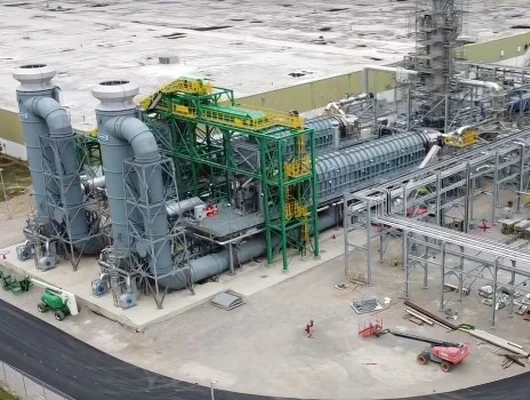
Volkmer described the surrounding area as a growing industrial area. A Cemex quarry sits immediately to the south. An Air Products facility is located to the northeast. To the northwest, a company called RubberLogix purchased what was formerly a paper mill processing site that had burned down.
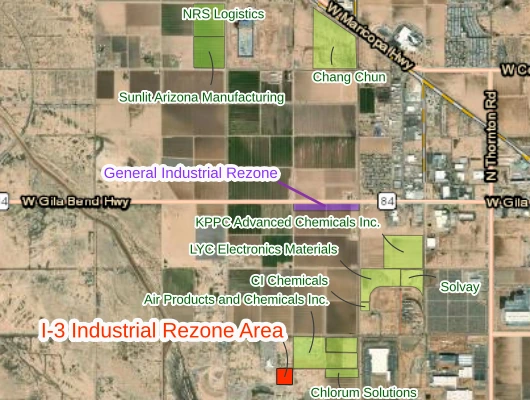
The nearby Air Products facility is part of a broader wave of semiconductor supply chain investment in the Casa Grande area. Companies including Chang Chun Arizona, Solvay, LCY Electronic Materials, Chlorum Solutions, Air Products, and Jing He Science have established operations on Casa Grande’s west side, supplying chemicals and industrial gases to chipmakers such as TSMC, Intel, and Micron. The Casa Grande City Council also recently rezoned 23 acres to General Industrial at Gila Bend Highway and Burris Road to meet growing demand for industrial land in the area.
According to the staff report, land to the north is zoned rural with single-family residential use. Land to the south is zoned rural and used as a quarry. Land to the east is zoned rural and vacant. Land to the west includes a mix of rural and light industrial zoning. The site has carried General Rural zoning since it was first designated, has never been rezoned, and is largely undeveloped.
Transparency Concerns Over Unknown Zoning
Commission Chairman Robert Klob questioned the practice of approving a rezone with no identified end user. He said he always has a challenge with “unknown zoning” and believes the commission should see at least a conceptual graphic showing what development might look like.
Klob said boards and commissions frequently get accused of “back room deals.” Providing even a basic site concept early in the process, he said, helps prevent that perception. As an example, he described a scenario where a manufacturing building goes up five feet from a property line. Without an early concept plan, neighbors have no advance notice of what is coming.
Klob noted his own professional background. “I do these site plans, it’s what I do for a living, and I get the concern of the cost,” he said. Still, he said he wants them presented earlier in the process. “A lot of times with site plans we don’t always see, and the public doesn’t always see,” Klob said. “Then the buildings are going up and they’re like, ‘What’s going on?’ That’s why I like to have them earlier on in the process.”
In response, Volkmer said the cost is difficult to justify without a known tenant. “We actually worked with the county engineer, because originally they wanted us to do a site plan. And our position is, we’re gonna spend tens of thousands, if not $50,000 developing a site plan that’s probably never gonna actually be used, because the end user’s gonna dictate what they need the space for,” he said.
County Stipulations Require Future Site Plan Review
Volkmer pointed to the 12 stipulations attached to the approval as the compromise. Those stipulations require the future developer to submit a site plan, a traffic impact analysis, and a drainage report before any permits are issued. “The county, through their stipulations, actually built in that concern — we just can’t put up a building willy-nilly,” Volkmer told Klob. “We actually have to go through the county, the county still has to approve it.” The site plan is required once a specific end user is identified, rather than at the time of rezoning.
Krauss on Reevaluating the County’s Zoning Code
Planning Manager Harvey Krauss also addressed the site plan question. Under the previous planning manager, past practice required a conceptual site plan at the rezone stage. Krauss said that without a specific user, such a plan is “almost meaningless.” His approach skips that step when the surrounding area already supports industrial use. “If the property should be industrial based upon what’s around it — rail, highway, other industrial uses — why not rezone it now?” he said. The applicant can then find tenants and “bring them forward to staff” for review. “That was the thinking, and that’s a different way than the previous planning manager and community development director did it,” Krauss said.
Krauss said the county’s zoning code also needs attention. “We need to reevaluate our zoning code and I-3 uses and see which I-3 uses would be compatible,” he said. He said the county should determine which types of industrial activity are compatible across all I-3 zoned land. For uses that are hazardous or incompatible with neighboring development, Krauss said the county could restrict them through an Industrial Use Permit (IUP) or other special requirements, such as buffer zones.
Jurisdictional Differences in Zoning Practices
Klob acknowledged Krauss’s comments and noted that zoning practices vary widely between jurisdictions. Some cities and towns require full site plans, renderings, and detailed documentation at the rezone stage. Others allow straightforward rezoning with minimal requirements. Krauss added that this comes down to how much the commission and elected officials want to be directly involved in the planning and zoning process. Some want full control with locked-in site plans tied to specific uses. Others delegate more authority to staff. He called it “a philosophical issue.”
Entitlements, Time Limits, and the Clawback Process
Vice Chair Karen Mooney asked how long a rezone entitlement can sit unused. She referenced other entitled properties in the San Tan area that date back to 1998 and remain undeveloped. She asked: if the economy declines, how long can this rezone remain in place without development?
Krauss explained that once a property owner receives zoning entitlements, those entitlements cannot simply be taken back. The only exception applies when a specific user has a development schedule and performance standards tied to stipulations. If the user fails to meet those standards, the county can initiate a revocation process through a public hearing. This is known as a “clawback.” Without a specific user — as in this case — no such deadline applies.
Krauss said that if the county wants to change things in the future, the approach is through the zoning code. “We go back to that I-3 zone and we change the site development standards, we change the uses, we add design guidelines,” he said. “You can approach it through the zoning code, is the way you do it.” Those changes would apply to all I-3 zoned properties. “That’s the way zoning is supposed to work, in fairness to all property owners who have I-3 zone properties,” Krauss said.
Mooney’s Motion and Final Discussion
Before the vote, Vice Chair Mooney noted that converting the parcel to I-3 opens it to a wide range of industrial uses rather than locking it into a single purpose. She said she has previously raised concerns when rezonings are limited to one specific project type. In this case, the proximity of existing industrial zoning made her more comfortable with the broader designation.
Mooney also acknowledged that some I-3 permitted uses might be unwanted by the area but are not excluded from the zoning designation. Under the county’s current zoning code, I-3 permits a wide range of activities. These include manufacturing and processing operations, junk and salvage yards, landfills and transfer stations, bulk fuel stations, prisons and detention facilities, heavy truck operations, and impounded vehicle storage yards. Still, Mooney said the existing industrial context distinguishes this case from situations where industrial zoning would be introduced to an area for the first time.
Departmental Review as a Check on Development
Commissioner Gary Pranzo asked whether the standard review process still applies when there is no specific use proposed. “When we have a blank slate like this, does that still get passed to the different departments?” he asked. Krauss confirmed it does. Pranzo followed up: “So they have an opportunity to put a stipulation?” Krauss again confirmed. “Then that satisfies my needs,” Pranzo said.
Vote and Motion
Mooney made the motion to recommend approval with the 12 stipulations. Commissioner Bryan Hartman seconded. The commission approved the recommendation unanimously, 8-0.
Public Notice and Neighborhood Feedback
Vice Chair Mooney asked Volkmer whether surrounding property owners had been notified and whether anyone expressed concerns. Volkmer said his team held the required neighborhood meeting. Only one person attended — a realtor who represented all surrounding property owners. Those owners hold vacant land currently zoned General Rural.
According to Volkmer, surrounding owners believe their land should also be industrial and expressed interest in pursuing similar rezones. Additionally, no written letters of opposition or support were submitted to county staff before the hearing.
What the Board of Supervisors Will Decide
The recommendation now advances to the Pinal County Board of Supervisors for final action. The Board will hold its own public hearing on the rezone. Residents can attend that hearing and speak, or file written statements of support or opposition with the Pinal County Planning Department.