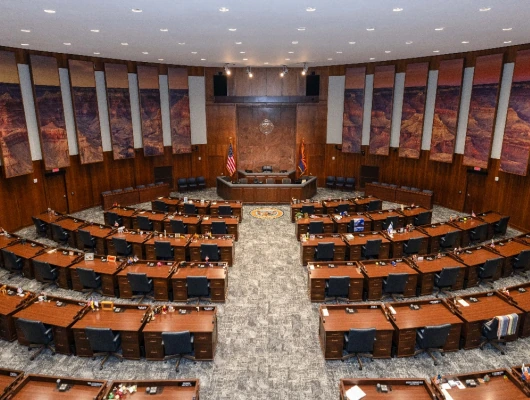
San Tan Valley’s appointed council reviewed the first draft articles of its new town code during its December 17, 2025, meeting. The code will replace Pinal County regulations, which currently govern the area. The council aims to adopt core articles before the July 1, 2026 operational independence deadline. Residents can expect a gradual rollout of rules governing everything from garbage collection to building permits.
Attorney Joe Estes of Pierce Coleman PLLC presented draft language for the first three articles and previewed future code sections.
What the San Tan Valley Town Code Means for Residents
San Tan Valley currently follows Pinal County’s code. Its own municipal code will let the town set rules reflecting local priorities.
“The goal of the town code is that it reflects the community’s priorities, growth goals, and values,” Estes told the council.
The code will provide consistent rules for developers and homeowners. It will also protect public health, safety, and welfare. Additionally, it reduces legal risks for the new town government.
First Three Articles Cover Government Basics
The council reviewed draft language for Articles 1 through 3. These establish the town’s governmental foundation.
Article 1 – General Provisions includes the form of government, rules of construction, definitions, and an appeals process. It also establishes general penalties for code violations. Estes noted that code violations are typically classified as class one misdemeanors. However, he included language allowing prosecutors to consider circumstances and apply civil infractions instead.
Article 2 – Mayor and Council covers elected officials, their duties, and meeting procedures. It currently reflects state law requiring two-year terms with the council appointing the mayor. These provisions may change based on August 2026 ballot measure results regarding terms and direct mayoral election.
Article 3 – Administration establishes key town positions: clerk, engineer, marshal (police chief), town manager, attorney, and magistrate judge.
Key Decisions the Council Must Make
The presentation outlined several choices facing the council. Each affects how the town will operate.
Council Salaries: The council can choose whether to compensate members. Estes noted two perspectives. Some believe council service should be voluntary. Others argue compensation allows people without financial means to serve. Town Attorney Allen Quist noted that municipalities of San Tan Valley’s size typically compensate council members. Arizona’s constitution prevents a council from setting its own salary. Any amount approved would apply to the first elected council.
Ordinance Readings: The council can require one or two readings before passing ordinances. Two readings prevent quick code changes and require multiple meetings. However, Quist recommended one reading initially. “We have a lot to do in a short period of time,” he explained. One reading speeds up the process during early operations.
Abstention Votes: Estes explained that abstentions due to conflicts of interest are never counted as votes. However, when council members abstain on difficult or political issues, municipalities handle it differently. Some count those abstentions as yes votes. Others count them as no. The council will decide which approach to adopt.
Citizen Petitions: The code could allow residents to petition for agenda items. If enough signatures are gathered, an issue would require a council hearing. Estes cautioned against setting the threshold too low.
Special Meetings: The council can decide who has authority to call special meetings. The mayor typically has this power. The code can also allow a set number of council members to call one. Estes cautioned against allowing just one member, citing risk of abuse—a frustrated member could call meetings every week. He also noted that requiring more than three members could raise open meeting law concerns, since four members constitute a quorum.
Who Gets Appointed and Who Gets Hired
Estes said the general consensus is that councils typically appoint four key positions: town manager, clerk, attorney, and magistrate judge. All other employees report to the manager. This creates separation between elected officials and day-to-day staff.
“You can’t have seven members of the council going around and giving direction to individual employees,” Estes explained. The manager serves as a buffer between the council and staff.
State law requires certain positions: town clerk, town engineer, and town marshal (police chief).
Estes noted that in his experience, clerks may serve 30 years at the same municipality while managers turn over every four or five years. Magistrate judges require minimum two-year contracts to maintain separation between the legislative and judicial branches.
Contracting Out Services Remains an Option
Estes noted that police, fire, and court services can all be contracted rather than staffed in-house. He cited Litchfield Park as an example. That city contracts fire services with Goodyear and police services with Avondale. Its manager has no direct oversight of public safety departments. Similarly, Queen Creek still contracts magistrate services through justice of the peace courts.
Rural Metro Operates Under State Fire Marshal Authority in Pinal County
Town Manager Brent Billingsley noted that Pinal County lacks its own fire department or fire marshal. Rural Metro fills that role through a memorandum of understanding with the State Fire Marshal’s Office. The company operates as fire marshal throughout the county except in areas served by a municipal fire department or fire district.
Taxes, Fees, and Cost Recovery Options
Future code articles will address finance and taxation. Article 4 will cover budget procedures, purchasing rules, and accounting standards. It will also address fees, charges, and local transaction privilege tax—if the council chooses to implement one.
Estes noted that some residents prefer taking their own garbage to the dump and don’t want to pay a fee. But allowing opt-outs makes it difficult to track which homes need collection.
Billingsley described different models. In Maricopa, the city required garbage service but let HOAs choose their providers. In Florence, the town bid on a single provider and collected fees directly.
If the council does not adopt impact fees, Estes recommended a public improvement cost recovery ordinance. This allows developers who front infrastructure costs to recoup them later.
Town Code Won’t Override HOA Rules
Councilmember Bryan Hunt asked what happens when town ordinances conflict with HOA rules.
“The CC&Rs, the covenants, conditions, and restrictions—they’re a contract between the homeowners and the HOA,” Quist explained. “Those will remain in force. Typically, a town code isn’t gonna trump or impact those contractual relationships.”
Quist noted that HOAs and the town may coordinate on enforcement. Some violations could exist under both CC&Rs and town code. Each has its own enforcement path.
Quist said that for issues like crosswalk lighting, the key question is road ownership. The town can intervene on public roadways. Private HOA roads remain the HOA’s responsibility.
Billingsley cautioned that adding traffic calming measures requires warrant studies and engineering analysis. “You can actually make situations more dangerous by adding things that you think are gonna make it safer,” he noted. The town would need to set up engineering guidelines based on national standards for speed humps, crosswalk lighting, and similar installations.
Lighting Standards May Balance Safety and Dark Skies
Estes said the council will face choices about lighting in future development standards. He described a Maricopa subdivision built under a dark sky ordinance with zero street lights. He asked the developer to add automatic coach lights on garages for minimal lighting.
Billingsley said Maricopa eventually eliminated its dark sky ordinance due to safety concerns. Police found it difficult to patrol communities that were exceedingly dark.
Estes noted that dark sky ordinances are harder to justify near the Phoenix Valley, where light pollution already exists.
Monthly Reviews Will Shape Code
The council took no action on December 17. The presentation was informational only.
Attorneys will bring additional code articles monthly. Town Manager Brent Billingsley noted that building code work has already been coordinated regionally. The county and all its cities and towns have worked together for about a year on adopting 2024 international codes.
The focus remains on essential regulations before July 1, 2026, when the town assumes full operational independence. Building code adoption benefits from regional work already completed. Other articles covering public safety, courts, business regulations, traffic, animals, and parks will follow in coming months.
Councilmember Rupert Wolfert underscored the scale of work ahead.
“This is a gargantuan task. This is a massive undertaking,” Wolfert said. “This is gonna continue to be an ongoing discussion that will outlast this current appointed council. So really, the task ahead for this particular council will be to get those core articles in place, the must-haves. So that will be the focus in the months ahead, prior to the official incorporation date.”