At a Glance:
- 93 group homes operate in San Tan Valley; only 14 are fully approved
- 62% of all juvenile crime under active investigation in Pinal County ties back to San Tan Valley group homes
- 36,055 calls for service in 2025, continuing an upward trend
- Teeple called San Tan Valley a “low crime neighborhood” for its population, with no organized gang activity
- Hunt and Bella Vista ranks as the #1 traffic hotspot
- 29 personnel currently patrol San Tan Valley; a typical benchmark would suggest roughly 200
- An outside firm is calculating the cost of a policing contract; no figure is available yet
- Teeple recommended hiring a deputy chief to serve as San Tan Valley’s chief of police
SAN TAN VALLEY, AZ – Pinal County Sheriff Ross Teeple presented a San Tan Valley crime overview to the Town Council on Wednesday, February 18, covering call volumes, crime trends, traffic hotspots, and staffing considerations. He identified one issue as the community’s “one glaring exception” to an otherwise safe profile: group homes. Of 93 group homes currently operating in San Tan Valley, only 14 have been fully approved by the Arizona Department of Child Safety. The rest remain in review, pending compliance, or some other incomplete status — yet they are already housing children and generating a large share of law enforcement calls.
62% of Pinal County Juvenile Crime Tied to San Tan Valley Group Homes
Since January 2022, the Sheriff’s Office has logged 4,913 incidents at San Tan Valley group homes. The top call types at those addresses include missing persons, follow-up investigations, welfare checks, and juvenile disturbances.
Teeple closed his presentation with the statistic he said he wanted the council to take away. While discussing the group home data slides, he stated: “62% of all juvenile crime that is actively being investigated in Pinal County, Pinal County, the size of the state of Connecticut, are directly related to group homes in San Tan Valley.”
He pointed to Maricopa County as a driving factor. That county raised licensing costs to discourage group home operators, pushing many into Pinal County. “The majority of these kids that are in group homes in San Tan Valley are not even from Pinal County,” Teeple said. “Maricopa County took the initiative and they said, ‘We don’t want these group homes in our county,’ so they made the cost for getting a license for a group home in Maricopa County cost prohibitive, so they moved them all back here.”
As a result, juveniles are placed in San Tan Valley group homes far from where they came from — and frequently run away to return. Teeple described a recurring pattern where group home staff call to report a “welfare check” on a juvenile who has announced they are packing a bag and leaving, yet the staff cannot intervene. Under current DCS guidelines, guardians at these facilities are told they cannot physically stop a child from leaving.
“They can’t physically stop a child from running away from a home where they have guardianship under. And to me, that’s just atrocious,” Teeple said.
Teeple shared a related example involving a parent. A mother once called to report her daughter running away from Fry’s Shopping Market at Hunt and Bella Vista after an argument over cereal. She gave deputies a play-by-play of the girl running into a busy intersection. When Teeple asked what force she used to stop her child, the mother replied: “No, no, that’s your job. That’s not my job.” The sheriff’s office cited the mother for contributing to the delinquency of a minor and secured a conviction.
Teeple connected the group home issue directly to patrol availability. “If you want lower response times, if you want more deputies out there conducting traffic enforcement on Gantzel and Bella Vista and Hunt and Bella Vista, think and look at the group homes,” he told the council. Each welfare check ties up a deputy for approximately 28 minutes on scene, plus nearly 10 minutes of travel time.
San Tan Valley Crime Statistics: A “Low Crime” Community
When Vice Mayor Tyler Hudgins asked how the area compares to other regions the sheriff’s office serves, Teeple said: “For your population, it’s considered a low crime neighborhood.”
The crime data shows a profile of “social friction and domestic issues rather than organized violent crime,” Teeple said. “There’s nothing in our crime statistics show that MS-13 is operating here or anything like that.”
The top criminal offenses from 2015 to 2025 were disorderly conduct (2,122 incidents), which covers fighting, violent behavior, or disruptive conduct and serves as the most common catchall charge for public disturbances. Criminal damage ranked second (1,873 incidents), involving reckless defacing or damaging of property — a category Teeple said is a current trend linked to juvenile problems countrywide. Assault ranked third (1,835 incidents), defined as intentionally or recklessly causing physical injury and serving as the primary violent crime statistic for the region. Disorderly conduct with a domestic violence designation added another 1,323 incidents, bringing the combined disorderly conduct total close to 3,500.
Domestic Violence Charges and Arizona’s Broad Legal Definition
Teeple explained why domestic violence numbers appear high. Under Arizona statute, domestic violence applies whenever two people in a physical altercation have ever shared a household or had a romantic relationship. That includes adult siblings who grew up together decades ago and military barracks mates.
Many of those cases never reach trial because prosecutors recognize the circumstances do not warrant prosecution. However, Teeple said a Phoenix news outlet periodically publishes articles highlighting that “half of domestic violence releasees never make it to trial” without providing that context. He called it “an easy statistic for them to twist.”
The sheriff said he wants the state legislature to reform the disorderly conduct domestic violence statute before his tenure ends.
Marijuana Legalization Drove Down Drug Paraphernalia Cases
Among property and drug crimes, theft led with 952 incidents, followed by drug paraphernalia at 919 and shoplifting at 604. Teeple pointed out that paraphernalia cases have dropped since Arizona legalized recreational marijuana. “Does anybody know why it’s gone down? ‘Cause Arizona legalized marijuana,” he said.
Still, marijuana possession accounted for 458 incidents in San Tan Valley over the same period. The sheriff explained those cases involve situations where possession remains illegal, such as carrying marijuana in a vehicle outside an approved container, or possession by minors. Dangerous drug offenses including methamphetamine, LSD, and cocaine totaled 378 incidents.
36,055 Calls for Service in 2025 — An Upward Trend
The presentation opened with a historical look at call volume. San Tan Valley has seen an overall upward trend in total calls for service since 2020, rising from 24,232 that year to 36,055 in 2025, with a temporary dip to 34,034 in 2024.
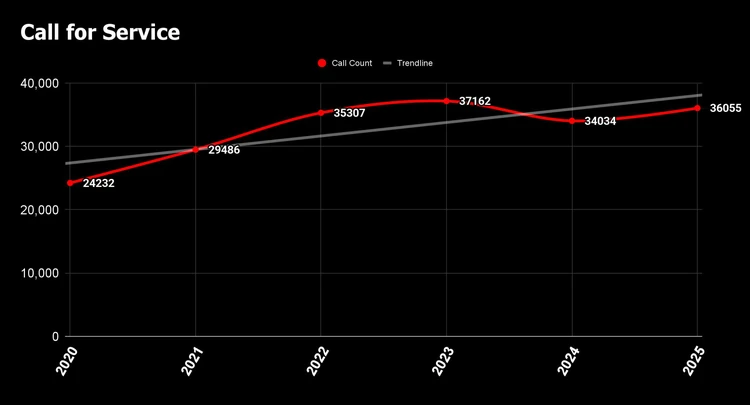
“That’s a lot of calls, guys,” Teeple said. “For the number of deputies that are here, that’s why if sometimes a deputy tells you, ‘I have to go. I have calls holding,’ that’s what he’s referring to there.”
High-priority calls are resource-intensive. Priority H (“hot”) calls — upgraded from Priority 1 when conditions worsen, such as a child in a pool who is not breathing and has been underwater for an extended period — average 103 minutes of dedicated unit time. Priority 1 calls, which are life-threatening emergencies, average roughly 59 minutes. Priority 2 calls, covering urgent in-progress crimes like felony shoplifting, average about 55 minutes. Even Priority 3 calls — standard service requests such as juvenile disturbances or neighbor disputes — average about 60 minutes. Teeple said these events “drain staffing levels immediately.”
What Takes Deputies the Most Time
Certain call types require the most time on scene. Officer-involved shootings average just over six hours on scene. Inmate deaths average about five hours, which Teeple attributed to the custodial caretaker doctrine — a Supreme Court ruling that makes law enforcement responsible for anyone in their custody. Search warrants take roughly three and a half hours, and SWAT barricade situations average about three hours.
In San Tan Valley specifically, mental health calls average over 85 minutes on scene and typically require two deputies. Dead body calls average about 90 minutes but usually require just one deputy helping a family through grief. Suicidal subject calls average over an hour.
Juvenile disturbances average about 26 minutes on scene.
Seven Beats Cover San Tan Valley’s Diverse Geography
The Sheriff’s Office divided San Tan Valley into seven patrol beats, labeled Adam One (A1) through Adam Seven (A7). All beat data covers January 2015 through December 2025. Each beat’s size reflects its call volume, not just its geographic area. Teeple noted that a beat might be smaller because of a large apartment complex or high-traffic retailers like Walmart and Home Depot, which generate frequent shoplifting calls.
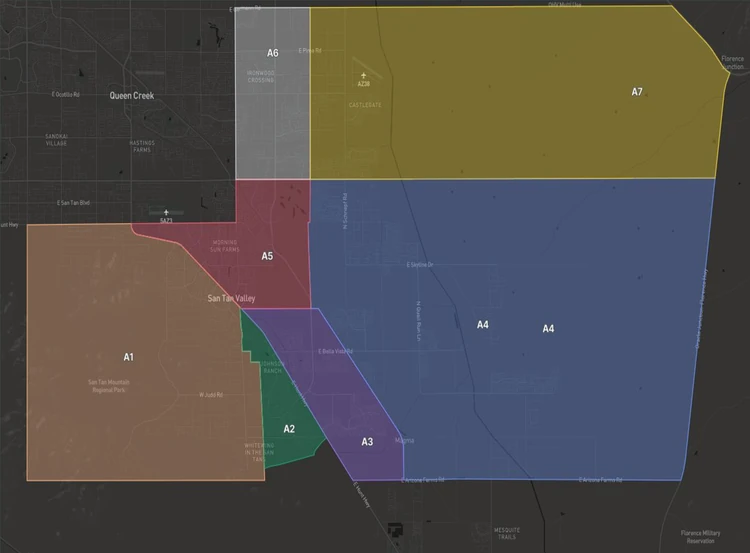
Adam One (A1) covers a broad area with 39,671 operational calls. Its top issues include welfare checks (2,950), reckless driving (2,271), and civil complaints (1,986). It recorded 2,530 traffic accidents, including 436 with injuries.
Adam Two (A2) is geographically small but high in activity. It logged 25,240 operational calls. Welfare checks topped at 2,068, followed by civil complaints (1,490) and domestic violence (1,430).
Adam Three (A3) is a small, high-volume beat with 48,934 operational calls — the highest of all seven beats. Its top issues include welfare checks (3,963), civil complaints (2,742), and reckless driving (2,600). Repossessions totaled 1,494. Teeple noted that traffic deputies posted to this area generate a high number of citations because of the vehicle volume.
Adam Four (A4) is geographically large but much of it is state trust land, farmland, and the reservoir. It generated 25,183 operational calls. Its top issues are welfare checks (1,539), disturbances (1,456), and civil complaints (1,436).
Adam Five (A5) recorded 47,184 operational calls, with 3,530 welfare checks leading all categories. Teeple told the council that “a large majority of the group homes are in this beat.” Repossessions here totaled 1,408.
Adam Six (A6) tallied 46,652 operational calls. Welfare checks (3,198) and civil complaints (2,567) led its profile.
Adam Seven (A7) had the lowest volume with 20,061 operational calls. Welfare checks (1,375) still top the list, followed by civil complaints (1,277) and domestic violence (1,063).
Across all seven beats, repossessions appeared consistently near the top. “We’re gonna go through every single beat, and you’re gonna see that people don’t pay their car payments,” Teeple said. He explained that under Arizona law, a repossession company can take a vehicle parked on the roadway without a court order, provided they complete the hookup and drive away without a disturbance. If the owner intervenes before the vehicle is fully removed from the property, the repo company must then obtain a court order.
Hunt and Bella Vista Leads Traffic Hotspots
The presentation listed the top 10 intersections by traffic incident volume:
- Bella Vista & Hunt Highway
- Gary & Hunt Highway
- Ironwood & Ocotillo
- Ironwood & Pima
- Gantzel & Bella Vista
- Gantzel & Empire
- Combs & Gantzel
- Hunt Highway & Stone Creek
- Bella Vista & Stardust Dr
- Hunt Highway & Mountain Vista Blvd
Regarding Hunt and Bella Vista, Teeple joked: “I think whoever designed the intersection that is Hunt and Bella Vista should be investigated.” He added: “It’s one a day, guys. We have at least one collision a day at Hunt and Bella Vista.”
He also recommended the city consider investing in synchronized traffic lights, pointing to the stretch along Hunt Highway where one light turns green while the adjacent light stays red. That pattern, he said, causes many low-speed fender benders.
Traffic Accidents With Injuries: Empire and Gantzel Ranks First
The presentation listed the top four intersections by accidents resulting in injuries:
- Empire & Gantzel — 148 injuries, 36 incapacitations, 10 fatalities (194 total)
- Bella Vista & Hunt Highway — 145 injuries, 32 incapacitations, 2 fatalities (181 total)
- Gary & Hunt Highway — 117 injuries, 41 incapacitations, 4 fatalities (162 total)
- Ocotillo & Ironwood — 98 injuries, 19 incapacitations (117 total)
San Tan Valley Response Times
For San Tan Valley specifically, the sheriff’s office provided updated travel times. Deputies arrive at assault calls in an average of 4 minutes and 55 seconds. Fire and smoke calls average 7 minutes and 15 seconds. Domestic violence calls average 7 minutes and 40 seconds.
County-wide, a call sits in queue for an average of about 10 minutes and 41 seconds before a deputy is assigned. Once assigned, the deputy’s average drive time is about 5 minutes and 34 seconds. Average time on scene is roughly 26 minutes. Teeple said those figures are “pretty good” by national standards, noting that some metro Phoenix departments have calls waiting about an hour before a deputy is assigned.
What the Policing Contract Will Cost — And Why It’s Not Simple
Many residents attending the meeting wanted to know what law enforcement will cost the newly incorporated city. Teeple said the answer is not ready: “We’re not even close to coming up with that number right now.”
He explained that 29 personnel — including patrol deputies, sergeants, and a lieutenant — are currently assigned to San Tan Valley. However, the total cost includes more than those positions. Detectives who handle follow-up cases, the traffic enforcement unit, county-paid insurance, fleet maintenance workers, vehicles, and dispatching costs all factor in. “It’s real easy to say, ‘How much is it going to cost us for those 29 deputies?’ But understand, this isn’t all the law enforcement professionals that service this area,” Teeple said.
The sheriff’s office hired an outside private company to compile the numbers. “So it’s fair and equitable to all of the taxpayers, is we went to an outside entity, a private company that does this sort of thing, and they’re figuring it out,” he said.
Teeple also addressed claims made at a prior incorporation meeting that the new city would immediately need to meet national staffing ratios. A commonly recognized benchmark suggests roughly 20 officers per 10,000 residents. For a community of about 100,000, that would mean roughly 200 sworn officers. However, Teeple noted that his office has 253 sworn personnel for all of Pinal County. Meeting that ratio is not realistic in the short term. The current patrol complement, plus some detectives and supporting staff, is the starting point.
He recommended the city consider hiring a deputy chief assigned specifically to San Tan Valley. “I think it would be very beneficial if you guys agreed to hire a deputy chief that’s over San Tan Valley. So, that would be your chief of police,” Teeple said. Any agreement would also need approval from the Pinal County Board of Supervisors. Teeple noted that the deputy chief position in particular “directly relates to the pocketbooks” of the Board, adding, “they hold the purse.”
Volunteer Squads and Their Role
Vice Mayor Hudgins asked whether volunteer squads could handle some welfare checks to free up deputies. Teeple said the office uses Citizens On Patrol (COPs) as eyes and ears, and the sheriff’s posse assists with perimeter security and inmate transport. However, for most welfare checks and active calls for service, sworn deputies must still respond. The volunteer impact is minimal for those call types.
Residents Call for Group Home Ordinances
During public comments, Jeanne Stockton of Johnson Ranch referenced the sheriff’s presentation and urged the council to adopt ordinances requiring group homes to be fully approved before housing residents. “The thing that’s concerning to me is that they’re housing, they’re populating those homes and they haven’t been approved,” she said.
Kenneth Diamond, a 10-year San Tan Valley resident, said his office has been investigating group home fire code compliance. He explained the difference between R3 facilities (one to five residents, no spacing requirements between homes) and R4 facilities (six to 10 residents, which have spacing requirements from other R4 homes and must meet fire sprinkler, alarm, and exit requirements). Diamond offered to assist the city in drafting group home ordinances.
Sheriff’s Office Preparing for a Continued Partnership
Teeple said he is willing to return for additional presentations and provide the council with detailed data for future planning. The presentation was informational only, and the council took no formal action.
The sheriff’s office has already realigned its Adam Region patrol boundaries to match San Tan Valley’s incorporated city limits. An intergovernmental agreement for continued contract policing is under discussion, though the cost study remains underway. Council members and residents can expect further updates as the outside firm completes its cost analysis.