Key Points
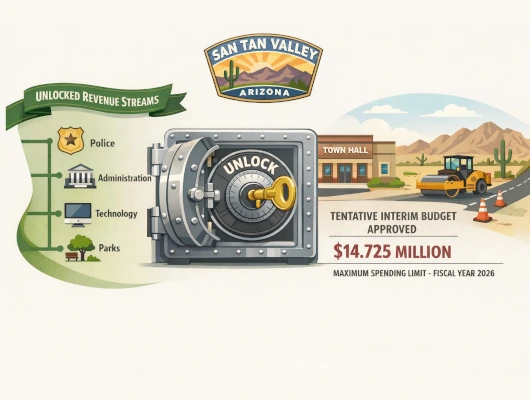
- The council unanimously approved a tentative interim budget of $14.725 million on March 4, setting the maximum spending limit through June 30, 2026.
- The budget covers two funds: a $10 million general fund and a $4.725 million Highway Users Revenue Fund restricted to road expenses.
- Much of the budget remains unallocated as the town works out costs for financial software, permitting systems, legal services, and other startup expenses still being finalized.
- Staff does not expect to spend the full $14.725 million.
- San Tan Valley had approximately $11.5 to $12 million in the bank that it could not spend until a budget was formally adopted.
- Final adoption is scheduled for April 1, 2026, following a public hearing. Spending authority begins upon final adoption on April 1.
- The town had borrowed $1.405 million from Queen Creek to cover startup costs, accruing $1,200 in interest as of February 19.
SAN TAN VALLEY, AZ — The San Tan Valley Town Council unanimously adopted a tentative interim budget of $14.725 million on March 4, 2026. Newly appointed Finance Director Gabe Garcia presented the budget at the March 4 regular meeting, updating a draft that had been reviewed at a February 19 work session. The council’s vote on Resolution No. 2026-07 sets the maximum spending limit for the rest of Fiscal Year 2026, which ends June 30. Without a formally adopted budget, the town cannot spend its own revenues. As of the February 19 work session, finance consultant Bill Kauppi of Pat Walker Consulting estimated the town had approximately $11.5 to $12 million in the bank that it could not yet spend. Final adoption is targeted for April 1, 2026. Following a public hearing, the council will immediately convene a special meeting to adopt the final interim budget.
What This Means for Residents
San Tan Valley has been borrowing from the Town of Queen Creek to cover startup costs while it waited to establish its own spending authority. Town Manager Brent Billingsley warned at the February 19 work session that spending needs would quickly outpace the town’s ability to borrow.
On March 4, the council separately approved increasing the Queen Creek financial assistance cap from $250,000 to $450,000 per month. For full details on that action and how the loan works, see the Pinal Post report on the Queen Creek financial assistance increase.
With a tentative budget now approved, the town moves toward April 1 — the date set for a public hearing and formal adoption. Once adopted, the town can begin spending its own revenues for the remainder of the fiscal year.
Where the Money Comes From
The $14.725 million budget spans two funds with different rules about how each can be used.
The general fund totals $10 million. It is funded primarily through state-shared revenues: $7.5 million in state sales tax and $2.5 million in vehicle license tax. Garcia explained that general fund money is unrestricted, meaning it can be directed toward administration, legal services, police-related expenses, community development, parks, or any other municipal purpose.
The Highway Users Revenue Fund (HURF) totals $4.725 million. HURF is funded through state collections on motor fuels, vehicle license taxes, motor vehicle registration fees, motor-carrier taxes, and other vehicle-related fees and charges. The state deposits these revenues into the fund and distributes them to cities, towns, and counties. HURF money is restricted to road and road improvement expenditures. HURF money is restricted to road purposes and cannot be used for general fund needs.
Urban revenue sharing — the state income tax component — is not included in this budget. Garcia explained that San Tan Valley will not begin receiving those funds until July 1, the start of the next fiscal year.
| Fund | Estimated Revenue | Spending Limit |
|---|---|---|
| General Fund | $10,000,000 | $10,000,000 |
| Highway Users Revenue Fund (HURF) | $4,725,000 | $4,725,000 |
| Total All Funds | $14,725,000 | $14,725,000 |
How the Interim Budget Is Structured
Garcia explained that state law requires all estimated revenues to be matched by equal expenditure authority, resulting in a zero-balance budget. The $14.7 million spending limit does not mean the town plans to spend every dollar — it means the council has authorized up to that amount.
“We may not use $14.7 million, and we hope actually not to,” Garcia said.
Billingsley described the budget as intentionally broad. “This is super general,” he said. “We did our best to identify likely expenditures. A lot of these expenditures won’t happen between May 1st and July. But we need to have a zero budget. That’s why you see a huge contingency. We just wanted to make sure we brought some things to the front that may be likely expenditures — so extremely general, but to satisfy the state requirements.”
Kauppi noted at the February work session that funds left unspent do not disappear. Unused money carries forward into the next budget year and can be reappropriated.
What Changed Between the Work Session and the March 4 Meeting
The budget presented on March 4 reflected updates from the February 19 draft. Garcia said he and Billingsley identified several expenditures that had been grouped into the contingency and moved them into their proper departments. The total general fund remained unchanged at $10 million — only the classification of certain items shifted.
| Department | Feb 19 Draft | March 4 Budget | Change |
|---|---|---|---|
| Council | $13,000 | $13,000 | — |
| Administration | $439,500 | $598,000 | +$158,500 |
| Town Clerk | $169,750 | $354,750 | +$185,000 |
| Legal | $640,000 | $640,000 | — |
| Finance | $327,900 | $327,900 | — |
| Human Resources | $169,800 | $184,800 | +$15,000 |
| Information Technology | $185,700 | $185,700 | — |
| Community Services | $657,300 | $672,300 | +$15,000 |
| Parks & Recreation | $99,100 | $149,100 | +$50,000 |
| Police | $60,000 | $60,000 | — |
| Court | $25,000 | $25,000 | — |
| Public Works | $171,100 | $221,100 | +$50,000 |
| Contingency | $6,942,750 | $6,568,350 | -$374,400 |
| Total | $10,000,000 | $10,000,000 | — |
Readers comparing these figures to the February 19 work session may notice a few things worth clarifying.
Parks & Recreation appears to show a decrease from the February 19 draft. The consultant’s draft listed Parks twice — once under General Government ($99,100) and again under Public Safety ($99,100) — for an apparent combined total of $198,200. Garcia said the duplicate entry was removed, leaving $99,100, and a parks plan consultant is included in the budget at $50,000, bringing the correct March 4 figure to $149,100.
Administration increased by $158,500 and Town Clerk by $185,000. Garcia said these increases reflect costs that were previously buried in the contingency, including office supplies, postage, legal advertising, software, and the $120,000 election expense quote that was moved into the clerk’s budget.
Public Works increased by $50,000 to cover Autodesk software, which Garcia said is needed for public works functions.
Contingency decreased by $374,000 — the combined total of all amounts moved into specific department budgets.
The $60,000 Police Budget Explained
Vice Mayor Tyler Hudgins asked staff to explain the $60,000 police line item for the public’s benefit, noting that the Pinal County Sheriff’s Office currently provides law enforcement services to the area.
Billingsley said the funds are not a payment to the Sheriff’s Office. Instead, the money is budgeted for consulting services the town may need as it negotiates various agreements with the county. He gave the example of how development impact fees collected by the county translate into projects under the town’s infrastructure improvement plan, noting that police could be one of those specialized negotiation areas. The line also includes off-duty security management for council meetings, which Garcia estimated at roughly $10,000.
“We may get a proposal from Pinal County, and we provide it to council and council says, ‘Whoa! What about this and what about that?’ We’re not experts in police, so we may need to hire a contractor to come in and help us with that,” Billingsley said.
High-Cost Items and Startup Expenses
Software and technology costs represent a significant portion of the town’s startup expenses, spread across multiple departments. The following table consolidates software and technology-related expenses identified across departments, totaling $344,100.
| Software / Technology | Department | Budgeted Amount |
|---|---|---|
| Permitting software / Bluebeam | Community Services | $100,000 |
| Financial software implementation | Finance | $59,100 |
| ESRI mapping software | Administration | $50,000 |
| Pinal County lease / IT support | Information Technology | $50,000 |
| Autodesk | Public Works | $50,000 |
| Council upgrades | Information Technology | $25,000 |
| Adobe | Administration | $10,000 |
| Total | $344,100 |
Mayor Daren Schnepf acknowledged the cost reality: “Moving forward, we’re gonna have a loaded front end on all these prices because we have no software. But once we get the software, it’ll be the maintenance of it, the updates — and so that’s why this is an important time for us.”
For financial software, Billingsley identified Tyler Technologies’ Munis platform — used by several Pinal County jurisdictions, including Maricopa — as the recommended candidate under a state cooperative contract. He said the negotiated price came in below the originally budgeted $125,000. Garcia said the town aims to have the system operational before July 1, though payroll modules may not be live until October.
Legal services total $640,000, based on the current contract with Pierce Coleman PLLC, the town’s law firm.
Community Services totals $672,300. It includes personnel for a community services director, building official, senior planner, and permit supervisor, plus $215,000 in consultant services covering two ESI contract employees for the impact fee study and zoning code update.
HURF funds can be used for highway construction, improvements, and other related expenses. In this interim budget, $4.725 million is allocated to pavement maintenance. Kauppi said at the February work session that the town will likely need an intergovernmental agreement with Pinal County to perform that work initially.
Personnel costs across the general fund cover 15 full-time equivalent positions, broken down as follows:
| Category | Amount |
|---|---|
| Salaries and hourly costs | $513,600 |
| Retirement costs | $61,500 |
| Healthcare costs | $54,000 |
| Other benefit costs | $44,000 |
| Total | $673,100 |
Spending Rules and Oversight
An expense appearing in the budget does not grant staff automatic spending authority. Garcia said procurement thresholds still apply, and certain expenditures must come back to council for authorization regardless of whether funds are allocated.
The interim budget also differs from the town’s annual budgets in reporting requirements. Finance consultant Bill Kauppi noted at the February work session that Auditor General forms A through G are not required for an interim budget, and an annual independent audit is not required for this partial year. Once the town completes its first full fiscal year, an audit will be required.
The Interim Budget Does Not Set Next Year’s Baseline
Under Arizona Revised Statute 42-17110, a newly incorporated city or town may adopt an interim budget for the remainder of the fiscal year in which it was incorporated. The statute states that the interim budget is not a base for computing allowable increases in the budget for the succeeding full fiscal year, and that the next budget may be made as if no interim budget had been adopted.
Billingsley noted that once the council votes on a tentative budget, the final adopted budget cannot exceed that figure. Kauppi said the town’s first full annual budget for fiscal year 2026–27 will follow the normal adoption process starting around May or June.
Mayor Schnepf said: “The next budget we do for the next fiscal year will be a little more sharp and a little more directed because we’ll have already been through this. There’s a first for everything. This is our first budget, and we’ll be able to tighten it down a little better. We have to start somewhere. This is good for us to have, so we can start spending some of our own money that we’re receiving. That’s very important for us as a town to start becoming self-sufficient and able to do what we need to do.”
Upcoming Budget Dates and Public Participation
The tentative budget will be published for two consecutive weeks in a local newspaper. After that, the following schedule applies:
- April 1, 2026: Public hearing at 6:00 p.m., Pinal County San Tan Valley Complex, Bronze Room, 31505 N. Schnepf Road. Following the hearing, the council will convene in a special meeting and adopt the final interim budget. Spending authority begins upon adoption.
- June 30, 2026: End of Fiscal Year 2026 and close of the interim budget period.
- May–June 2026: Work begins on the first full annual budget for fiscal year 2026–27.