Key Points
- No decisions were made. The March 2 study session was informational only.
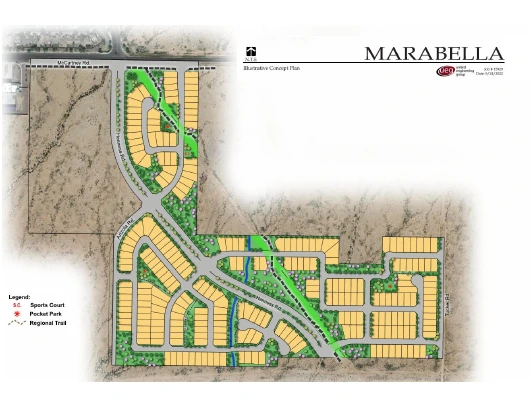
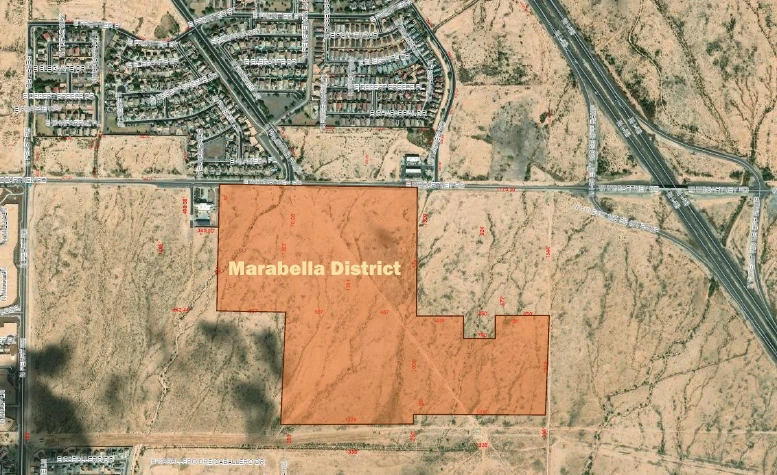
- The proposed Marabella development is a 104-acre, 500-unit master-planned community near Henness and Kortsen roads.
- The developer seeks to form a revitalization district to help finance water, sewer, and roadway infrastructure.
- Future homeowners could pay an estimated $1,773 per year in additional taxes and assessments, according to the developer’s presentation.
- A revitalization district is controlled by a landowner board, not the City Council. The city carries no financial liability.
- The developer owes Arizona Water Company approximately $6.3 million before construction can begin. Bond proceeds from the district would cover that cost — the primary driver behind the request.
- The 104-acre project carries infrastructure costs — oversized roads, water, and sewer lines — more typical of a 400- to 600-acre development.
- City staff expects to bring a formal revitalization district policy back to council by early summer 2026.
- Construction could begin in January 2027. First home closings are targeted for July 2028.
CASA GRANDE, AZ — The Casa Grande City Council heard a presentation on March 2, 2026, about a proposed Marabella revitalization district. The developer’s presentation estimates the district could add roughly $1,773 per year in additional taxes and assessments for future homeowners. The 104-acre, 500-unit development seeks to use special assessment bonds to pay for water, sewer, and roadway infrastructure. No decisions were made during the study session. Council members and city staff stressed the meeting was informational only.
City Manager Larry Rains said staff would likely bring a formal revitalization district policy back to council by early summer 2026.
What the Marabella Project Plans to Build
RMG Marabella, LLLP proposes a master-planned community located east of North Peart Road, north of East Kortsen Road, and west of Henness Road. The project would include two phases. Phase 1 consists of 250 single-family detached homes. Phase 2 consists of 250 built-to-rent units.
The development’s presentation estimated infrastructure costs at approximately $32.5 million for Phase 1 and shared backbone improvements. That figure does not include in-tract costs for the built-to-rent phase. The developer seeks to finance a portion through the revitalization district and would cover the remaining costs directly.
Planned improvements include water and sewer systems, storm drains, box culverts, dry wells, streetlights, curb and gutter, paving, utility trenching, landscaping, and parks.
Why Marabella Chose a Revitalization District
Pam Giss, of LAUNCH Development Finance Advisors, told the council that “there are a number of different cost issues that are driving the problems that we’re having with this project. But one of them is a very massive obligation that we owe to AWC to get this thing started.”
The project must pay Arizona Water Company (AWC) approximately $6.3 million upfront for well supply infrastructure, arsenic removal, booster pump stations, water storage tanks, and main extensions. “There’s just no way for a project of our size to absorb those costs,” Giss said.
Giss explained the team originally explored a Community Facilities District (CFD). However, a CFD cannot finance private utility infrastructure such as AWC water lines. A revitalization district can. City Manager Rains confirmed that “under the current statutes today, CFD financing cannot be utilized for private utility infrastructure.”
Additionally, a CFD’s general obligation bond structure does not work well for smaller projects. A project of this size, she said, would not “generate enough tax revenue from a general obligation, ad valorem [assessed-value-based] tax, to really move the needle much.”
Infrastructure Costs Burdening the Developer
The developers outlined several categories of exceptional costs beyond the AWC obligation.
Oversized roadway requirements force the project to build Henness Road as an arterial with a 105-foot right-of-way, four travel lanes, a turn lane, and two bike lanes. A typical subdivision road would require a 60-foot right-of-way with two lanes.
Oversized sewer lines are required to support surrounding growth. The project needs 10-inch and 12-inch sewer lines instead of the standard 8-inch lines. Similarly, oversized water lines on Henness Road and Tucker Road must be 16 inches instead of 8 inches. These sewer and water upsizes add an estimated $1.5 million in additional costs.
Together, these requirements push the project’s effective infrastructure burden to a level more typical of a 400- to 600-acre development, according to Giss.
Three Special Taxing District Options for Casa Grande
Nick Dodd of Raymond James gave the council an overview of the three types of special taxing districts available to Arizona cities.
A municipal improvement district is typically city-initiated. If property owners fail to pay, the city must backstop the payments. “At the end of the day, you’re on the hook for an improvement district,” Dodd said.
A Community Facilities District is what Casa Grande already uses in communities like Mission Royale. A CFD can issue both general obligation bonds and special assessment bonds. The City Council sits as the district board, sets annual budgets, and approves bond deals. City staff serves as district staff.
A revitalization district resembles a CFD with two key differences. First, it cannot issue general obligation bonds. It can only issue special assessment bonds and revenue bonds. When Councilmember Matt Herman asked whether the district could sell GO bonds, Dodd confirmed it could not.
Second, “city council does not sit as the board. It is a landowner-controlled board,” bond counsel Zach Sakas said. Once formed, the district is governed by a three-member board of directors who must own real property in the district. The city council appoints the initial board under ARS 48-6801 and related sections{target=”_blank”} The city has no financial obligation to support or backstop the district, and the city’s general fund carries no liability.
Dodd said the development agreement negotiated before formation would set the framework for what the district can do. Beyond that, the landowner board would decide when to sell bonds and on what terms.
How a Revitalization District Generates Revenue
Sakas and Dodd outlined several methods a revitalization district can use to generate revenue.
Sakas said the district can issue special assessment bonds, where individual assessments are assigned to parcels based on the benefit received, as determined by a district engineer. Dodd noted that in practice, each lot typically pays the same amount. Sakas said a landowner election is required upfront to approve a maximum assessment interest rate. This differs from a CFD, where no election is required for special assessments.
The district can also issue revenue bonds, which are repaid from income generated by a specific project or enterprise — not from taxes. Sakas said these are most commonly used when a district owns a utility or similar revenue-generating operation. Dodd described them as secured by a “dedicated identified revenue source.”
Additionally, the district can levy a property tax for operations and maintenance. According to the presentation, this tax is calculated as a rate per $100 of a property’s assessed value. The statutory default maximum is $0.30 per $100. The presentation noted the rate can increase following a landowner election and vote of the district board. A landowner election is also required to impose this tax initially. Sakas noted the revenue from this tax pays for running the district — not for debt service on bonds.
Powers and Limitations of the District
The district can collect revenues, assess property, and enforce those assessments. Sakas told the council: “Included in the ability to levy assessments is the ability to enforce those assessments. So if there’s delinquent payments, there is the ability to foreclose.” He added that even though the city does not operate the district, there may be “headline risk or policy concerns that somehow people think the city did it” if a homeowner faces foreclosure.
However, the district has “no zoning power, no eminent domain,” Sakas said. “All the entitlement agreements related to development remain with the city. The revitalization district is really a financing conduit for infrastructure purposes, and there’s no other sort of powers that are delegated to it by the city.”
“As its own freestanding political subdivision, it would adopt an annual budget, comply with open meetings laws, no conflict of interest, compliance, those sorts of things,” Sakas said. By default, the statute assigns city staff to serve as staff to the district. However, Sakas said “most cities that I work with do not like that” and instead require the landowner to hire separate staff. He called it a policy choice Casa Grande would need to consider.
According to the presentation, eligible projects include roadways, wastewater, water, flood control, drainage, lighting, traffic control, landscaping, parks, pedestrian malls, multipurpose facilities, and parking structures. The district may not fund professional sports facilities.
What the Assessment Means for Homeowners
The Marabella developer proposes placing approximately $20,000 in special assessment liens on each lot to net $7.75 million for infrastructure after associated bond costs and reserves.
The purpose of the district is to provide upfront financing. Once the bonds are issued, the proceeds pay for infrastructure — including the $6.3 million AWC obligation — before any homes are sold. As Sakas explained, this allows the developer to “finance those earlier in the process” rather than waiting to recapture costs through home sales. The developer pays the assessment installments while it still owns the lots. As homes sell, the new owners take over those payments. The bond proceeds also include 12 months of capitalized interest to cover debt service during early development.
According to the presentation’s financial projections, each homeowner would pay an estimated $1,773 annually — $1,668 in debt service and $105 for district operations and maintenance. The bonds carry a projected interest rate of 6.5% and are amortized over 24 years. On a home priced at approximately $380,000, the total annual tax burden including existing property taxes would be roughly $4,313. Those projections assume an operations and maintenance tax rate of $0.50 per $100 of assessed value, which exceeds the $0.30 statutory default. The statute allows a higher rate with landowner approval.
Homeowners may prepay the assessment at any time without penalty. Giss cautioned, however, that “the market’s not going to recognize that pre-payment.” A homeowner who prepays is unlikely to see a higher resale price, she said, because “the next buyer of that house is probably not going to pay me more because I’ve paid off my assessment.”
How Assessments Work for Property Owners
Unlike a mortgage, the special assessment stays attached to the property. They “run with the land,” as Sakas explained, transferring automatically with ownership.
Councilmember Herman asked how homeowners would see these charges. Sakas said the operations and maintenance property tax would show up as a line item on the property tax bill. For the special assessment, he said the district could either bill homeowners directly or enter an agreement with the Pinal County Treasurer to add it as a line item. Drawing on his experience with CFDs and other districts, Sakas said most choose the Treasurer route.
Giss confirmed the assessment would apply to all property in the district, including built-to-rent parcels. For rental parcels, however, “the owners may prefer to just write the check upfront, which they can do,” she added.
Home builders must disclose the special taxing district in their public report. Homeowners must also sign a document acknowledging the assessment before closing.
City Manager’s Comments and Formal Policy Expected by Summer 2026
City Manager Larry Rains acknowledged the Marabella project, at 104 acres, is smaller than what would typically qualify under the city’s acreage-based policies. Projects of that size do not normally carry the infrastructure costs Marabella faces — oversized roads, water, and sewer lines required to serve surrounding development, plus a $6.3 million upfront payment to AWC. However, Rains said those unique burdens justified consideration. Rains said staff would set a minimum acreage requirement for the city’s formal revitalization district policy. Councilmember Herman asked whether the policy would also account for smaller developments with disproportionately high infrastructure costs. Rains acknowledged the idea, saying “right, an equation,” but added that those details would be part of future policy discussions.
The developer presented the following timeline:
- Zoning and entitlements: Already completed
- Backbone and Phase 1 construction: January 2027
- Sale of parcels to home builders: January 2027
- Model home construction begins: October 2027
- Homes offered for sale: January 2028
- Home construction begins: January 2028
- First home closings: July 2028