FLORENCE, AZ – Joe Singleton from the Pinal County Water Augmentation Authority updated Florence Town Council on its cloud seeding efforts on Feb. 17, 2026. During the regular council meeting, he shared his own analysis of how much additional rainfall cloud seeding could generate and what it costs. His remarks also covered groundwater modeling, new state water programs, and long-term infrastructure efforts.
The presentation was an information-only agenda item. Mayor Keith Eaton invited Singleton to help newer council members understand the authority’s work.
What Is PCWAA and How Does It Relate to the County?
Despite its name, the Pinal County Water Augmentation Authority is not a county office. PCWAA is a separate corporate and political body created under Arizona Revised Statutes, Sections 45-1901 through 45-1999. It operates with a volunteer board of directors appointed by its member organizations.
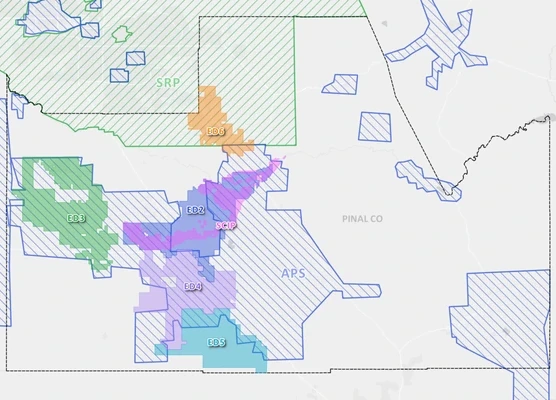
Its statutory purpose includes regional water planning, assisting providers in meeting the 1980 Groundwater Management Act, cooperating to augment water supplies, and representing Pinal Active Management Area interests in Arizona water policy. Singleton explained that the Pinal AMA differs from Pinal County in geography. It is based on hydrologic sub-basins, not political boundaries. For example, he said the eastern part of the county falls outside the AMA. Meanwhile, Apache Junction in the far north belongs to the Phoenix AMA.
The board includes representatives from five municipalities — Casa Grande, Coolidge, Eloy, Florence, and Maricopa — along with Pinal County, two irrigation and drainage districts, a domestic water improvement district, and two private utilities. Mayor Eaton currently represents Florence on the board. Singleton said these groups are not always sitting at the same table elsewhere. He added that private water companies and irrigation and drainage districts, in particular, do not often participate alongside municipalities in other settings.
Cloud Seeding Pilot Targets Monsoon Season Rainfall
PCWAA completed a cloud seeding feasibility study roughly two and a half to three years ago. Based on those findings, it launched a pilot program during the 2025 summer monsoon season covering July, August, and September. According to Singleton, the process uses crystals or salts to seed clouds and increase rainfall efficiency. He said these materials pose no threat to the environment. He also said cloud seeding does not disadvantage downwind areas because it works by extracting moisture from clouds more efficiently rather than diverting it.
According to Singleton, the feasibility study indicated that there would be an average of 23 days during the summer monsoon seeding season where cloud seeding conditions could be effective. The final report is available on the PCWAA website.
August 2025 Cloud Seeding Flight Log
The PCWAA cloud seeding pilot, formally called the Pinal Authority Creating Enhanced Rainfall (PACER) program, conducted eight flights in August 2025, deploying 19 salt-based flares across Pinal County. Seeding operations took place near Eloy, Stanfield, Mammoth, and other locations in the central-to-eastern part of the county. The following table shows the flight log for the month.
| Date | Flares | Flight Minutes | Area Seeded |
|---|---|---|---|
| 1 August | 3H | 69 | Pinal |
| 3 August | 3H | 56 | Pinal |
| 16 August | 0H | 66 | RECON |
| 16 August | 3H | 51 | Pinal |
| 20 August | 3H | 55 | Pinal |
| 21 August | 4H | 38 | Pinal |
| 26 August | 1H | 22 | Pinal |
| 26 August | 2H | 45 | Pinal |
| TOTAL | 19H | 402 |
“H” indicates a hygroscopic (salt-based) flare. “RECON” indicates a reconnaissance flight with no flares deployed.
A haboob swept through Pinal County on Aug. 25, 2025. The dust storm occurred during the monsoon season while the PACER program was operating in the area. No seeding flights took place on Aug. 25.
A haboob sweeps through Pinal County on Aug. 25, 2025, as seen from Apache Junction. No PACER cloud seeding flights took place that day. (Video: City of Apache Junction)
The full August 2025 operations report is available on the PCWAA website.
Estimated Water Gains and Cost per Acre-Foot
Councilmember Tony Bencina asked about the projected increase in rainfall from cloud seeding. Singleton explained that meteorologists estimated results using the entire county’s acreage and rain gauge data from various sites. However, he went back and refined those numbers. First, he reduced the acreage to reflect where PCWAA was actually operating — the Pinal AMA minus Tohono O’odham lands. Second, he removed rain gauge data from sites outside the Pinal AMA. Those sites included a gauge at what he called “the Arboretum,” which he said is in the Phoenix AMA, and Oracle State Park, which he said is just outside the Pinal AMA.
After those adjustments, Singleton said he thinks he arrived at about 34,000 acre-feet of water. He said he thinks the total cost paid to the cloud seeding operator came to under $6.50 an acre-foot of water. He described that figure as “orders of magnitude cheaper than I can get water supplies any other way.”
Council Questions on Public Notice and Effectiveness
Bencina also asked whether cloud seeding contributed to the strong rains during the past monsoon season. Singleton said the authority believes it did, though he acknowledged the estimates remain estimates. He said PCWAA is looking at ways to possibly refine and better define those measurements.
Bencina further asked whether the public had been warned about increased rainfall. Singleton said public notification fell short. He explained that the state permitting process requires a license for cloud seeding. Because of his background working for the state, he said he got used to those kinds of things containing a public notice provision. He said PCWAA did discuss the program at its board meetings, so member organizations were aware. However, he said he did not know how well that information reached all 11 member organizations.
“Ultimately, I should have done a better job in making sure that the public was aware of what we were going to do,” he said.
Mayor Eaton also acknowledged the notification gap. He noted that cloud seeding is not a new concept, recalling its use in Illinois when he was a child. He said the board agreed it could have done a better job notifying the public. He said he thinks residents will see a different approach to communication going forward.
Groundwater Modeling and the Assured Water Supply Program
Singleton also addressed PCWAA’s work on groundwater modeling for the Pinal AMA. He said the authority hired Matrix New World to analyze the Arizona Department of Water Resources (ADWR) 2019 groundwater model. According to Singleton, that model suggested a shortfall in physically available groundwater that could impede future subdivision development. He said PCWAA supported technical work through a stakeholder group that submitted recommended changes to ADWR on how the agency interprets the model and administers the Assured Water Supply (AWS) program. He noted PCWAA was not the only organization supporting that effort.
Out of the governor’s stakeholder group came a new concept called ADAWS, or an alternative path to a designation of Assured Water Supply. Singleton said this program was designed within existing AWS rules to let some subdivisions continue development even though the model showed a lack of physically available groundwater. In exchange, he said it will require a portion of new renewable water supplies to offset some legacy groundwater use. The program would also require accounting for non-subdivision groundwater use and pre-AWS rule uses that might not have been accounted for in the program otherwise. He described this as a concession the state requested in return for allowing those subdivisions to move forward.
Ag-to-Urban Credits and Bartlett Dam Expansion
According to Singleton, a separate program known as “Ag-to-Urban” offers credits toward physically available groundwater. It works through the permanent relinquishment of an agricultural groundwater right. He said the land must meet specific irrigation history criteria. Singleton said the program is currently contemplated in rule and statute, though the process is still evolving. He noted that the credit available in the Pinal AMA is relatively modest compared to the Phoenix AMA. He said he thinks Pinal County’s agricultural growers may have already been using water more efficiently than those in the Phoenix area, which meant less water savings to capture when those rights are relinquished.
On infrastructure, Singleton said PCWAA joined as a steering committee member and cost-share partner for a feasibility study of Bartlett Dam modification alternatives. He said the predominant opinion is to raise the dam’s height to offset storage capacity that the Salt River Project has lost elsewhere in its system. A group of private partners hopes to split any new capacity over and beyond what is needed, he added. However, he noted the project involves federal agencies and is not moving quickly.
SRP-CAP Interconnect Facility and Desalination Updates
Singleton also described a separate but related project called the SRP-CAP Interconnect Facility, or SCIF. Singleton explained that a one-way connection currently allows Central Arizona Project water to flow into the SRP system. The proposed SCIF would allow SRP water to flow the other direction, through the CAP canal. He said this would be the easiest and most direct route to deliver any new water gained from Bartlett Dam modifications down to the Pinal AMA.
Councilmember Jose Maldonado asked about the status of desalination efforts. Singleton said he has not heard much about them recently. He recalled a specific project proposed for Mexico whose timing, he said, “got derailed.” He also mentioned that the Water Infrastructure Finance Authority of Arizona, or WIFA, had solicited project applications. According to Singleton, some of those funds were intended to focus on bringing water supplies in from out of state. However, Singleton said he does not think the original desalination proposal he was aware of stood up to the first round of questions.
Speaking personally and not on behalf of the process, Singleton said desalination may ultimately need to be part of the region’s water strategy. However, he said no one had adequately explained how desalinated water from Mexico would physically reach central Arizona without a conveyance mechanism. Singleton committed to following up with WIFA on the status of submitted projects and reporting back through Mayor Eaton.
Continued Monitoring of Water Legislation
Mayor Eaton closed the discussion by noting he has begun sharing legislative tracking reports with council. Those reports, prepared by Compass Strategies, cover water-related bills that PCWAA and its partners are following during the current session. Singleton’s presentation required no council action.