Key Points:
- Planning and Zoning Commission voted 4-3 to recommend denial on January 15, 2026.
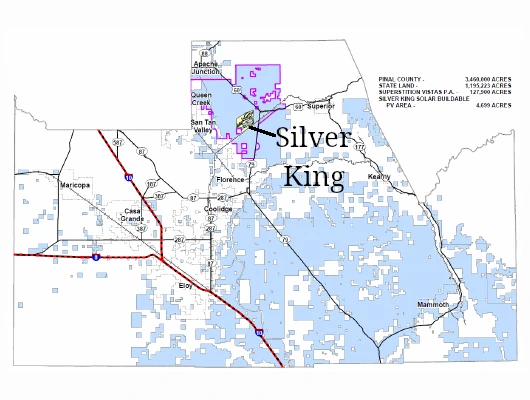
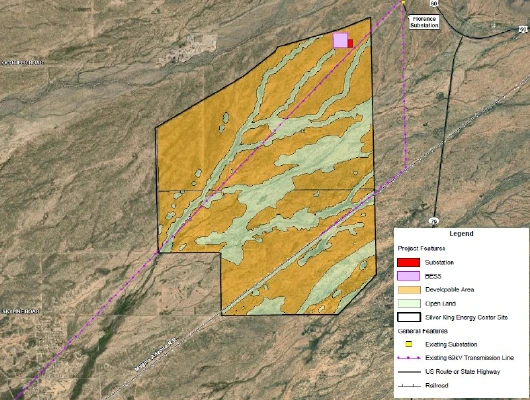
- 8,122-acre application area on State Trust Land near Florence Junction; actual solar footprint roughly 4,600 acres.
- Includes 800 MW solar, 800 MW battery storage for four hours, and up to 400 MW natural gas generation.
- Applicant claims undisclosed power customer under NDA would generate $1 billion in economic output.
- Commissioners questioned vague mixed-use plans and whether tax revenue would reach local communities.
- Board of Supervisors will make final decision in February.
The Pinal County Planning and Zoning Commission voted 4-3 to recommend denial of the Silver King Energy Center on January 15, 2026. This proposed 8,122-acre energy facility near Florence Junction would be the largest renewable project in county history. Commissioners raised questions about mixed-use plans and whether economic benefits would reach Pinal County residents. The discussion lasted nearly three and a half hours.
What the Recommendation Means for Local Residents
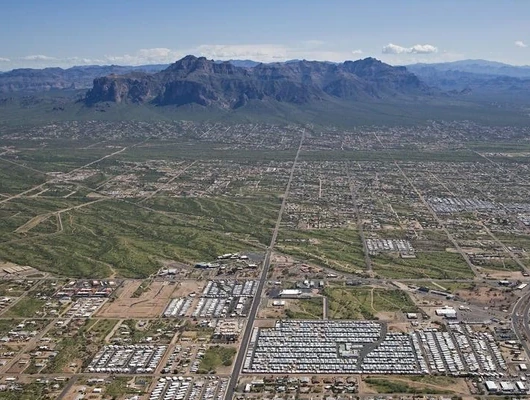
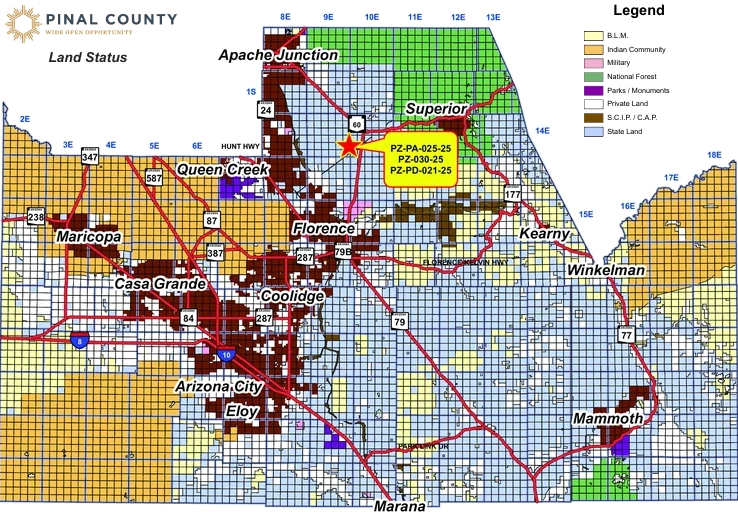
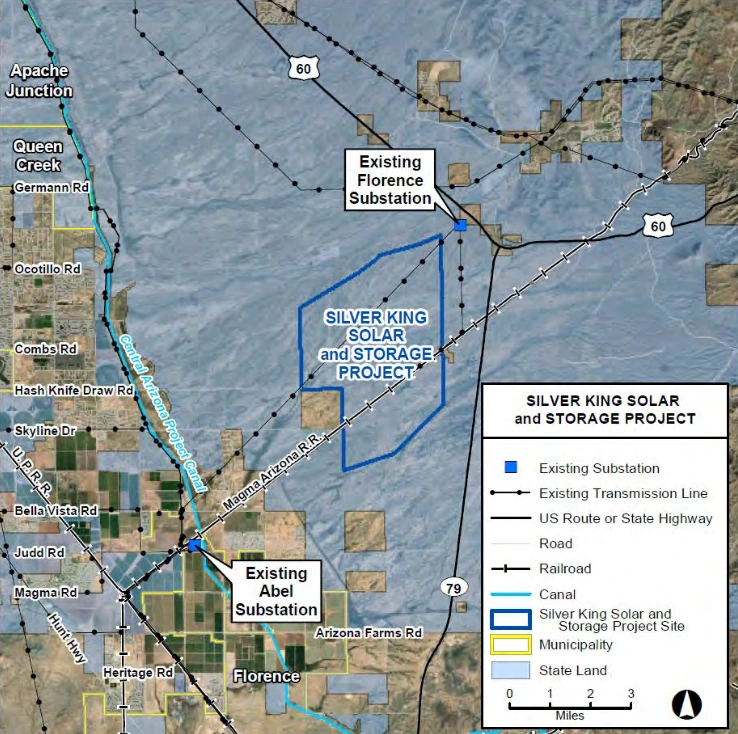
The Silver King Energy Center would occupy Arizona State Trust Land southwest of Florence Junction.
Arevia Power, a Nevada-based developer, proposed generating up to 800 megawatts of solar power. The project also includes 800 megawatts of battery storage (3,200 megawatt hours) and up to 400 megawatts of natural gas thermal generation.
However, the application area of 8,122 acres differs from the actual solar development footprint. Dave Lundgren of Arevia Power clarified this distinction during the hearing. “Our application area that we’re looking for the rezone and the PAD and the minor comp plan amendment is 8,122 acres,” he said. “The size of the solar development is gonna be roughly 4,600 acres.”
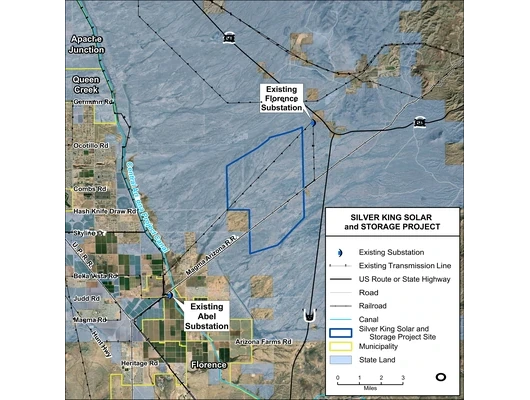
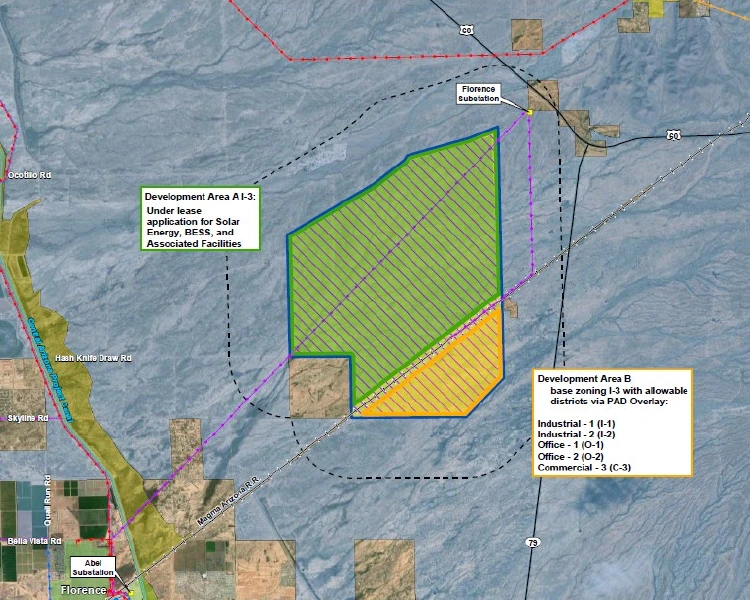
The project splits into two development areas. Development Area A, covering 6,671 acres north of the Magma Arizona Railroad, would house solar panels and battery storage. Development Area B, spanning 1,451 acres south of the railroad, would contain a thermal generation facility and future mixed employment uses.
Economic Benefits Questioned by Commissioners
Commissioner Tom Scott, who also sits on the Coolidge Planning and Zoning Commission, raised questions about where tax revenues would flow. He described watching a solar project in Coolidge that promised $1 million annually but delivered far less.
“They were promised a million dollars a year,” Scott said. “I’ve been watching that project for four years. And it started out at $48,000, and the next year went down to $44,000, and now it’s down to $38,000.”
Scott questioned whether the projected tax revenues would benefit local communities. “The problem for the communities is it’s paid to the state,” he said. “And then our governor reallocates those funds and we do get money back.”
However, according to the Arizona Department of Revenue, property taxes are collected by the county treasurer and distributed directly to local taxing jurisdictions. The gap between a project’s total property tax and what a single municipality receives reflects how those taxes are divided among multiple entities: the county, school districts, community colleges, fire districts, library districts, and other special districts.
The applicant’s economic study illustrated this distribution. Of the projected $202.3 million in property taxes over the project’s lifetime, Pinal County would receive $66.2 million, school districts $91.6 million, and special districts $44.4 million.
Chairman Morris Mennenga remained skeptical. “The little pittance that dribbles down to the county, it’s pretty minor,” he said. When a public commenter argued that housing would generate more tax revenue than solar, Mennenga agreed, estimating residential development would produce “somewhere around 20 to 30 times what this will generate.”
Where the Lease Money Goes
The project would generate approximately $202 million in Arizona State Land Department lease payments over its lifetime. Lundgren acknowledged these payments benefit state trust beneficiaries broadly rather than Pinal County specifically.
“We have two sources of revenue that are going to the state and to the county,” Lundgren explained. “We have the direct taxes that should be a benefit directly to the county. And we have the lease payments, which are substantial, and those go to the state trust beneficiaries, which counties, schools are part of that.”
The primary beneficiary of these lease payments would be Arizona State University through the Normal School trust designation. “Now, those monies are distributed across the entire state, and how much of those dollars come directly back to this community, I can’t speak to that,” Lundgren said, noting that the state determines the distribution.
Subsidies and Federal Tax Credits
Commissioner Gary Pranzo asked directly whether the project receives federal subsidies. Lundgren clarified the distinction between various federal programs.
“We do not receive subsidies for our project,” Lundgren initially stated. He then elaborated on tax credits. “Some subsidies from the government are through loan programs or other grants. And we do not participate in loan programs or grants from the federal government.”
The project would utilize investment tax credits, which Lundgren described as helping “drive additional institutional investment into projects like this.” The applicant’s economic study estimated $2.9 billion in capital expenditures.
Rail Line and Future Development Questions
Vice Chairman Robert Klob expressed concern about the project’s impact on future economic development. Many Pinal County communities use rail access to attract industrial employers.
“Numerous communities that we have throughout Pinal County are looking at these rail lines for industrial development,” Klob said. “In Maricopa, we’ve allocated special space just for rail line development, industrial development. Casa Grande’s been making a killing at doing it for numerous years.”
John Krieg, a Queen Valley resident, spoke during public comment. He said the land could generate more economic value as housing or industrial development. “When you take 8,000 acres and you put houses on that, the property value of that and the taxes you’ll get off that is much more than you’ll get than $213 million over 30 years,” Krieg stated.
Arevia’s Community Contributions
Arevia Power reported contributing $175,000 to local organizations to date. When Scott asked whether contributions would continue for the project’s duration, Lundgren did not commit to specific figures but said, “Our kind of ethos is that we are a local partner.”
The applicant is also negotiating a development agreement with the county for regional transportation funding and a separate agreement with the Superstition Fire and Medical District for infrastructure contributions. Chairman Mennenga noted the county agreement would be a first for solar projects in Pinal County.
SRP Power Demand Expected to Double or Triple
The applicant said the project addresses regional power needs. During discussion, references were made to a special session the Board of Supervisors held with utility representatives.
“From SRP directly to the special session that they held with the Board of Supervisors, they estimated that their system will need to double, if not triple, over the next decade,” Lundgren reported.
Pranzo questioned the magnitude of this projection. “Not double, I’m sure. Substantial,” he responded. “I wonder how much of that investment SRP is making.”
Undisclosed Power Customer
Hayes said Silver King is in advanced negotiations with a power customer he could not identify. “Silver King Energy Center is in advanced commercial negotiations with an end-user that has recently received entitlements from a municipality in Pinal County,” he said. “There are NDAs, and given the kind of sensitive nature of where those agreements are, I can’t share the specific user or the specific location.”
Hayes claimed the undisclosed customer would generate significant economic activity. “At the low end of their projections, this end-user is expected to produce almost a billion dollars of economic output directly benefiting Pinal County,” he said.
Vice Chairman Klob expressed skepticism about approving a project based on an undisclosed agreement. “We can’t talk about it, we don’t know about it. Well, then technically they don’t exist at this point,” he said. “Hard to approve something that is, you know, a maybe, we can’t tell you.”
Hayes acknowledged the timing challenge. “This is a little bit of a chicken and egg situation,” he said. “SRP can’t plan and its end-user can’t plan on this project if it doesn’t exist.”
Why This Location Was Chosen
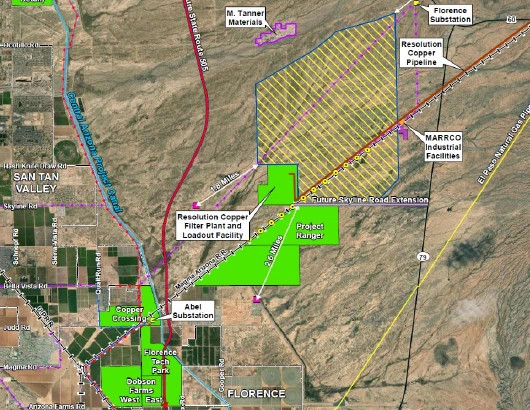
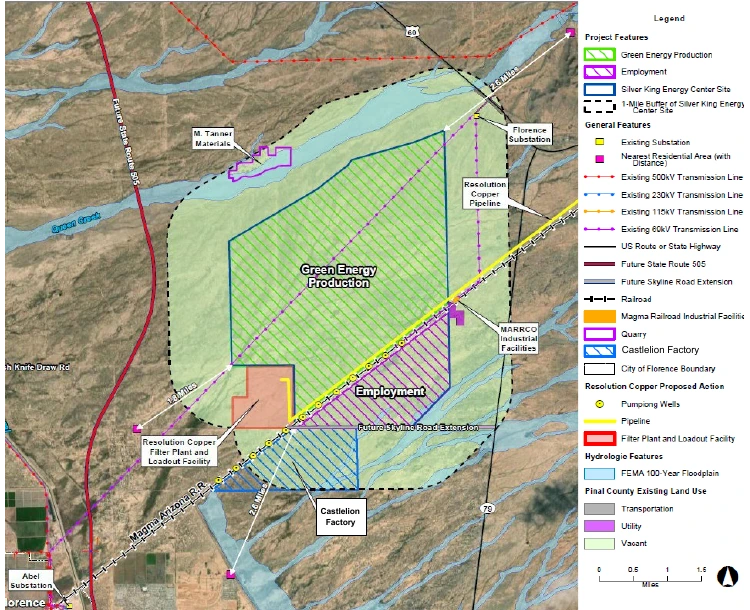
The site sits between two major substations. The existing Florence Junction Substation lies immediately northeast of the project area. The Abel Substation connects via an existing transmission corridor that crosses the property.
“This site was chosen because of its compatibility with energy generation and employment uses,” explained Alex Hayes, the project’s legal representative. “There’s existing energy infrastructure that bisects the site.”
Hayes also noted nearby industrial activity. Resolution Copper owns a facility southwest of the site. Project Ranger, a recently approved hypersonic missile testing facility, lies directly south.
The thermal generation component would draw from nearby natural gas infrastructure. Hayes mentioned the existing large natural gas line and the incoming TransWest pipeline as available fuel sources.
San Tan Valley Town Manager Raises Concerns
Brent Billingsley, Town Manager of San Tan Valley, submitted written concerns about the project. County staff shared his comments with commissioners before the meeting.
Billingsley noted the project narrative estimated only 10-15 long-term operational jobs for the solar component. He expressed concern about the project consuming thousands of acres of developable land. Additionally, the Arizona State Land Department had not contacted San Tan Valley about the proposal despite its proximity to the town.
County staff summarized that the town “has concern about locating large industrial solar, gas-fired power plant, and other heavy industrial development adjacent to the town in general.”
Special District Zoning and Mixed-Use Questions
The project sought a “Special District” land use designation, a comprehensive plan category created in 2022 specifically for Arizona State Trust lands. This designation allows for flexible mixed-use development including green energy production.
Commissioner Karen Mooney questioned whether the application met Special District requirements. “Did you add the mixed use so that you could, since it was withdrawn from the major comp plan, you didn’t have to wait till next year’s major comp plan changes?” she asked.
The project was previously submitted as a major comprehensive plan amendment in 2025. The Citizens Advisory Committee recommended denial, and the applicant withdrew before the Planning and Zoning Commission hearing.
Hayes explained the change came from stakeholder feedback. “The change in the project design was done in coordination with the community and stakeholders, county officials,” he said. “Adding a thermal generation component and then the ASLD additional employment entitlements is actually what the county would prefer.”
Staff planner Valentyn Panchenko clarified the Special District requirements. “For the Special District, in order to be qualified for that, applicant need to show mixed use,” he explained. However, he acknowledged “there is no requirements from the county side that we can request from the applicant to provide” specific acreages for different uses.
Multiple commissioners questioned the lack of specificity in Development Area B plans.
“Show me, don’t tell me,” Klob said. “Per your presentation, you got the 1,400 acres. But it could be, in theory, based on what you’ve presented here, one acre we’re gonna put some offices there, that’s employment, and 1,399 are then solar.”
Commissioner Wallace Keller agreed. “It’s just too vague,” he said. “Way too vague for what it is and the amount it is and where it’s going.”
Hayes said the Arizona State Land Department, which owns the land and receives lease payments as trustee for state beneficiaries, wanted flexibility for future auctions. “They want to establish the entitlements that would encourage additional employment development here,” he said. “What that ultimately develops as is up to future developers who can go through that ASLD auction process and propose something here in the county.”
Wildlife Corridors and Fencing
The applicant said the project includes provisions for wildlife movement across the site. Approximately 2,000 acres would remain as open space, primarily along drainage corridors.
Pat Golden, a wildlife biologist with Heritage Environmental Consultants, explained the approach. “We actually mapped all of the washes, which ended up leading us to leaving those open areas based on consultation with Game and Fish,” he said. “They wouldn’t be fenced.”
Mooney asked about wildlife impacts given the project’s scale. “It’s such a vast area,” she said. “The animals, no matter how big or small, they’re just being driven out.”
Golden described pre-construction survey protocols. “We would do raptor surveys to look for active nests, all kinds of birds,” he explained. “We would place buffers around those, avoidance buffers. During construction, there would be timing constraints to allow those birds to fledge.”
The applicant said no federal or state-listed threatened or endangered wildlife have been identified on the site.
Fire Protection and Water Concerns
Scott raised questions about fire response, citing a recent battery fire at an SRP facility in Peoria. “Between 2018 and 2025, in the United States there were 55 solar battery fires from what I read,” he noted. “Last year there was four and we know the SRP had one in the Peoria area.”
He asked about fire response. “How are you gonna mitigate a fire out there when you don’t have any water to start with?” Scott asked.
Hayes acknowledged the question required further planning. “That’ll all be determined in our fire response mitigation plans, and in coordination with the fire district in determining what fire water we need to have on site,” he responded.
The applicant’s fire protection consultant, James Caulfield of Fire Risk Alliance, added that firefighters would stay at least 100 feet from burning battery containers and use intermittent water rather than a constant flow.
Water Use Comparison
Staff presentations showed solar using less water than alternative land uses. During construction, the project would consume approximately 700 acre feet, primarily for dust control. Operations would require about 20 acre feet annually for panel washing.
The thermal generation facility would use 200-300 acre feet annually, depending on final technology selection.
Staff comparisons showed solar using 75-90% less water than residential development and 90-98% less than agriculture on the same acreage.
Decommissioning Plans and Bond
The project includes a decommissioning requirement. Arevia already submitted a draft decommissioning plan to both the Arizona State Land Department and the county.
Lundgren explained the bond calculation process. “Once we have a complete design of the project, we would be working with Arizona State Lands Department, where we would be paying for a third-party engineer that they would choose to confirm all of the materials, the quantities,” he said.
For similar-sized projects, decommissioning bonds typically range from $25 to $50 million. The bond amount would be revisited every five to 10 years to adjust for inflation.
Public Testimony Split on Project
Don Seifert, a local rancher who operates on the land through Seifert Ranches LLC, spoke in support. “Ever since they began out there, the Silver King Energy, they’ve been in touch with me, they’re very transparent, they’re very good to work with,” he said.
John Krieg, a Queen Valley resident, raised concerns about the project’s impact on future freeway construction. “My major problem is the freeway corridor location,” he said. “When I go to ADOT meetings, they want that freeway to come through Florence Junction.” Krieg argued the project could affect planned highway routing.
Phillip Todd, a Gold Canyon resident who worked in General Electric’s gas turbine division from 1968 until 2023, raised technical questions about the thermal generation component. “All I see is the words ‘gas turbine fossil-fired plant,’ 400 megawatts,” he said. “I’ve not heard one word about how they want to operate these gas turbines. Are they peaking machines? Are they base-loading machines?”
Todd noted the distinction affects emissions requirements and equipment costs. “I do not know whether Pinal County or the State of Arizona puts a classification for what the emissions will be, what the NOx levels will be,” he said. “Technology right now, you can buy hardware to get you to 25 parts per million. If you want to go to single digit, you’ve got to add ammonia into the exhaust system.”
Commission Votes to Recommend Denial of All Three Applications
The commission considered three linked applications: a minor comprehensive plan amendment, a rezone from General Rural to Industrial, and a Planned Area Development overlay.
Commissioner Scott made the motion to recommend denial of the comprehensive plan amendment. Commissioners Mooney, Keller, and Klob joined Scott in voting for denial. Chairman Mennenga and Commissioners Pranzo and Hartman voted against denial, favoring the project.
The same 4-3 split applied to the rezone and planned area development (PAD) overlay applications.
Board of Supervisors to Make Final Decision
All three denial recommendations will go before the Pinal County Board of Supervisors in February. The Board can accept the commission’s recommendation, approve the project despite the recommendation of denial, or return it for further consideration.
Hayes addressed the commission following the vote. “If you support growth and development in the county, then you need to support development of projects like this that power that growth,” he said.
If approved, the project would operate under a roughly 30-year lease with the Arizona State Land Department. After that term, the land would be decommissioned and available for future development.