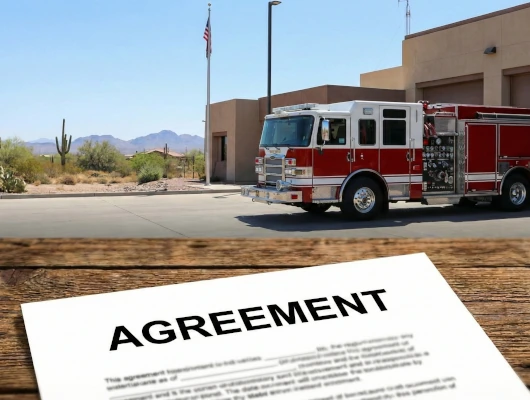
San Tan Valley, AZ — Residents who subscribe to Rural Metro Fire will continue paying the company directly under a new three-year agreement approved by the San Tan Valley Town Council on December 17, 2025. The agreement does not change the subscription-based relationship between homeowners and Rural Metro. Instead, it formalizes the town’s partnership with the fire service provider while San Tan Valley evaluates its long-term public safety needs.
Mayor Daren Schnepf sought clarification for residents: “It’s still subscription-based through Rural Metro, not through the town?” Town Attorney Allen Quist confirmed: “The subscription-based model will continue during this three-year interim period.”
What Residents Can Expect from the Rural Metro Agreement
Under the approved agreement, the town will receive semi-annual reports on response times, staffing levels, and equipment availability. This gives San Tan Valley its first formal oversight of fire services in the community.
Rural Metro also committed to significant investments. The company will place an additional ladder truck in service by June 30, 2026. It also committed to constructing a fourth fire station within the town’s boundaries.
No Cost to Taxpayers
“There’s no financial obligations for the town created through this agreement,” Quist said. “It’s a transitional arrangement designed to maintain service levels, we hope, and in some areas perhaps enhance service levels while the town considers its future direction.”
Councilmember Brian Tyler expressed gratitude for Rural Metro’s commitment. “The investment that you’re agreeing to put into the community is awesome,” he said. “I just want to make a public statement that I’m really grateful for our firefighters in San Tan Valley and your commitment to this area.”
Vice Mayor Highlights Public Safety Needs
Vice Mayor Tyler Hudgins spoke at length about why the agreement matters. He called it the first step in a two-step process to improve public safety.
“For the first time in history, San Tan Valley residents have the ability to set expectations for their fire service,” Hudgins said.
He noted the community’s size creates unique challenges. “The reality is, we’re 100,000 residents. We have three fire stations. Rural Metro stated last time they would like to be at six. This gets us our fourth fire station.”
Hudgins also pushed back against comparisons to Queen Creek. “Queen Creek didn’t get a fire department for 35 years, and I don’t think that’s a good comparison,” he said. “They incorporated in the 1980s with about 2,500 people in their community. The situation San Tan Valley is in is we’ve incorporated with 100,000 residents with high needs, and this council has a responsibility to meet those needs.”
Why the Town Chose This Approach
Quist explained that San Tan Valley does not yet have the facilities, equipment, staff, or financial resources to operate its own fire department. The town is also not positioned to replace the subscription model with a direct municipal contract.
Under the terms, the town agreed not to establish a competing municipal fire service during the three-year period, provided Rural Metro meets the community’s public safety needs.
Resident Raises Concerns About Future Costs
During the public comment period, San Tan Valley resident Jeanne Stockton raised concerns about potential cost increases. Stockton, who also serves on Pinal County’s Citizen Advisory Committee for District 4, worried that Rural Metro’s new investments might burden existing subscribers.
“I’m real concerned if this is gonna have an impact on the rates for the people,” Stockton said. At the previous December 3rd council meeting, CEO James Wessel stated there was only “about a 37% subscription rate in San Tan Valley.” Stockton asked: “These additional services, the fire station, the fire truck, if they’re not gonna get the other [residents] to pay into this, is that gonna fall on my back?”
Stockton also warned about co-employment liability. “Providing work direction to contract employees creates a co-employment relationship,” she said. “This is why you don’t want to interface with some of the contract employees, because that would open the town up to a lawsuit.”
Mayor Schnepf acknowledged her concerns. He requested that the co-employment and liability issue be added to a future agenda item for further discussion.
Council Members Voice Support
Several council members shared their reasoning before the vote.
Councilmember Daniel Oakes said he was initially skeptical. However, he changed his mind after Rural Metro’s presentation and his conversations with the company’s new management.
“I was extremely impressed with their transparency, their willingness to give us anything we asked for in terms of information,” Oakes said. “They’re committed to the area. They want to be here. They want to stay here.”
Councilmember Rupert Wolfert stressed the town has “a trusted partner on the other side, one who’s receptive to our feedback.” He added: “Under no circumstances should neighbors sense that we’re imposing this type of relationship on them.”
The Vote
Vice Mayor Hudgins made the motion to approve the agreement. Councilmember Oakes seconded. The motion passed unanimously.
The three-year contract was approved.