Key Points:
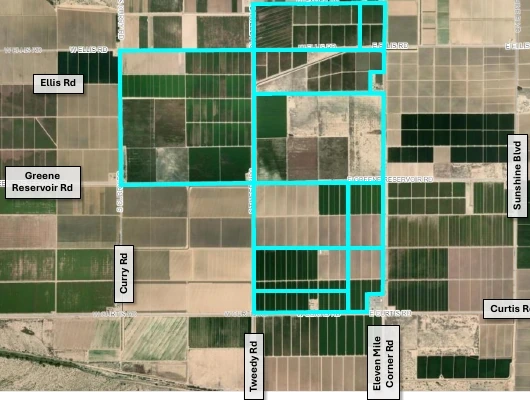
- Board approved a 2,137-acre solar and battery storage facility 3-2, overturning Planning Commission denial
- Facility includes 270-megawatt solar array and 270-megawatt battery energy storage system
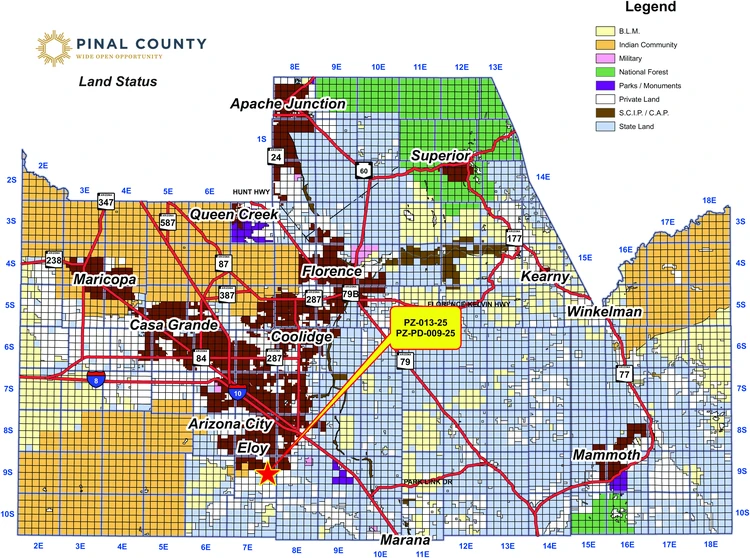
- Location: approximately eight miles south of Eloy in the Friendly Corners area
- Estimated $52 million in tax revenue over the project’s lifetime
- 300 to 400 construction jobs expected; construction to last 12 to 18 months
- Planning Commission cited concerns about cumulative solar impacts, land use compatibility, and decommissioning uncertainties
- Supervisors Serdy and Vitiello voted no; Serdy cited solar saturation and concern that solar approvals reduce urgency for nuclear development; Vitiello raised concerns about financial assurance requirements for decommissioning
- Chairman Miller, Vice Chairman McClure, and Supervisor Goodman voted yes. Supporters of the project cited alignment with Comprehensive Plan goals, energy demand, and the site’s remote location
- No construction start date announced; site plan review required next
Cactus Flower Solar Project Approved by Pinal County Board of Supervisors
The Pinal County Board of Supervisors approved the Cactus Flower Solar project on December 3, 2025, overturning a Planning Commission denial. The 2,137-acre solar facility with battery storage will bring an estimated $52 million in tax revenue over its lifespan. Construction could create 300 to 400 jobs.
Project Details and Specifications
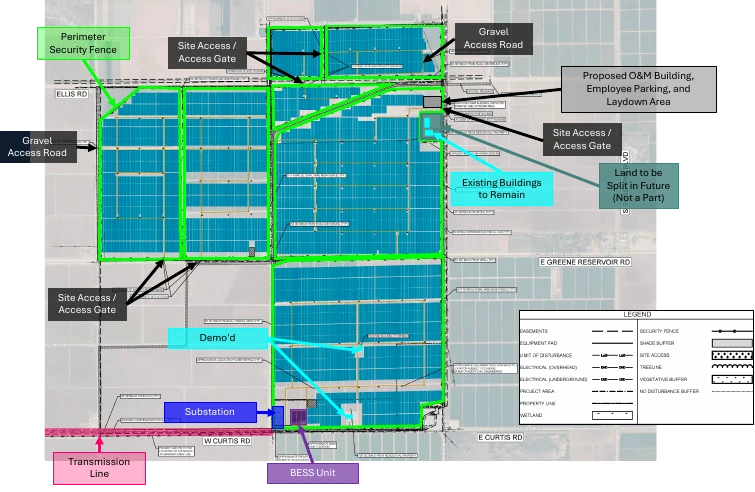
The Cactus Flower Solar project will include a 270-megawatt photovoltaic solar array with bifacial panels on single-axis tracking systems. Additionally, the facility will feature a 270-megawatt Battery Energy Storage System. At full capacity, it could power approximately 30,500 homes for four hours during emergencies. At typical 60% operating capacity, it could serve approximately 18,000 homes for four hours.
The development also includes an operations and maintenance building and a 9-mile transmission line. This gen-tie will connect to the Tat Momoli-Saguaro 230 kV line. Cypress Creek Renewables will own and operate the facility through its subsidiary, Cactus Flower Solar LLC.
Why This Location Was Chosen
Peter Furlow, attorney with Quarles & Brady LLP representing the applicant, outlined several reasons why developers selected this site. He emphasized its remoteness as the primary factor.
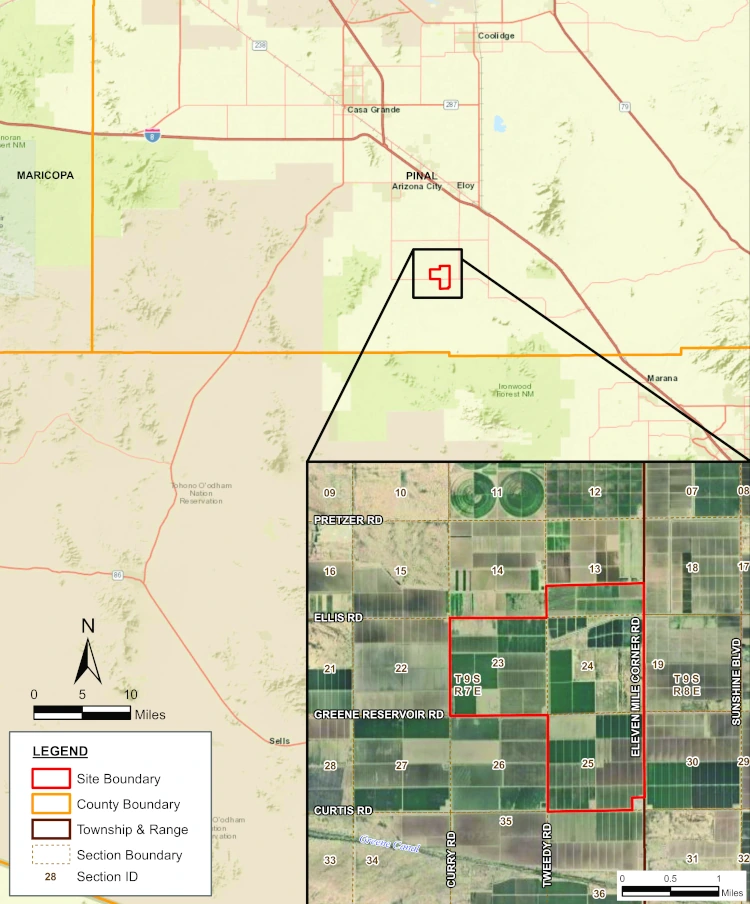
“Why here? I think the most important one is the remote location. The closest residential structure from our project is over a mile away,” Furlow said, referring to neighboring residences not involved in the development. He noted that residence is to the west of the project.
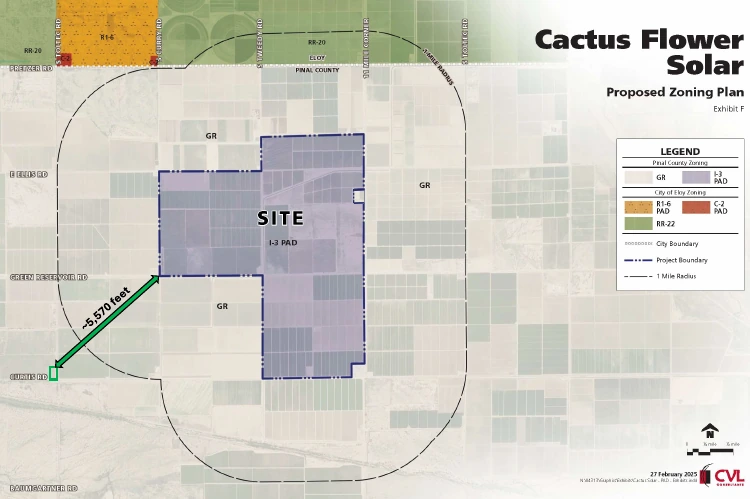
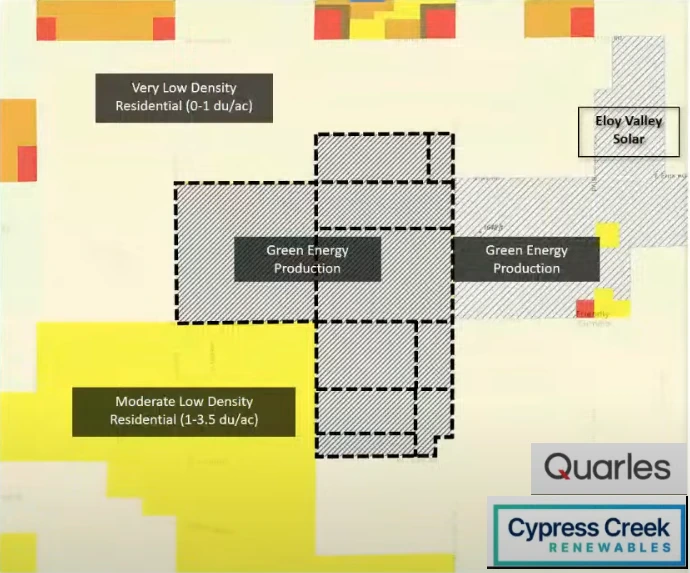
Furlow stressed the area has no future development planned. “It’s remote now and it’s also going to be remote in the future in the sense that there are no planned industrial, commercial or residential development in this area,” he explained.
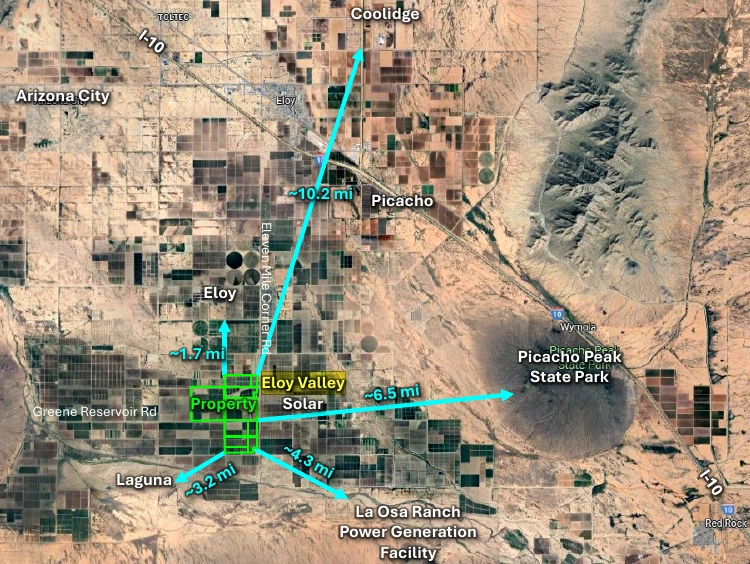
Other factors supporting the location include proximity to transmission infrastructure, flat agricultural land requiring minimal grading, and no interference with scenic areas or recreational trails. The project also sits adjacent to Eloy Valley Solar, an already-approved solar project to the east with the same Green Energy Production designation. Developers met with Eloy officials and surrounding jurisdictions before filing. They received support from all nearby entities.
Water shortages made farming difficult for the four landowners involved: Toone Family Ltd Partnership #3, Stambaugh Farms LLC, Curtis 1035 LLC, and Gordita L.P. Reduced allocations from the Central Arizona Project left farmers exploring alternatives. According to Furlow, Arizona Public Service (APS), the interconnecting utility, has indicated it must significantly expand generation capacity over the next decade, creating demand for new generation.
Solar Development in Context
At the Planning Commission hearing, some commissioners expressed concern about solar projects consuming too much county land. Furlow addressed this directly during his Board presentation.
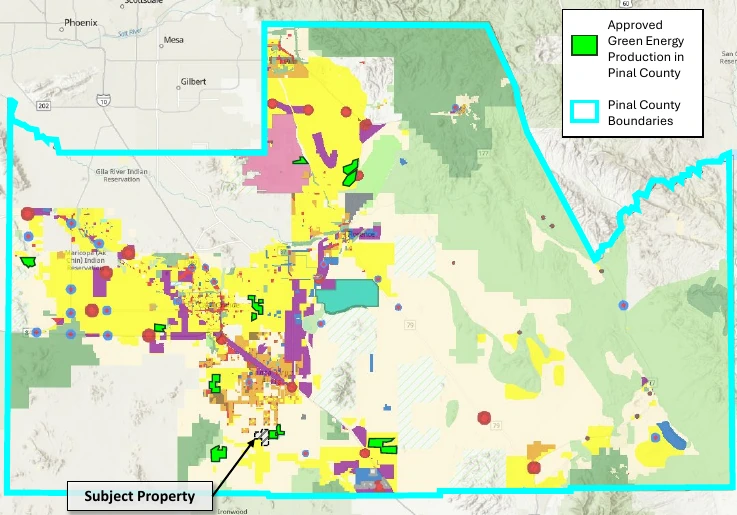
“If you take just private land, it’s about 2.5% of total private land that is planned,” Furlow said. “So I’m not here to give you what number’s responsible. I just wanted to contextualize it a bit because at Planning Commission, we had heard things such as it’s making up almost half of the land, so just wanted to kind of give the numbers.”
According to Furlow, approximately 40,000 acres are planned for solar countywide. This represents only 1.16% of total county acreage. Less than half a percent is currently built.
Financial Benefits and Tax Revenue
The project is estimated to generate $52 million in property tax revenue over its lifetime. Accounting firm Ernst & Young provided this conservative projection. According to Furlow, if federal tax incentives are removed, that figure could increase significantly.
Furlow explained the revenue distribution would benefit schools, fire districts, and county services. Construction will create 300 to 350 jobs, with additional permanent positions at the on-site operations building.
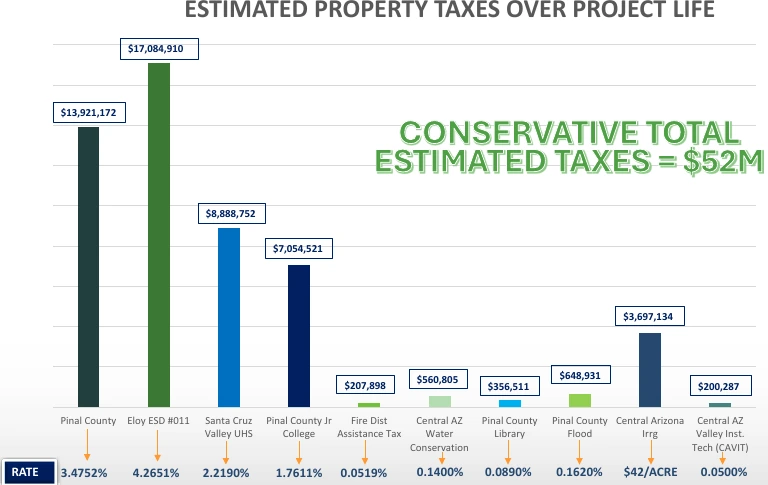
Ylenia Aguilar from the Sierra Club cited developer-submitted materials projecting $70 to $80 million in tax revenue. She noted this would support schools and emergency response without raising taxes on families.
Water usage will drop dramatically compared to agricultural use. The solar facility will consume 90-98% less water than farming currently does.
Decommissioning and Bond Requirements
Supervisor Rich Vitiello questioned how decommissioning bonds would work. He asked how often the bond amount would be reviewed to account for inflation.
Furlow explained that bonding is typically 2.5 to 5% of total project cost. Review periods are usually every 7.5 to 10 years. When Vitiello suggested stipulating five-year reviews, Furlow saw no issue with that requirement.
Chairman Stephen Miller clarified an important point. “I don’t believe we have an ordinance that requires the bonding of the decommissioning,” he said. Deputy County Attorney confirmed the county has no formal bonding requirement for solar projects. Therefore, the decommissioning bond remains a voluntary stipulation.
The project stipulations require a comprehensive decommissioning plan prior to site plan approval and issuance of construction permits. This plan must address what happens when facilities become obsolete or inoperable, including physical removal of panels and batteries, cable and structure removal, land restoration, cost estimates, and financial assurance. The stipulations require “financial assurance” but do not define what form it must take or what amount is required.
Residential Properties Handled Through Land Division
After the Planning Commission hearing, the applicant reduced the project area from approximately 2,149 acres to 2,137 acres. This change excluded an existing residence from the development boundary.
Valentyn Panchenko, the county planner, explained that Industrial I-3 zoning does not permit residential use. Landowner Stambaugh Farms LLC will complete a Minor Land Division to create a 12-acre parcel, excluding an existing residential dwelling from the rezoning. Another landowner indicated they may remove their residential structure.
The 20th stipulation requires completing this land division before the formal site plan review.
Public Support and Community Involvement
Six public speakers supported the project at the Board hearing. No one spoke in opposition. The county received eight letters of support and zero opposition letters for this specific rezoning case.
Landowner Michael Toone wrote in support, noting that water supply to his property has been cut in half in recent years. “Without question, the best use of my property for the next 20 years is the development of a solar farm to provide clean electricity and assist farmers by sharing the water resources to grow more crops than they are currently able to,” he stated.
Former Eloy Mayor Micah Powell strongly endorsed the project. He noted the location aligned with Eloy’s strategic solar overlay. “This is so far south of I-10 where there’s nothing around there,” Powell said. He emphasized schools would benefit from additional tax revenue.
Andrew Rodriguez, executive director of the Eloy Chamber of Commerce, highlighted the developer’s community involvement. Cypress Creek Renewables has fed seniors for Thanksgiving, provided 70-pound food boxes for 125 families, and made a $25,000 donation to the Santa Cruz Valley Historic Museum for accessibility improvements.
The company has also sponsored scholarships through its Energizing Tomorrow’s Leaders program. It maintains active membership in the Eloy Chamber of Commerce, Pinal Partnership, Pinal Alliance, and Greater Florence Chamber of Commerce.
Cepand Alizadeh spoke on behalf of the Arizona Technology Council, which submitted a letter of support. He emphasized the need for an “all-of-the-above energy approach” and noted the project would help meet growing energy demands from new residents and businesses.
At the September Planning Commission hearing, one Coolidge resident spoke in opposition. Her concerns included cumulative solar impacts, storm-related panel breakage, heat island effects, and uncertainty about long-term land restoration.
Nuclear Energy Discussion Between Supervisors
Before the vote, Supervisor Jeff Serdy raised concerns about solar’s impact on other energy technologies. “If you keep approving things like this then there’s not gonna be a rush to develop better technology like nuclear,” he warned. “But soon we’ll be just covered with solar.”
Drawing on a recent APS presentation, Chairman Miller responded. “Nuclear is being built in the United States right as we speak,” he said. “I wished everybody could have attended the APS presentation I saw yesterday ’cause it might give some ease. I can’t opine on that right now, but it’s coming and it’s 10 years away, but it’s coming.”
Planning Commission Denial Overturned
The Planning and Zoning Commission had recommended denial by a 6-3 vote in September. Commission concerns included regional land use compatibility, cumulative solar impacts, future growth limitations, long-term agricultural and soil health, economic opportunity costs, public safety concerns, and decommissioning uncertainties.
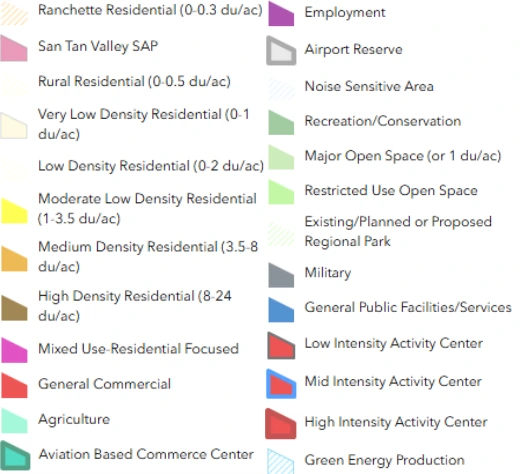
However, the Board found the project aligned with county comprehensive planning goals. The property was designated Green Energy Production (GEP) through a Major Comprehensive Plan Amendment unanimously approved in October 2024. That amendment received unanimous support at all three levels: the Citizen Advisory Committee (15-0), Planning and Zoning Commission (7-0), and Board of Supervisors.
At the Planning Commission rezoning hearing and again before the Board of Supervisors, Furlow noted the designation limited future land use options. “With the GEP green energy designation, the only types of uses that could occur on the site without having to go back through another Comprehensive Plan amendment are these solar, BESS … only what’s allowed in GEP.,” he said.
Vote Results and Supervisor Positions
Supervisor Mike Goodman made the motion to approve both the rezoning and PAD overlay. Vice Chairman Jeff McClure seconded both motions.
The Board approved Item 10 (rezoning with one stipulation) by a 3-2 vote. Chairman Miller, Vice Chairman McClure, and Supervisor Goodman voted yes. Supervisors Serdy and Vitiello voted no.
Item 11 (PAD overlay with 20 stipulations) passed with the same 3-2 split. Serdy expressed concerns about solar saturation and that continued approvals could slow nuclear development. Vitiello had raised questions during the hearing about battery storage enclosures, bond review frequencies, and whether APS was still accepting solar projects.
Path to Construction
The project now moves to formal site plan review. Before that approval, the developer must complete several requirements. These include submitting a decommissioning plan with financial assurance, completing the Minor Land Division for residential property, and obtaining all federal, state, and local permits.
According to the applicant’s materials, construction is expected to last 12 to 18 months. No projected start date was provided during the hearing.
The Eloy Fire District has confirmed ongoing discussions about a service contract. Their letter stated the project does not pose significant risk to the public as currently designed.